Decent Work Deficit and Employment Trends in India
Source:The Hindu ↗
Why It Matters
Crucial for understanding the gap between quantitative job growth and qualitative employment metrics (decent work, informalization) which is a frequent theme in GS3 Indian Economy questions.
Summary
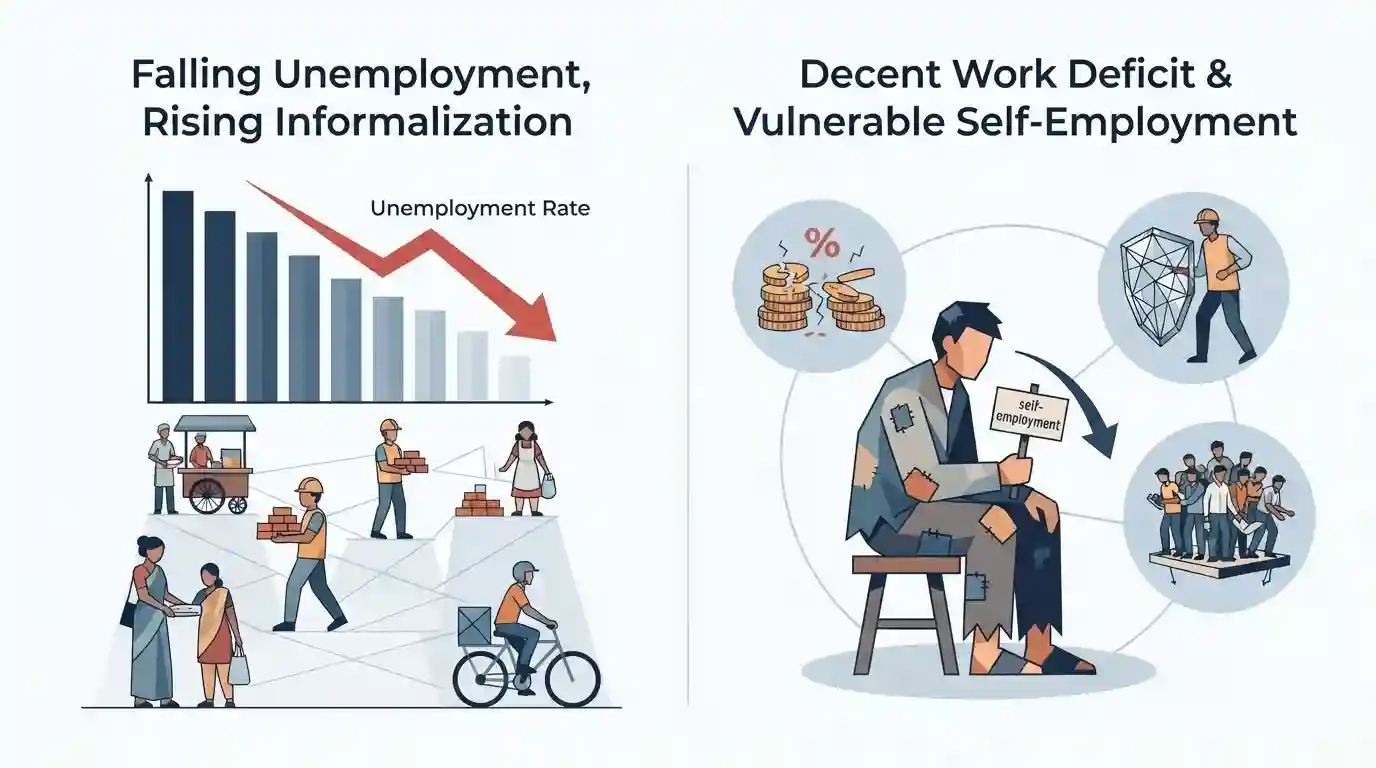
The article critically examines the paradox of falling unemployment rates alongside a profound deficit of 'decent work' in India. It highlights issues such as informalization, low wages, lack of social security, and the prevalence of vulnerable self-employment, arguing that quantity of employment must be matched by quality for true inclusive growth.
Key Points
- Despite falling headline unemployment rates in India, there is a persistent crisis of 'decent work' characterized by low earnings, lack of social security, and rising informalization.
- A significant portion of employment growth is concentrated in low-productivity sectors, self-employment, or unpaid family labor rather than regular, salaried formal jobs.
- The quality of jobs remains a critical bottleneck for translating economic growth into inclusive human development and demographic dividend.
- Policy measures must focus beyond mere job creation to ensure wage security, social protection, and formalization of the workforce.
Important Terms
Periodic Labour Force Survey

India's official national survey framework launched by the NSO to measure employment, unemployment rates, and labor force participation across rural and urban sectors on periodic bases.
UPSC context
UPSC Paper III (Economy - Employment & Inclusive Growth). Tests understanding of official labor market statistics, data reliability, and jobless growth debates.
International Labour Organization
A specialized UN agency setting international labor standards, promoting rights at work, and advancing the Decent Work Agenda encompassing fair income, social security, and safe conditions.
UPSC context
UPSC Paper II/III (International Organizations / Social Sector). Evaluates global governance frameworks, labor rights compliance, and inclusive social development policies.
Prelims Trap
Falling headline unemployment rates indicate a robust and formalizing labour market with high job quality.
Aspirants often assume that a falling headline unemployment rate reported by PLFS automatically indicates an improvement in overall labour welfare and formalization, missing the rise in vulnerable self-employment and unpaid work.
Static Concepts Connected
What are the key indicators used by the Periodic Labour Force Survey (PLFS) to measure employment?
- WPR metric: Worker Population Ratio (WPR) measures the percentage of employed persons in the total population.
- LFPR metric: Labour Force Participation Rate (LFFR) indicates the percentage of persons in the labour force (working or seeking work) in the population.
- Unemployment Rate: Unemployment Rate (UR) calculates the percentage of persons unemployed among the persons in the labour force.
- Activity Status: Activity Status is recorded under Usual Status (principal and subsidiary) and Current Weekly Status.
Cross-Topic Patterns
Employment Statistics vs. Demographic Dividend Quality
The paradox of job-poor growth or jobless growth transitions into 'job-quality' crisis, frequently linking employment statistics with demographic dividend utilization in GS Paper 1 and inclusive growth in GS Paper 3.
Informalization and Social Security Architecture
Informal sector dominance obstructs social security universalization efforts, connecting labour market structural bottlenecks with social justice and welfare schemes.

PLFS data trends + 'decent work' deficit will likely be tested via a statement-based MCQs or analytical Mains GS-3 question on job quality.
Linked PYQs · 3
Linked PYQs · 3
- 2023MainsGS3
Most of the unemployment in India is structural in nature. Examine the methodology adopted to compute unemployment in the country and suggest improvements.
- 2024MainsGS3
Discuss the merits and demerits of the four 'Labour Codes' in the context of labour market reforms in India. What has been the progress so far in this regard?
- 2016MainsGS3
How globalization has led to the reduction of employment in the formal sector of the Indian economy? Is increased informalization detrimental to the development of the country?
