Macroeconomic Trends in Cash Usage and UPI Payment Systems
Source:The Hindu ↗
हे का महत्त्वाचे आहे
The article highlights critical macroeconomic indicators, specifically the behavior of currency in circulation versus digital payments. It underscores the ongoing debate on official inflation metrics, the vitality of the informal economy, and the policy implications of introducing MDR on digital public goods like UPI.
सारांश
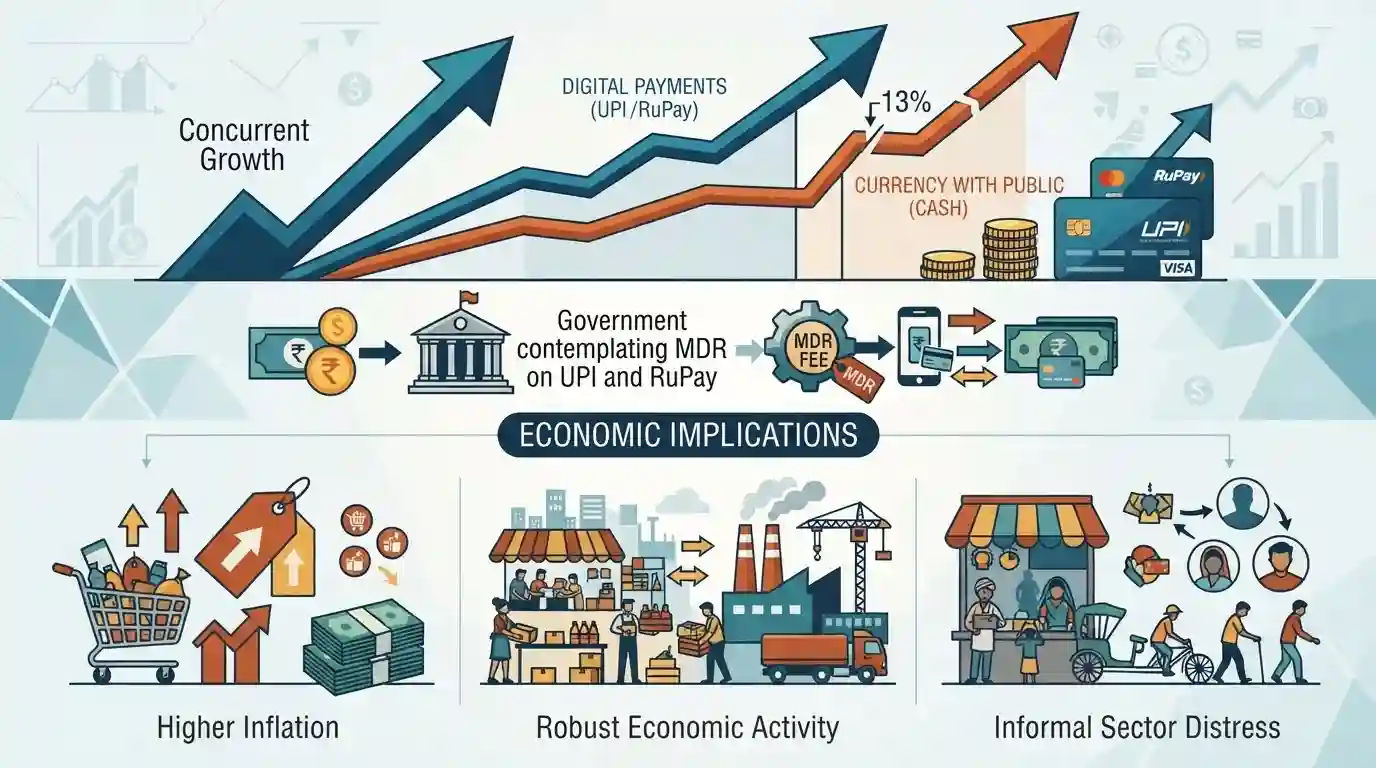
As the government contemplates implementing a Merchant Discount Rate (MDR) on UPI and RuPay transactions, data reveals a paradoxical economic trend: the growth rate of cash usage is accelerating despite the continued expansion of digital payments. Currency with the public grew by 13% by mid-October, a sharp increase from earlier in the year. Economists suggest that the concurrent rise in both cash and digital transactions might indicate that true inflation is higher than officially reported, or it could reflect robust economic activity. Alternatively, it might point to economic distress and high unemployment within the informal sector, which relies heavily on cash.
मुख्य मुद्दे
- The government is considering introducing a Merchant Discount Rate (MDR) charge on UPI and RuPay debit card transactions.
- Despite the widespread adoption of digital payments, the growth rate in the value of UPI transactions has slowed down to 18.7%.
- Conversely, cash usage is accelerating, with currency in circulation and cash with the public growing at 12.9% and 13% respectively by mid-October.
- Experts suggest this simultaneous growth in both cash and digital transactions could indicate robust economic activity or imply that true inflation is higher than official figures.
- Another perspective links the increased reliance on cash to economic distress and high unemployment in the informal sector, where daily sustenance heavily depends on physical currency.
महत्त्वाच्या संज्ञा
Merchant Discount Rate (MDR)

A fee charged to merchants by banks and payment service providers for processing digital transactions made via credit or debit cards. It compensates stakeholders for the infrastructure costs of the transaction.
UPSC context
GS Paper 3 (Indian Economy). Tests understanding of digital payment ecosystems, the zero-MDR mandate, and its implications for financial inclusion.
Unified Payments Interface (UPI)
An interoperable, real-time payment system developed by NPCI that enables instant, 24/7 inter-bank transfers using a mobile platform and a Virtual Payment Address (VPA), eliminating the need to share bank details.
UPSC context
GS Paper 3 (Digital Economy). Extremely important for Prelims and Mains regarding India's Digital Public Infrastructure and cashless economy initiatives.
Currency with the public
The total physical cash—notes and coins—held by individuals and businesses, calculated by deducting the cash held by commercial banks from the total currency in circulation. It is highly liquid.
UPSC context
GS Paper 3 (Macroeconomics). Tested in Prelims regarding components of money supply (M1, M3), liquidity, and inflation dynamics.
National Payments Corporation of India (NPCI)
A not-for-profit umbrella organization established by the RBI and Indian Banks' Association in 2008 to operate India's retail payments and settlement systems, including UPI, RuPay, and IMPS.
UPSC context
GS Paper 3 (Economy). Tests knowledge of India's payment infrastructure, regulatory frameworks, and drivers of a formal financial ecosystem.
Reserve Bank of India (RBI)
India's central bank and apex monetary authority. It formulates monetary policy, regulates the banking system, manages foreign exchange reserves, and acts as the sole issuer of currency notes.
UPSC context
Core GS Paper 3 topic. Extensively tested in Prelims and Mains on monetary policy tools, inflation targeting, and economic stability.
RuPay
India's indigenous domestic card payment network launched by NPCI. It provides debit, credit, and prepaid cards with lower transaction costs, aiming to reduce dependence on international payment gateways.
UPSC context
GS Paper 3 (Economy). Relevant for topics on financial inclusion (Jan Dhan Yojana), digital sovereignty, and payment policies.
पूर्वपरीक्षा सापळा
"An increase in 'currency with the public' leads to an increase in the money multiplier."
Higher cash holding increases the currency-deposit ratio, leaving banks with fewer deposits to lend. This inversely decreases the money multiplier in the economy.
संबंधित स्थिर संकल्पना
What distinguishes 'Currency in Circulation' from 'Currency with the Public'?
- Currency in Circulation: Total physical notes and coins issued by the RBI and government circulating within the economy.
- Currency with Public: Currency in circulation minus the cash held by commercial banks; it forms the most liquid part of M1.
- Money Multiplier Link: Increased cash holding raises the currency-deposit ratio, reducing available bank deposits for credit creation and lowering the money multiplier.
What is the Merchant Discount Rate (MDR) mechanism in India?
- Definition: A fee charged to a merchant by a bank or payment service provider for processing digital payments.
- Zero-MDR Policy: Mandated since 2020 under the Payment and Settlement Systems Act, prohibiting MDR on UPI and RuPay debit cards.
आंतर-विषय नमुने
Informal sector formalisation bottleneck
Persistent cash reliance reflects structural issues in the informal sector, acting as a barrier to the formal credit ecosystem and slowing down the overarching formalisation of India's economy.
Inflation masking via cash usage
Economists note that simultaneous growth in cash and digital transactions may indicate unrecorded, higher 'true inflation', forcing consumers to hold more physical currency for daily sustenance.

Questions will likely interlink MDR policy exemptions with the macroeconomic effects of the currency-deposit ratio on money multiplier.
संबंधित PYQ · 3
संबंधित PYQ · 3
- 2018PrelimsGS1
Which one of the following best describes the term "Merchant Discount Rate" sometimes seen in news?
- 2019PrelimsGS1
The money multiplier in an economy increases with which one of the following?
- 2021PrelimsGS1
The money multiplier in an economy increases with which one of the following?
