UPI Transaction Growth Trends and Economic Cash Usage Dynamics
Source:The Hindu ↗
কেন এটি গুরুত্বপূর্ণ
The changing dynamics between physical cash in circulation and digital payments directly impacts monetary policy, financial inclusion, and macroeconomic stability. Tracking the impact of MDR on UPI adoption is essential for evaluating India's shift toward a less-cash economy.
সারসংক্ষেপ
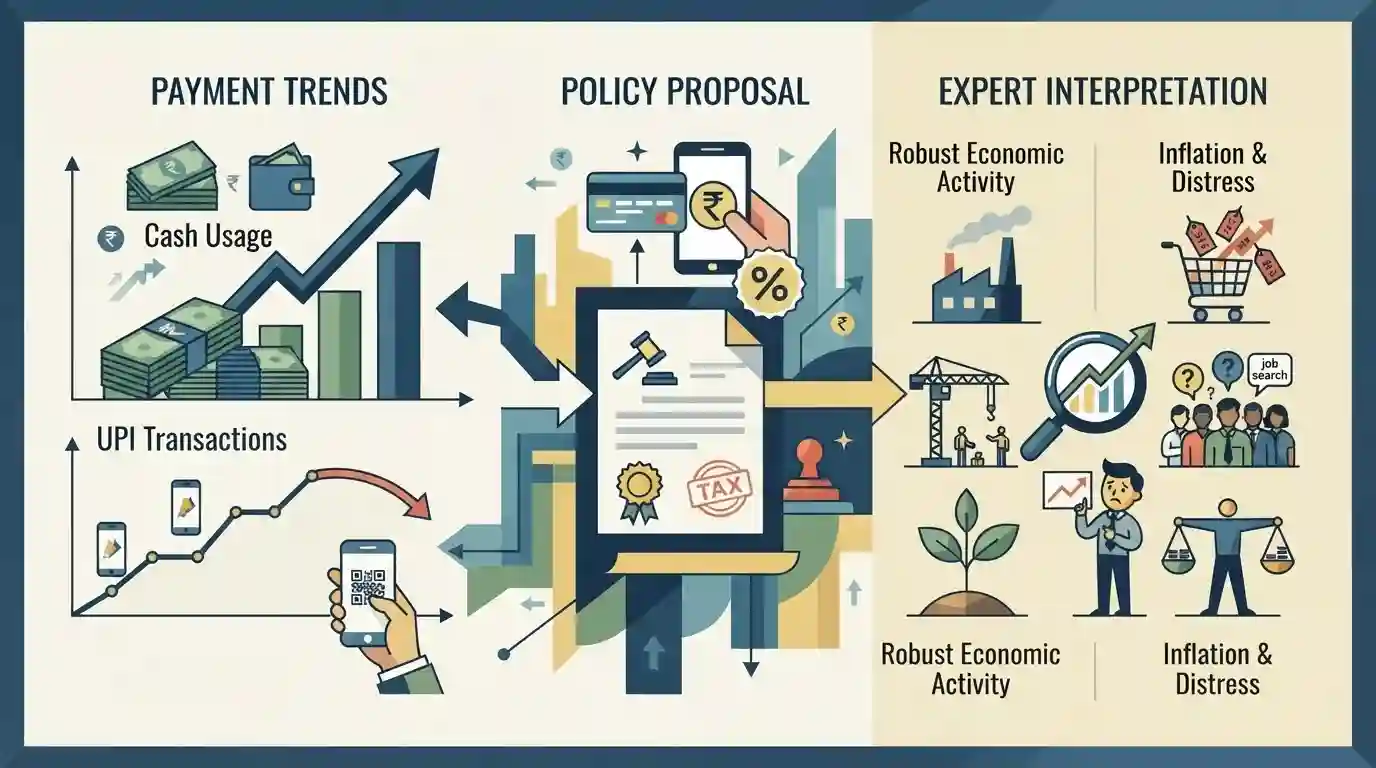
The article highlights a trend where cash usage in the Indian economy is accelerating even as the growth rate of UPI transactions slows down. The government is also proposing an MDR charge on UPI transactions under the Taxation and Other Laws (Amendment) Bill, 2026. This simultaneous rise in both cash and digital payments is interpreted by experts as a sign of robust economic activity, though it could also indicate underestimated official inflation figures or underlying economic distress such as high unemployment.
মূল বিষয়
- The government is considering allowing a Merchant Discount Rate (MDR) charge on UPI transactions via the Taxation and Other Laws (Amendment) Bill, 2026.
- Despite the push for digitalization, the growth rate of cash with the public is quickening, reaching nearly 13% in 2026-27.
- The growth rate in the value of UPI transactions is slowing down, though it still stands at 18.7% for 2026-27.
- Simultaneous growth in cash and digital transactions suggests higher economic activity with real growth over 7%.
- Alternatively, some experts warn that increased cash usage could indicate underestimated inflation or economic distress stemming from high unemployment.
গুরুত্বপূর্ণ শব্দ
Taxation and Other Laws (Amendment) Bill, 2026

A legislative measure passed in 2026 to modernize India's fiscal regime, incentivize electronics manufacturing, and amend the Payment and Settlement Systems Act to permit digital payment transaction charges.
UPSC context
GS Paper III: Government Budgeting, Mobilization of Resources, and Indian Economy.
Unified Payments Interface (UPI)
A mobile-first, real-time payment system developed by the National Payments Corporation of India (NPCI) that enables instant inter-bank peer-to-peer and person-to-merchant transfers.
UPSC context
GS Paper III: Digital Public Infrastructure, Science and Technology, and Banking.
Merchant Discount Rate (MDR)
The transaction fee charged to a merchant by payment aggregators or banks for processing digital transactions, typically calculated as a percentage of the transaction value.
UPSC context
GS Paper III: Indian Economy, Banking Systems, and Financial Inclusion.
Payment and Settlement Systems Act, 2007
The primary legislative framework governing the regulation and supervision of payment systems in India, designating the Reserve Bank of India as the apex regulatory authority.
UPSC context
GS Paper III: Banking and Financial Sector Regulation, and Digitalization.
Currency in Circulation
The total physical cash (banknotes and coins) issued by the Reserve Bank of India that is held by the public and commercial banks.
UPSC context
GS Paper III: Macroeconomics, Monetary Policy, and Money Supply.
প্রিলিমস ফাঁদ
India's Cash-to-GDP ratio has continuously increased post-demonetisation alongside the absolute rise in cash in circulation.
While absolute cash (Currency in Circulation) has doubled post-demonetisation, the Cash-to-GDP ratio peaked during the pandemic (FY21) and has declined since.
সংযুক্ত স্থির ধারণা
How does cash holding by the public impact the money multiplier?
- Inverse relationship: Higher cash retention by the public (cash leakage) reduces deposits available with banks, directly lowering their credit-creation capacity.
- Formula dynamics: The Money Multiplier is Broad Money (M3) divided by Reserve Money (M0). It increases when the public's currency-to-deposit ratio falls.
What is the Merchant Discount Rate (MDR) in digital payment systems?
- Definition: MDR is the fee a merchant pays to a bank for processing credit/debit card or digital payment transactions.
- Revenue splitting: The fee is typically split between the acquiring bank (merchant's bank), the issuing bank (customer's bank), and the payment network (e.g., NPCI).
- Zero MDR policy: Since 2020, UPI and RuPay debit cards have operated under a government-mandated Zero MDR framework to promote digital financial inclusion.
আন্তঃবিষয় প্যাটার্ন
Cash paradox & the informal sector
The simultaneous growth of digital payments and physical cash points to India's vast, cash-reliant informal economy and the hoarding of cash during periods of localized economic distress.
Monetization of Digital Public Goods
Shifting from a Zero MDR policy to threshold-based fees on UPI reflects the broader governance challenge of making state-backed Digital Public Infrastructure commercially sustainable without stifling adoption.

Expect a multi-statement question blending the mechanics of MDR, exemptions for P2P transfers, and the recent Cash-to-GDP ratio trend.
সংযুক্ত PYQ · 4
সংযুক্ত PYQ · 4
- 2020PrelimsGS1
If you withdraw ₹ 1,00,000 in cash from your Demand Deposit Account at your bank, the immediate effect on aggregate money supply in the economy will be
- 2021PrelimsGS1
The money multiplier in an economy increases with which one of the following?
- 2019PrelimsGS1
The money multiplier in an economy increases with which one of the following?
- 2023MainsGS3
What is the status of digitalization in the Indian economy? Examine the problems faced in this regard and suggest improvements.
