European Union Artificial Intelligence Act and Indian IT Sector Scope
Source:The Hindu ↗
Why It Matters
As AI reshapes the global economy, the divergence in regulatory frameworks (the EU's strict regulation vs. India's pro-innovation stance) directly impacts tech investments, India's IT exports, and leadership in global technology governance.
Summary
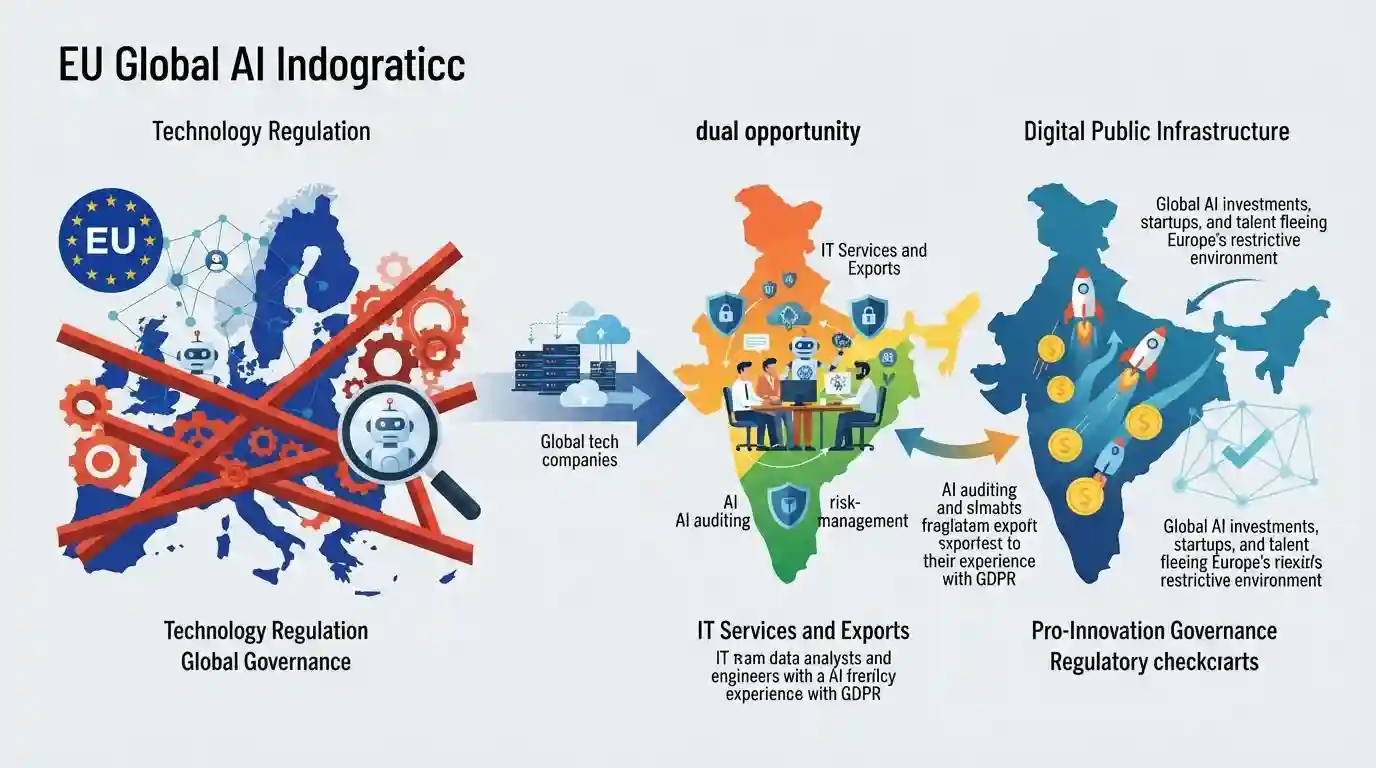
The European Union's newly enacted Artificial Intelligence (AI) Act introduces stringent, risk-based regulations that will impose heavy compliance costs on tech companies. This prescriptive regulatory approach, while aiming to ensure safety and ethical standards, risks stifling AI innovation within Europe. However, it presents a dual opportunity for India. Firstly, India's robust IT services sector, already experienced in navigating European data laws like the GDPR, is uniquely positioned to provide lucrative AI auditing, risk-management, and compliance services to global firms. Secondly, by maintaining a balanced, pro-innovation regulatory framework—focusing on agile governance rather than rigid rules—India can attract global AI investments, startups, and talent fleeing Europe's restrictive environment, thereby cementing its position as a leading global AI hub.
Key Points
- The European Union's AI Act introduces a stringent, risk-based regulatory framework that imposes heavy compliance and transparency requirements on tech companies.
- This regulatory burden creates a massive opportunity for India's IT services sector to offer 'AI compliance, auditing, and risk management as a service', similar to the windfall seen after the EU's GDPR implementation.
- Over-regulation in Europe risks stifling indigenous AI innovation, potentially driving European startups and tech capital to seek more flexible and supportive jurisdictions.
- India can capitalize on this by establishing a balanced, pro-innovation regulatory framework that prioritizes agile governance and Digital Public Infrastructure (DPI), attracting global AI investments and talent.
Important Terms
EU AI Act

A comprehensive, risk-based European Union regulation governing artificial intelligence. It categorizes AI systems by risk level, imposing strict compliance and transparency obligations on high-risk applications to ensure ethical and safe use.
UPSC context
Crucial for GS-2 (International Relations) and GS-3 (Science & Tech). Highlights global AI governance and regulatory models relevant to India.
General Data Protection Regulation (GDPR)
A stringent European Union legal framework ensuring data privacy and security. It imposes strict rules on how organizations globally collect, store, and process the personal data of EU residents.
UPSC context
Important for GS-2 (Governance) and GS-3 (Cyber Security). Serves as a global benchmark for evaluating data privacy laws and compliance.
Digital Personal Data Protection (DPDP) Act
India's landmark legislation designed to protect digital personal data. It establishes obligations for data fiduciaries, balancing individual privacy rights with the lawful processing needs of businesses and the government.
UPSC context
Highly relevant for GS-2 (Polity) and GS-3 (Cyber Security). Tests knowledge of India's digital governance, data sovereignty, and privacy rights.
Indian IT Sector
India's knowledge-based tech industry encompassing software services and business outsourcing. It is increasingly shifting towards high-value services like AI auditing, regulatory compliance, and risk management for global markets.
UPSC context
Vital for GS-3 (Economy). Assesses understanding of service sector growth, digital exports, and the industry's ability to capitalize on global trends.
Prelims Trap
India regulates Artificial Intelligence through a legally binding, tiered risk-based framework similar to the EU AI Act.
India currently has no dedicated AI legislation. It relies on agile governance, the DPDP Act for privacy, and the IndiaAI Mission, prioritizing innovation over rigid statutory regulation.
Static Concepts Connected
How does the tiered risk-based framework in the EU AI Act function?
- Unacceptable Risk: Bans systems posing clear threats to safety and fundamental rights, such as social scoring and real-time remote biometric categorization.
- High Risk: Subjects critical systems (e.g., healthcare, transport AI) to strict conformity assessments, data quality checks, and mandatory human oversight.
- Limited Risk: Requires basic transparency, such as clearly labeling AI-generated content (deepfakes) or chatbots to ensure users know they are interacting with machines.
What are the core components of the ₹10,372-crore IndiaAI Mission?
- Compute Capacity: Builds scalable AI infrastructure by deploying over 10,000 GPUs through public-private partnerships to support domestic startups and researchers.
- Foundation Models: Focuses on developing indigenous, domain-specific AI models trained on diverse Indian datasets to reduce reliance on foreign systems.
- Safe & Trusted AI: Institutionalizes responsible AI by funding projects for deepfake detection, privacy-preserving algorithms, and mitigating systemic biases.
Cross-Topic Patterns
Tech Sovereignty vs Global Standards
The contrast between the EU's heavy-handed AI Act and India's pro-innovation stance mirrors past GS2/GS3 themes on data localization, tech sovereignty, and e-commerce rule divergences.
AI integration with Digital Public Infrastructure
India integrates AI not just as enterprise tech, but as public infrastructure (e.g., Bhashini), linking AI regulation directly to digital governance and financial inclusion themes.

Expect a GS3 question in 2026 contrasting the EU's rigid AI Act with India's agile, DPI-integrated AI governance and IndiaAI Mission.
Linked PYQs · 4
Linked PYQs · 4
- 2023MainsGS3
Introduce the concept of Artificial Intelligence (AI). How does Al help clinical diagnosis? Do you perceive any threat to privacy of the individual in the use of Al in healthcare?
- 2024MainsGS3
Describe the context and salient features of the Digital Personal Data Protection Act, 2023.
- 2020PrelimsGS1
With the present state of development, Artificial Intelligence can effectively do which of the following? 1. Bring down electricity consumption in industrial units 2. Create meaningful short stories and songs 3. Disease diagnosis 4. Text-to-Speech Conversion 5. Wireless transmission of electrical energy Select the correct answer using the code given below:
- 2018MainsGS3
Data security has assumed significant importance in the digitized world due to rising cyber crimes. The Justice B. N. Srikrishna Committee Report addresses issues related to data security. What, in your view, are the strengths and weaknesses of the Report relating to protection of personal data in cyber space?
