EU reinstates Iran sanctions after UN snapback mechanism
Source:The Hindu ↗
Why It Matters
The reinstatement of UN and EU sanctions against Iran due to the collapse of the JCPOA disrupts global energy markets and escalates geopolitical tensions in West Asia. This significantly impacts India's foreign policy, energy security, and regional diplomacy.
Summary
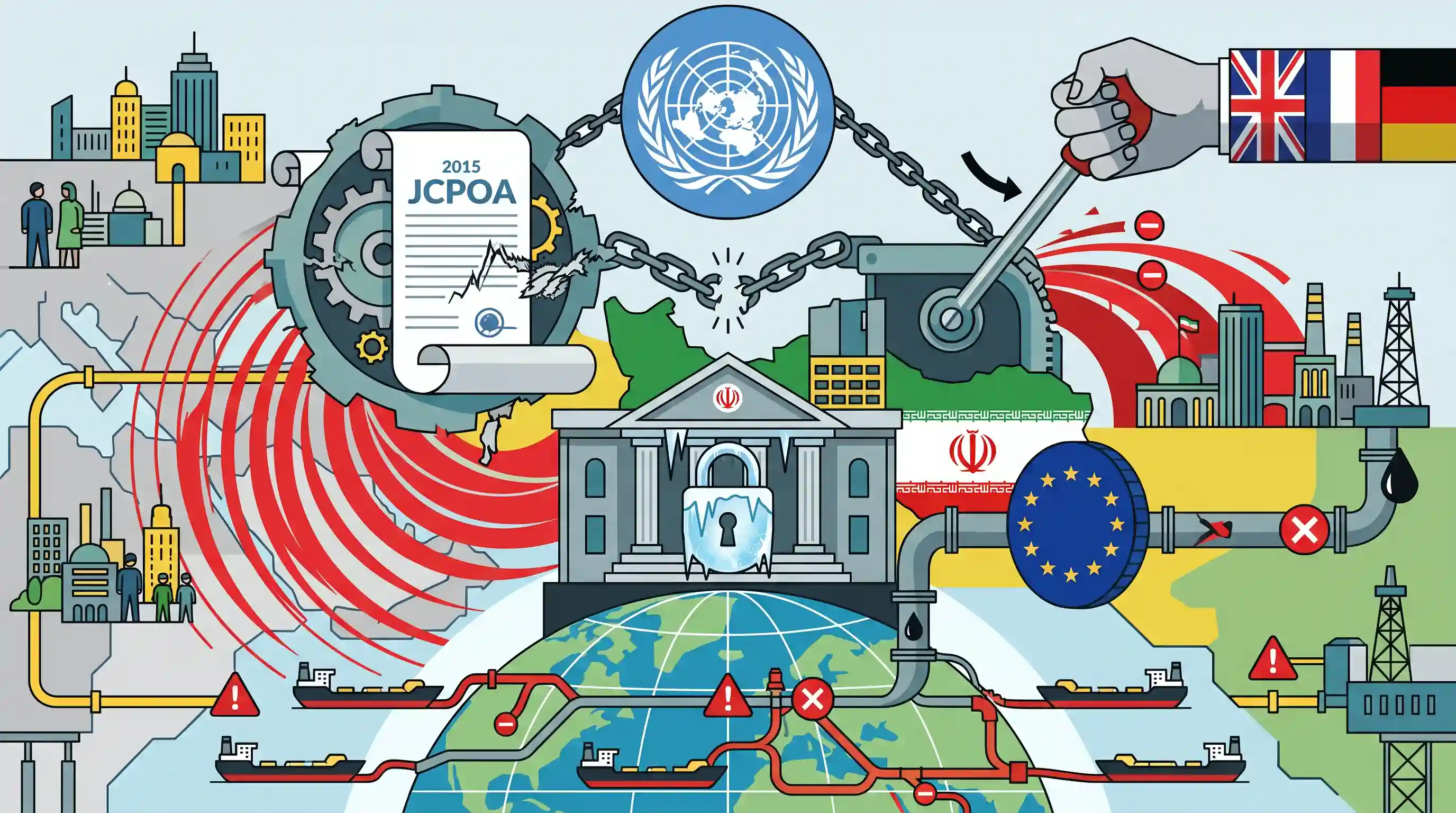
The European Union has reinstated sweeping sanctions against Iran—including freezing central bank assets and banning crude oil purchases—following a similar "snapback" of sanctions by the United Nations. The punitive measures, triggered by Britain, France, and Germany at the UN Security Council, are a response to Iran's continued non-compliance with the 2015 nuclear agreement (JCPOA), raising concerns over regional stability and global energy flows.
Key Points
- The European Union reinstated sanctions on Iran in response to its continued non-compliance with the 2015 nuclear agreement (JCPOA).
- The EU's decision follows the UN Security Council's reinstatement of an arms embargo and "snapback" sanctions, a process initiated by Britain, France, and Germany.
- The EU sanctions include freezing the assets of the Iranian Central Bank, travel bans on certain officials, and a ban on purchasing and transporting Iranian crude oil.
- The restrictions also prohibit the sale or supply of gold and certain naval equipment to Iran, further isolating the nation economically.
Important Terms
JCPOA (Joint Comprehensive Plan of Action)

A landmark 2015 agreement between Iran and world powers (P5+1) designed to limit Iran's nuclear program in exchange for lifting international economic sanctions.
UPSC context
GS Paper II: International Relations; bilateral/global agreements affecting India's interests (e.g., energy security and regional connectivity).
Snapback Mechanism
A provision under UN Resolution 2231 allowing any participant state to unilaterally reimpose all pre-2015 UN sanctions if Iran significantly violates the nuclear deal.
UPSC context
GS Paper II: Important International Institutions; tests understanding of UN-based legal instruments and diplomatic "kill switches."
UN Security Council (UNSC)
The principal UN organ for maintaining international peace. It oversees Resolution 2231, which manages the international legal framework and sanctions regime for Iran's nuclear program.
UPSC context
GS Paper II: Important International Institutions; tests knowledge of global governance, veto powers, and security enforcement.
Central Bank of Iran (CBI)
Iran's primary financial institution, frequently targeted by international sanctions and asset freezes to cut off Tehran from the global banking system and oil revenues.
UPSC context
GS Paper III: Indian Economy/Global Trade; effects of sanctions on international payment mechanisms (like INSTEX) and energy imports.
European Union (EU)
A 27-member political and economic union that acts as a key diplomatic mediator in the JCPOA and implements autonomous regional sanctions alongside UN measures.
UPSC context
GS Paper II: Regional Groupings; tests the bloc's role in global diplomacy and multilateral security negotiations.
E3 (Group of Countries)
The term used for the three European signatories to the JCPOA (France, Germany, and the UK) who coordinate diplomacy and triggered the 2025 sanctions snapback.
UPSC context
GS Paper II: Bilateral and Regional Groupings; understanding the influence of European powers in Middle Eastern stability.
Prelims Trap
"The reinstatement of UN sanctions on Iran under the snapback mechanism can be blocked by a P5 veto."
The 'snapback' under Res 2231 is uniquely designed to bypass the traditional P5 veto. Any participant can trigger it unilaterally.
Static Concepts Connected
What is the JCPOA and its 'snapback' mechanism?
- JCPOA: 2015 agreement limiting Iran's nuclear program in exchange for sanctions relief, negotiated by the P5+1 (US, UK, France, Russia, China + Germany).
- UNSC Res 2231: UN Security Council Resolution 2231 endorsed the JCPOA and legally embedded its provisions.
- Snapback Mechanism: Allows any participant to unilaterally restore all pre-2015 UN sanctions on Iran for non-compliance, without the possibility of a P5 veto.
Why is Chabahar Port strategically significant for India?
- Location: Located in southeastern Iran on the Gulf of Oman, allowing India to bypass Pakistan for direct sea-land access.
- Connectivity: Serves as India's primary gateway to Afghanistan and Central Asia, acting as a key node in the International North-South Transport Corridor (INSTC).
- Sanctions Risk: Sweeping international sanctions threaten the viability of India's $120 million investment (Shahid Beheshti Terminal) due to secondary penalty risks.
Cross-Topic Patterns
Collapse of INSTEX and De-dollarisation
The definitive return of EU sanctions marks the failure of INSTEX, highlighting the difficulty of bypassing US/UN sanctions even with Euro-denominated clearinghouses, accelerating broader de-dollarisation debates.
Chabahar Port & Secondary Sanction Pressures
The UN/EU sanctions snapback directly threatens India's operational control of Chabahar, mirroring past US CAATSA pressures on India's independent energy and defense ties.

Expect a multi-statement Prelims question testing the mechanical difference between standard UNSC vetoes and the Res 2231 "snapback".
Linked PYQs · 3
Linked PYQs · 3
- 2018MainsGS2
In what ways would the ongoing US-Iran Nuclear Pact Controversy affect the national interest of India? How should India respond to this situation?
- 2012MainsGS2
How have the US sanctions against Iran affected India's bilateral relations with Iran?
- 2025MainsGS2
"Energy security constitutes the dominant kingpin of India's foreign policy, and is linked with India's overarching influence in Middle Eastern countries.” How would you integrate energy security with India's foreign policy trajectories in the coming years?
