EU Parliament Postponement of US Trade Deal Vote
Source:The Hindu ↗
Why It Matters
It highlights the contemporary shift toward trade protectionism and the weaponization of tariffs in bilateral relations between major economic blocs. Understanding these friction points is critical for analyzing global trade dynamics, the weakening of multilateralism, and their ripple effects on developing economies like India.
Summary
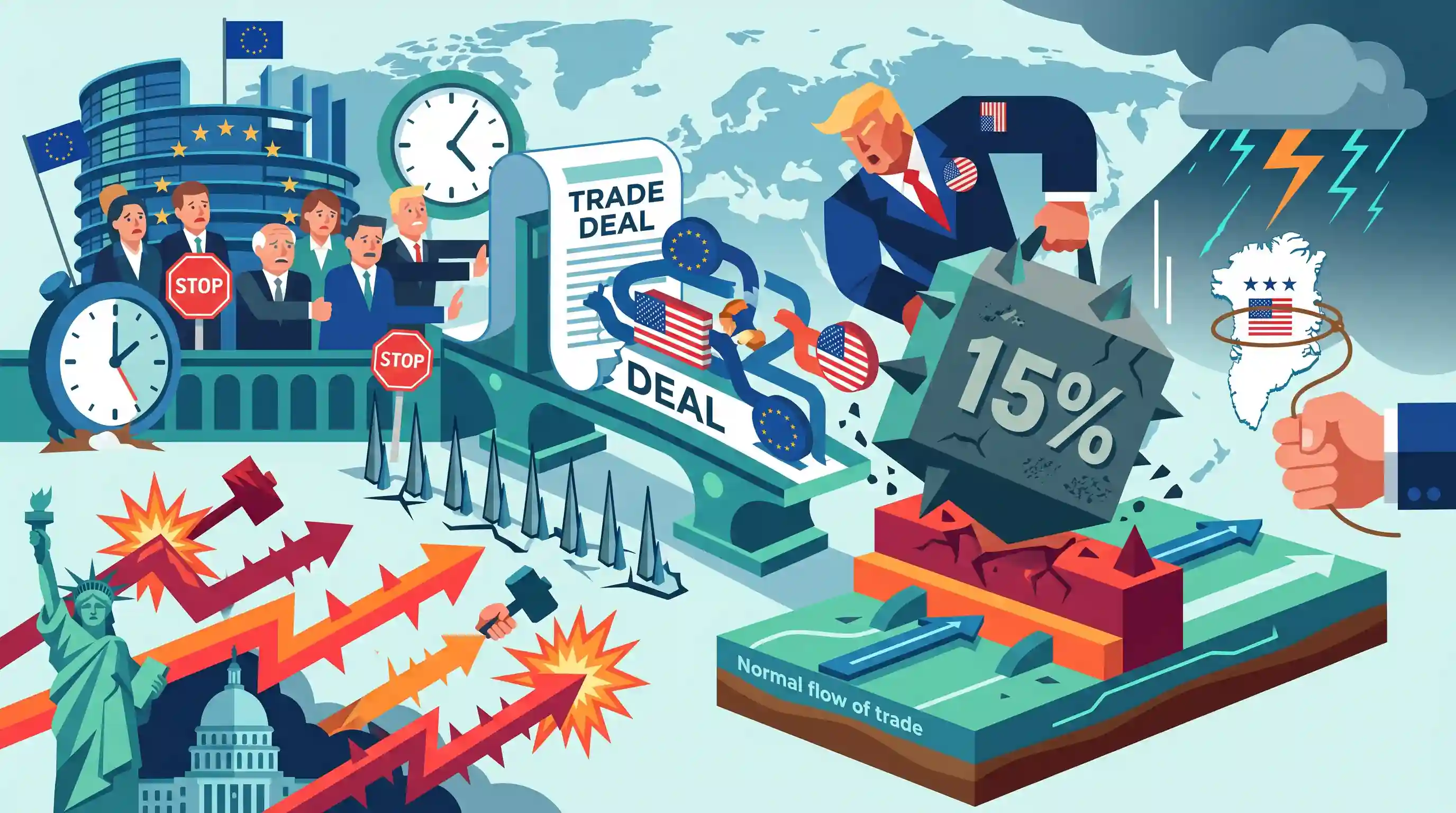
European Union lawmakers have once again postponed a critical vote on a transatlantic trade deal following a sudden 15% blanket import tariff imposed by US President Donald Trump. The legislative suspension reflects growing friction between the EU and the US over protectionist policies, adding to previous geopolitical tensions surrounding Trump's demands to acquire Greenland. The temporary US tariff threatens to supersede the negotiated agreement, potentially layering over existing 'most-favoured-nation' duties and sparking fears of retaliatory countermeasures from the EU.
Key Points
- The European Parliament postponed its vote on the EU-US trade deal for a second time following President Donald Trump's imposition of a blanket 15% import tariff.
- The proposed agreement, originating from discussions in Turnberry, Scotland, aims to remove many EU import duties on US goods while capping the US tariff rate at 15% for most EU goods.
- A previous suspension of the vote occurred in protest of Donald Trump's geopolitical demands to acquire Greenland.
- EU lawmakers fear the new temporary US tariffs might supersede the deal and be placed on top of pre-existing 'most-favoured-nation' duties, potentially pushing overall tariffs on some EU products to 30%.
Important Terms
Most-Favoured-Nation (MFN)

A World Trade Organization (WTO) principle requiring a country to provide the same trade concessions, like lower tariffs, to all member nations without discrimination.
UPSC context
GS Paper III (Economy) and GS II (IR); fundamental for understanding WTO rules and non-discriminatory trade practices.
Trade Protectionism
Economic policy of restricting imports from other countries through methods such as tariffs, quotas, and subsidies to shield domestic industries from foreign competition.
UPSC context
GS Paper III (Economy); relevant for analyzing trade wars, domestic industry support, and global trade shifts.
European Union (EU)
A supranational political and economic union of 27 member states located primarily in Europe, operating as a single market with common laws and institutions.
UPSC context
GS II (International Institutions); crucial for understanding regional integration and India’s strategic bilateral relations.
Blanket Import Tariff
An across-the-board tax imposed on all imported goods regardless of their country of origin or specific product category, often used as a tool for revenue or negotiation.
UPSC context
GS Paper III (Economy); tests knowledge of trade barriers and their impact on global supply chains and inflation.
European Parliament
The directly elected legislative body of the European Union, responsible for passing EU laws, overseeing the budget, and ratifying international trade agreements.
UPSC context
GS II (International Relations/Institutions); identifies the legislative role in democratic oversight of international treaties.
Bilateral Trade Agreement
An exchange of goods or services between two nations that gives them preferential trade status, such as reduced tariffs or increased quotas.
UPSC context
GS II and GS III; tests understanding of trade negotiation frameworks versus multilateralism.
Prelims Trap
"MFN status allows a nation to provide exclusive, preferential low tariffs to a single allied trade partner."
MFN under WTO actually mandates equal, non-discriminatory treatment to ALL members. Exclusive low tariffs are exceptions requiring a formal FTA.
Static Concepts Connected
What is the Most-Favoured-Nation (MFN) principle and its exceptions?
- Equal treatment: GATT Article I mandates that any tariff concession granted to one nation must be extended to all WTO members equally.
- FTA exception: Countries can bypass MFN to offer exclusive lower tariffs if they form a formal Free Trade Agreement (FTA) or Customs Union.
- GSP exception: Developed nations can grant unilateral tariff reductions to developing countries under the Generalized System of Preferences (GSP).
What are the different types of tariffs in international trade?
- Bound rates: The maximum tariff rate a WTO member legally commits not to exceed for a specific product line.
- Applied rates: The actual tariff rate currently charged at the border, which can be flexibly set below the bound rate.
- Retaliatory tariffs: Punitive duties imposed by one country against another in response to perceived unfair trade practices or blanket tariffs.
Cross-Topic Patterns
Spillover effects on India's exports
US-EU tariff wars disrupt supply chains and invite retaliatory dumping, often forcing emerging economies like India to defensively hike safeguard and anti-dumping duties.
Weaponization of bilateral trade
Linking territorial claims (Greenland) to trade deals highlights the global shift from WTO rules-based multilateralism to transactional, geoeconomic leverage.

A multi-statement Prelims question contrasting MFN obligations with FTA/GSP exceptions is highly likely given rising protectionism.
Linked PYQs · 3
Linked PYQs · 3
- 2025MainsGS3
What are the challenges before the Indian economy when the world is moving away from free trade and multilateralism to protectionism and bilateralism? How can these challenges be met?
- 2018MainsGS3
How would the recent phenomena of protectionism and currency manipulations in world trade affect macroeconomic stability of India?
- 2023MainsGS2
‘The expansion and strengthening of NATO and a stronger US-Europe strategic partnership works well for India.’ What is your opinion about this statement ? Give reasons and examples to support your answer.
