European Leaders Reject US Tariffs Tied to Territorial Ambitions
Source:Indian Express ↗
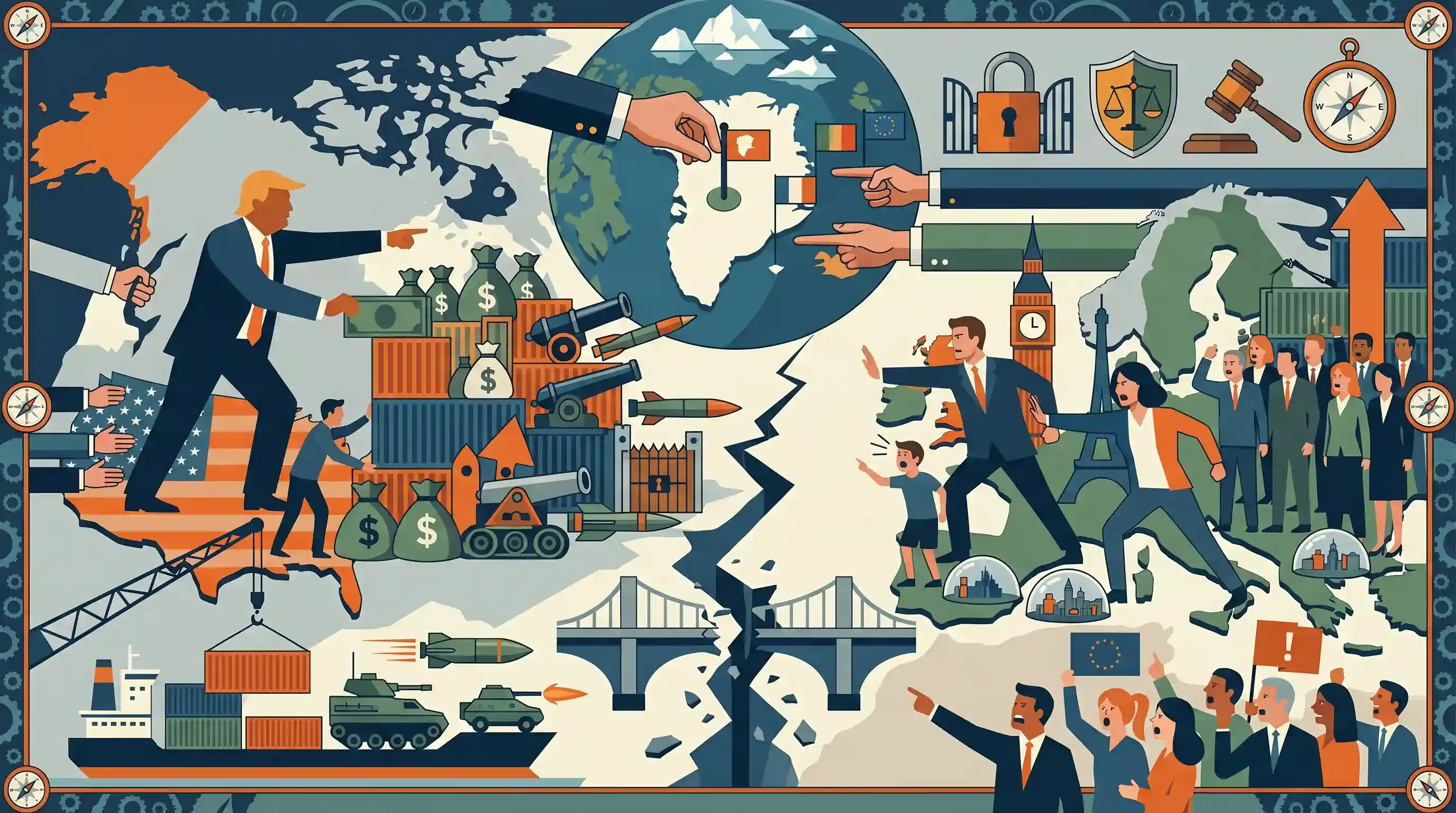
Why It Matters
The article highlights a shift in international relations where economic tools (tariffs) are used to exert pressure on allies for territorial ambitions. This challenges the rules-based global order, impacts NATO's cohesion, and is relevant for UPSC aspirants studying global geopolitics, protectionism, and the strategic significance of the Arctic.
Summary
European leaders are pushing back against US President Donald Trump’s decision to impose additional 10% tariffs on goods from the UK and France (with threats of up to 25% on other EU members) in retaliation for their opposition to his proposal to acquire Greenland. European officials have condemned the move, invoking international law and asserting that sovereign territories are not commodities to be traded. This diplomatic row underscores deep fissures in transatlantic relations, the weaponization of trade for geopolitical leverage, and the strategic importance of the Arctic region in contemporary global politics.
Key Points
- U.S. President Donald Trump imposed a 10% tariff on goods from the UK and France, threatening to increase it to 25% for EU countries opposing his plan to acquire Greenland.
- European leaders rejected the move, emphasizing that sovereign territories cannot be bought or sold under modern international law.
- The dispute highlights the increasing weaponization of economic policies, specifically trade tariffs, to achieve geopolitical and territorial objectives.
- Greenland's immense strategic and resource value in the Arctic region makes it a focal point of emerging geopolitical competition.
Important Terms
NATO

A 32-member intergovernmental military alliance established in 1949 for collective security and mutual defense across the North Atlantic region.
UPSC context
GS Paper II/International Relations; tests global security architectures and the stability of the post-WWII world order.
European Union (EU)
A political and economic union of 27 member states that coordinates shared trade, security, and legal policies through supranational institutions.
UPSC context
GS Paper II/International Relations; critical for understanding regional blocs, trade diplomacy, and strategic autonomy.
Weaponization of Trade
The strategic employment of trade measures, like tariffs or sanctions, as coercive tools to force geopolitical concessions from other nations.
UPSC context
GS Paper II & III/Economy & IR; relates to geo-economics and the breakdown of rules-based multilateral trade (WTO).
Geopolitics of the Arctic
The strategic rivalry for control over resource-rich territories and new maritime shipping routes made accessible by melting polar ice.
UPSC context
GS Paper II/IR & Geography; relevant for India's Arctic Policy and global resource diplomacy.
Transatlantic Relations
The historic security and economic bond between North America and Europe, traditionally serving as the foundation of the Western alliance.
UPSC context
GS Paper II/International Relations; examines shifting power dynamics and challenges to traditional strategic partnerships.
Prelims Trap
"Greenland is a fully independent sovereign nation located in the Arctic region."
Greenland is an autonomous territory within the Kingdom of Denmark. It is not an independent state, though it enjoys significant self-rule over domestic affairs.
Static Concepts Connected
What are the key pillars of India's Arctic Policy (2022)?
- Science & Climate: Studies teleconnections between Arctic ice melting and the Indian monsoon, utilizing the Himadri research station in Svalbard.
- Economic Security: Explores opportunities for critical mineral extraction and utilizing the Northern Sea Route (NSR) for maritime trade.
- Global Governance: Supports a rules-based framework and UNCLOS in managing Arctic resources, opposing unilateral territorial disruptions.
How does modern international law view the acquisition of populated territory?
- UN Charter: Prohibits the threat or use of force against the territorial integrity or political independence of any state.
- Self-Determination: Populated territories are not commodities; altering their political status requires the freely expressed consent of their inhabitants.
- Outlawing Conquest: Unlike the historical 1867 Alaska purchase, modern international law rejects the unilateral buying/selling of sovereign land.
Cross-Topic Patterns
Tariff weaponization + WTO paralysis
Using trade tariffs to achieve territorial ambitions violates WTO MFN principles, further straining a global trade regime already hampered by a paralyzed Appellate Body.
Arctic strategy + Clean energy supply chains
Securing Greenland's rare earth reserves intersects with global green energy transitions, aiming to reduce dependence on Chinese supply chains for EV and defense manufacturing.

Expect a 2026 Prelims question linking India's Arctic Policy, the geographical location of the GIUK gap, and critical mineral mapping.
Linked PYQs · 5
Linked PYQs · 5
- 2023MainsGS2
‘The expansion and strengthening of NATO and a stronger US-Europe strategic partnership works well for India.’ What is your opinion about this statement ? Give reasons and examples to support your answer.
- 2025MainsGS2
"With the waning of globalization, post-Cold War world is becoming a site of sovereign nationalism.” Elucidate.
- 2025MainsGS3
What are the challenges before the Indian economy when the world is moving away from free trade and multilateralism to protectionism and bilateralism? How can these challenges be met?
- 2018MainsGS3
How would the recent phenomena of protectionism and currency manipulations in world trade affect macroeconomic stability of India?
- 2018MainsGS1
Why is India taking keen interest in resources of Arctic Region?
