Transatlantic Security Dynamics and European Strategic Autonomy
Source:The Hindu ↗
Why It Matters
The transformation of the US-Europe security alliance affects the global balance of power. A push towards European strategic autonomy or a weakened NATO could alter multipolarity, directly impacting India's foreign policy calculus regarding its strategic partnerships with the US, Europe, and Russia.
Summary
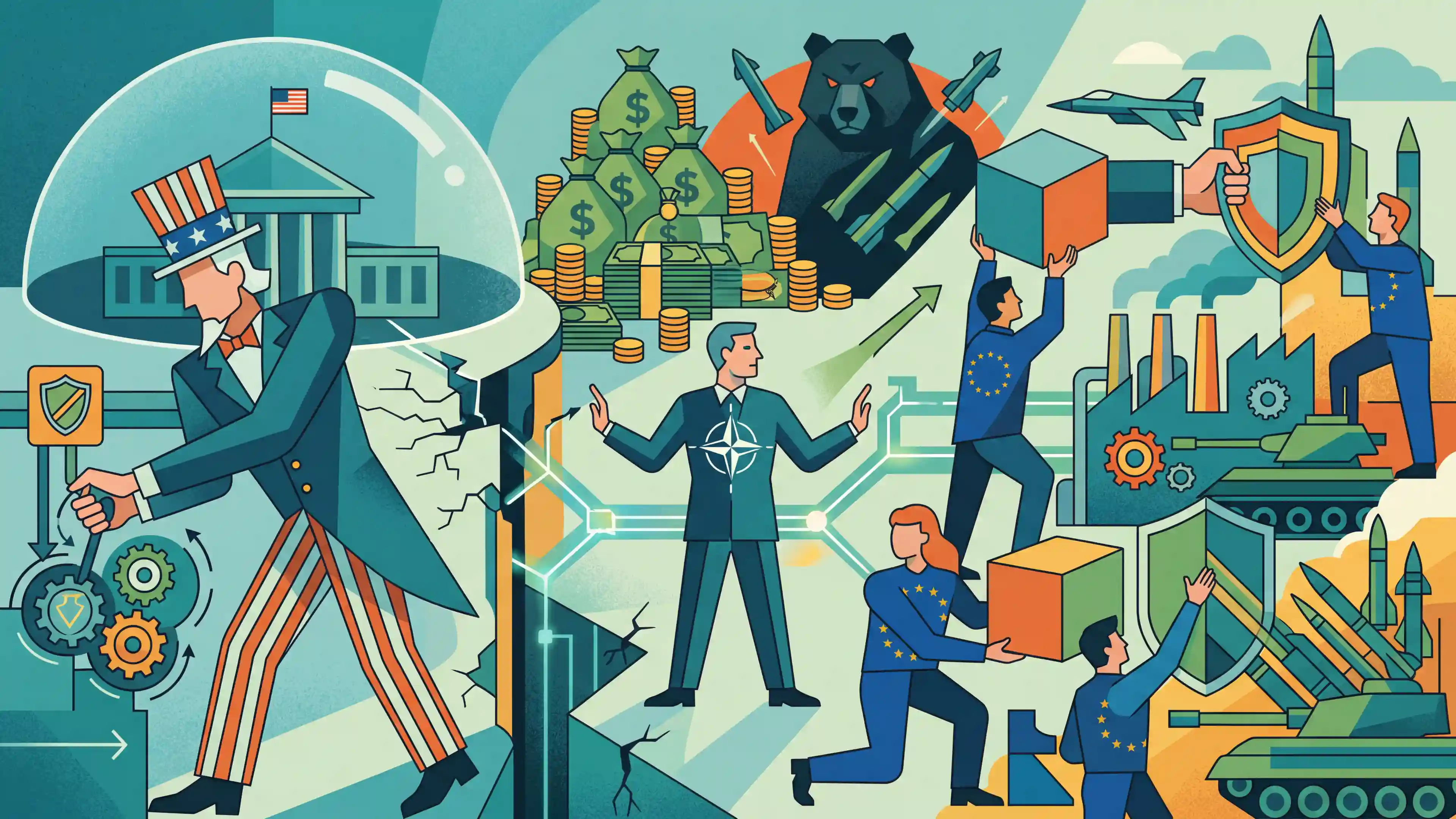
As the US administration under Donald Trump re-evaluates its traditional commitments to European security, EU leaders are increasingly advocating for "strategic autonomy" and a stronger, more self-reliant defence framework. EU diplomats emphasize the urgent need for Europe to increase military investments and build its own defence-industrial base to adapt to new geopolitical realities. However, NATO officials caution against fully detaching from the US, noting that replacing the American nuclear and security umbrella would be prohibitively expensive and could embolden adversaries like Russia. This debate highlights the evolving and fragile nature of the contemporary transatlantic alliance.
Key Points
- Top EU diplomats are urging Europe to boost its defence capabilities and reduce its military reliance on the US in response to changing transatlantic dynamics under the Trump administration.
- Recent remarks by Donald Trump, including suggestions to "seize" Greenland from NATO ally Denmark, have highlighted the unpredictability of the US security guarantee for Europe.
- Despite calls for European strategic autonomy, NATO chief Mark Rutte warned that independently replacing the US nuclear and security umbrella is financially unfeasible and would benefit Russia.
- The ongoing Russia-Ukraine war has already catalyzed a push for increased defence spending and the revitalization of the European military-industrial base.
Important Terms
Strategic Autonomy

The ability of a state to pursue its national interests and foreign policy independently, without being structurally dependent on or constrained by external powers or military blocs.
UPSC context
Relevant for GS Paper II (International Relations); tests understanding of India's non-alignment and Europe's shift toward self-reliance amidst shifting US policies.
NATO (North Atlantic Treaty Organization)
An intergovernmental military alliance established in 1949 by the Washington Treaty, founded on the principle of collective defense (Article 5) where an attack on one member is an attack on all.
UPSC context
Key International Organization under GS Paper II; tests knowledge of global security architecture and the impact of its expansion on regional stability.
Transatlantic Alliance
The historic political, economic, and security partnership between North America (primarily the US) and Europe, serving as the cornerstone of the post-WWII international liberal order.
UPSC context
GS Paper II (Global Groupings); tests ability to analyze the 'America First' policy's impact on traditional Western alliances and global governance.
European Union (EU)
A unique political and economic union of 27 member states that is increasingly integrating its security and defense policies through frameworks like PESCO to achieve greater autonomy.
UPSC context
Regional grouping under GS Paper II; tests understanding of the EU's evolution from a trade bloc to a geopolitical actor.
Defence-Industrial Base (DIB)
The collective network of a nation's or region's research, manufacturing, and supply chain facilities capable of producing and maintaining the military materiel required for national security.
UPSC context
Related to GS Paper II (Security & IR); tests the link between industrial self-reliance and sovereign foreign policy (Atmanirbhar Bharat context).
Article 5 (Collective Defence)
A core provision of the NATO treaty stating that an armed attack against one member shall be considered an attack against all, mandating a collective response.
UPSC context
GS Paper II (International Agreements); tests understanding of the legal and strategic triggers that define modern military alliances.
Prelims Trap
The European Union is building an independent nuclear umbrella to replace US extended deterrence.
While Europe is boosting defense spending and building its industrial base, replacing the US nuclear umbrella remains financially and militarily unfeasible, per NATO.
Static Concepts Connected
What is NATO's collective defense principle and extended deterrence?
- Article 5: Under the Washington Treaty, an armed attack against one member is considered an attack against all NATO allies.
- Nuclear Umbrella: The US guarantees nuclear retaliation against adversaries attacking non-nuclear European allies, forming the core of Europe's security architecture.
What are the core pillars of the EU's 'Strategic Autonomy'?
- Defense Capability: Building a sovereign defense-industrial base to minimize structural military and supply-chain dependence on the United States.
- Global Actorness: Asserting independent foreign policy and economic choices in a multipolar world, rather than acting as a junior partner to Washington.
Cross-Topic Patterns
EU Strategic Autonomy & India's Multialignment
Europe’s push for defense independence mirrors India's own multi-alignment strategy, reflecting a broader global shift from rigid Cold War alliances toward transactional, multipolar sovereign nationalism.
NATO burden-sharing & the Indo-Pacific
A self-reliant Europe capable of deterring Russia would free up US military and diplomatic resources for the Indo-Pacific, directly aiding India's strategic calculations against China.

Expect a 2026 Mains question on how US isolationism and EU strategic autonomy impact the Indo-Pacific pivot and India's interests.
Linked PYQs · 2
Linked PYQs · 2
- 2023MainsGS2
‘The expansion and strengthening of NATO and a stronger US-Europe strategic partnership works well for India.’ What is your opinion about this statement ? Give reasons and examples to support your answer.
- 2025MainsGS2
"With the waning of globalization, post-Cold War world is becoming a site of sovereign nationalism.” Elucidate.
