European Union Proposes Trade Agreement Suspension Over Gaza
Source:Indian Express ↗
Why It Matters
The article illustrates how major economic blocs utilize trade agreements and tariffs as leverage to enforce international humanitarian norms and pressure foreign governments. It provides crucial context on the evolving dynamics of the Israel-Palestine conflict and the European Union's foreign policy approach, which is vital for understanding contemporary international relations and geopolitical realignments.
Summary
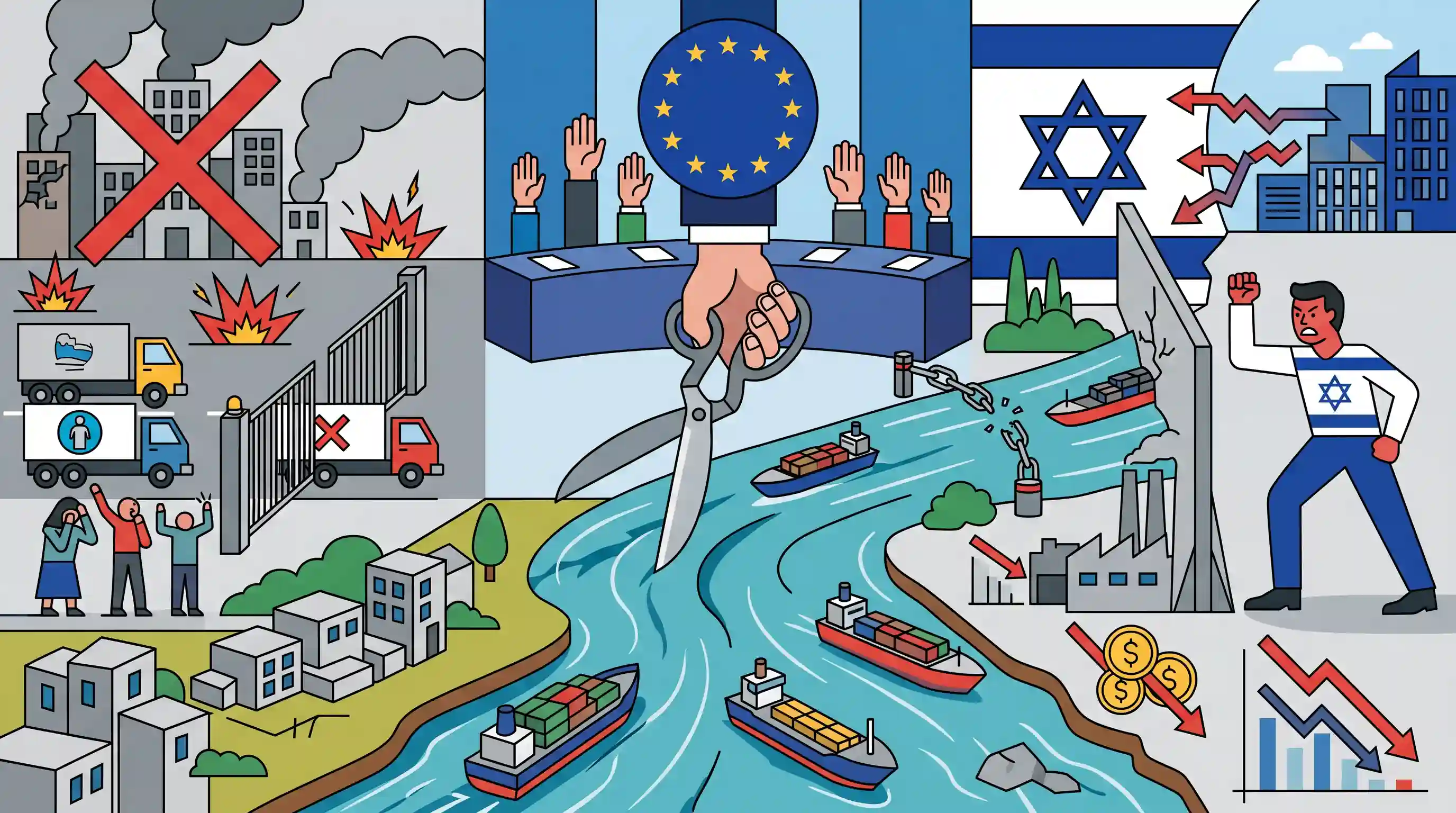
The European Commission has proposed suspending parts of its trade agreement with Israel, a move that would remove preferential market access for Israeli exports in response to the ongoing Gaza war and escalating humanitarian crisis. Triggered by pressure from several member states, the suspension targets Israel's military operations, aid blockades, and West Bank settlement expansions. The EU remains Israel's largest trading partner, meaning the reinstatement of tariffs could significantly impact its economy. Israel has strongly rejected the proposal, warning of retaliatory measures and asserting that the move will ultimately harm European interests.
Key Points
- The European Commission has proposed suspending parts of the EU-Israel association agreement, stripping Israeli exports of preferential market access due to the Gaza war.
- The proposal is driven by concerns over the humanitarian crisis in Gaza, the blockade of aid, and Israeli settlement expansion in the E1 area of the West Bank.
- The EU is Israel's largest trading partner, comprising 32% of its global trade; reinstating tariffs could impact €5.8 billion of Israeli exports and cost €227 million in duties.
- The proposals, which also include sanctions on Hamas, extremist ministers, and violent settlers, require approval from all EU member states, where political divisions still exist.
- Israeli Foreign Minister Gideon Saar strongly condemned the move, warning that it would harm Europe's interests and provoke an appropriate response from Israel.
Important Terms
EU-Israel Association Agreement

A 2000 treaty governing EU-Israel political and economic relations, providing Israel with preferential market access to its largest trading partner, the European Union.
UPSC context
GS-II: Bilateral/Global Agreements. Tests understanding of trade conditionality and institutional frameworks governing international diplomacy and economic partnerships.
Article 2 (Human Rights Clause)
A provision in EU agreements stating that relations are based on respect for human rights and democratic principles, serving as the legal basis for treaty suspension.
UPSC context
GS-II: International Treaties. Relevant for analyzing how human rights standards are integrated into global trade laws and used as diplomatic leverage.
Qualified Majority Voting (QMV)
A voting mechanism in the EU Council requiring 55% of member states representing 65% of the EU population to pass decisions, such as suspending trade treaties.
UPSC context
GS-II: International Groupings. Crucial for understanding supranational governance and the shift from unanimity to majority voting in foreign policy.
European Commission
The executive arm of the European Union responsible for proposing legislation, implementing policy, and representing the bloc in international trade negotiations.
UPSC context
GS-II: Global Groupings. Tests knowledge of the institutional structure of the EU and its role in imposing economic sanctions.
West Bank Settlements
Israeli communities built on territories captured during the 1967 Six-Day War; the EU considers them illegal under international law and a barrier to peace.
UPSC context
GS-II: International Disputes. Vital for mapping the territorial and legal triggers behind European policy shifts in the West Asian region.
Hamas
A Palestinian Sunni-Islamic militant organization governing the Gaza Strip, designated as a terrorist group by the EU, and a primary combatant in the conflict.
UPSC context
GS-II/III: Security/International Relations. Key for understanding non-state actor dynamics and their impact on regional stability and global trade policies.
Prelims Trap
Sanctions and trade suspensions by the EU against Israel require only a simple majority vote in the European Commission.
EU foreign policy decisions, including suspending trade pacts or imposing sanctions, strictly require unanimous approval from all 27 member states, making implementation vulnerable to individual member vetoes.
Static Concepts Connected
What are the precise geographical boundaries of the Gaza Strip and West Bank?
- Gaza Strip: It is bordered by the Mediterranean Sea to the west, Egypt's Sinai Peninsula to the south/southwest, and Israel to the north and east.
- West Bank: A landlocked territory bordered by Jordan and the Dead Sea to the east, and surrounded by Israel to the north, west, and south.
- E1 Area: A sensitive, 12-square-kilometer corridor in the West Bank located between East Jerusalem and the Ma'ale Adumim settlement.
What is an "essential elements" clause in international trade agreements?
- Definition: A legal provision making bilateral trade preferences conditional upon the respect for human rights and democratic principles by both parties.
- Enforcement: It allows one party to unilaterally suspend preferential market access or reinstate tariffs if the other party commits severe human rights violations.
- International Law context: The Fourth Geneva Convention prohibits an occupying power from transferring its civilian population into occupied territory, rendering Israeli settlements illegal under international law.
Cross-Topic Patterns
Weaponization of trade preferences
The EU's use of trade access to enforce human rights mirrors US GSP withdrawals. This highlights the growing trend of "weaponized interdependence" where geoeconomics dominates traditional diplomacy in international relations.
E1 area and the Two-State Solution
The E1 corridor's expansion threatens to geographically bisect the West Bank, making a contiguous Palestinian state impossible. UPSC tests specific conflict locations alongside their direct geopolitical consequences.

Expect a Prelims 2026 map-based question pairing Levant conflict zones (E1 area, Gaza borders) with statements on the Two-State Solution.
Linked PYQs · 3
Linked PYQs · 3
- 2018MainsGS2
“India’s relations with Israel have, of late, acquired a depth and diversity, which cannot be rolled back.” Discuss.
- 2023PrelimsGS1
Consider the following pairs: Regions often mentioned in news Reason for being in news 1. North Kivu and Ituri : War between Armenia and Azerbaijan 2. Nagorno-Karabakh : Insurgency in Mozambique 3. Kherson and Zaporizhzhia : Dispute between Israel and Lebanon How many of the above pairs are correctly matched?
- 2023PrelimsGS1
Consider the following pairs: Area of conflict mentioned in news Country where it is located 1. Donbas : Syria 2. Kachin : Ethiopia 3. Tigray : North Yemen How many of the above pairs are correctly matched?
