El Nino Impact on European Heatwaves and Global Climatology
Source:Indian Express ↗
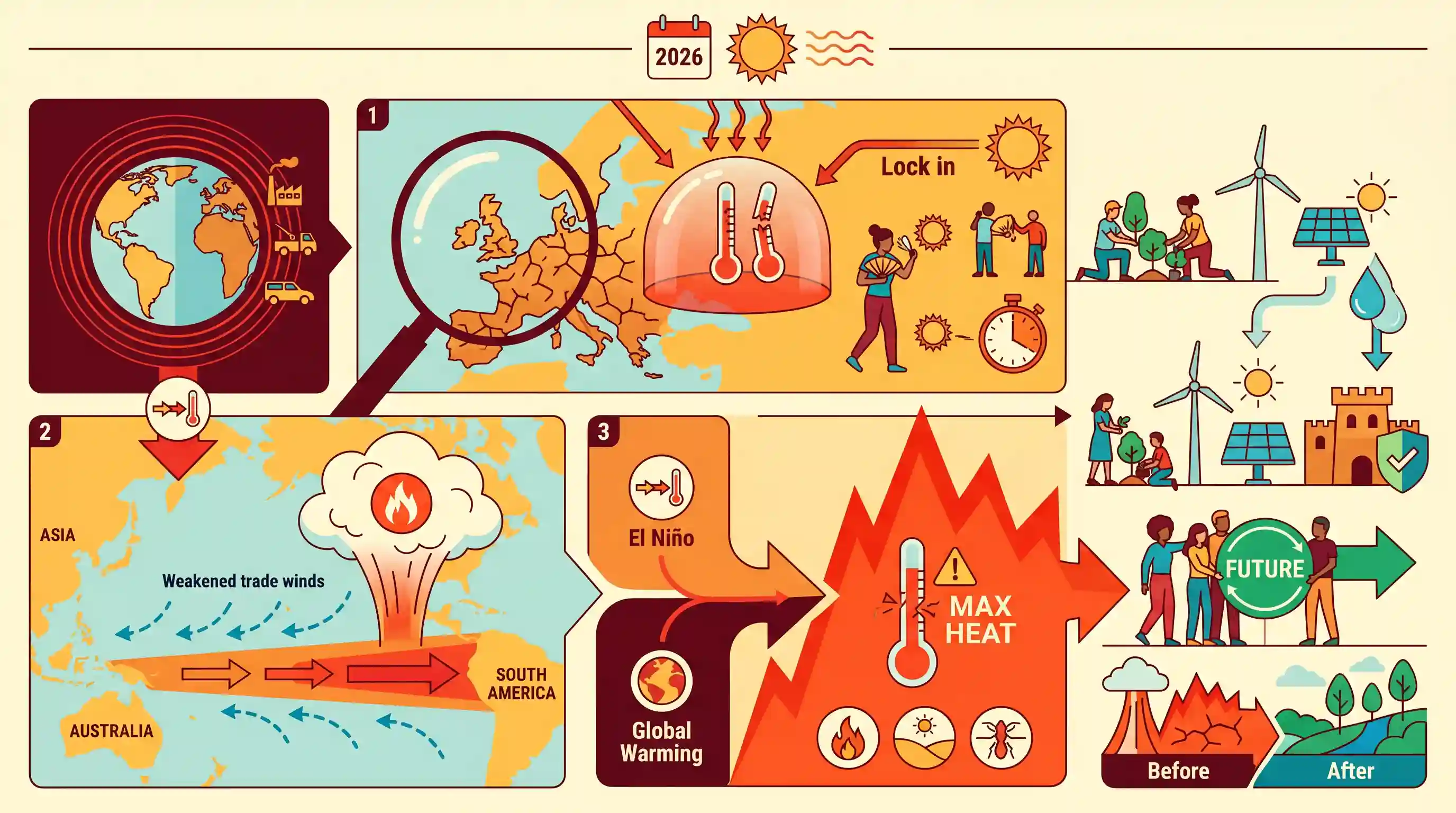
Why It Matters
Understanding the interplay between natural climate variability (like El Niño) and anthropogenic climate change is crucial for UPSC aspirants, as it directly impacts global weather systems, disaster management, and international environmental policies.
Summary
The article discusses the severe heatwave affecting Europe in 2026 and explains how a strong El Niño event is worsening global heat. El Niño, a naturally occurring climate phenomenon involving the warming of the central and eastern Pacific Ocean, releases significant heat into the atmosphere and disrupts global weather patterns. When this natural warming phase combines with the long-term, human-induced trend of global warming, it results in unprecedented temperature spikes. The compounded effect leads to more frequent, prolonged, and intense heatwaves, highlighting the urgent need to address climate change and build resilience against extreme weather events.
Key Points
- Europe is experiencing a severe heatwave in 2026, leading to record-breaking temperatures and heightened climate-related risks across the continent.
- The extreme temperatures are being significantly exacerbated by a strong El Niño event, a climate pattern characterized by the warming of the equatorial Pacific Ocean.
- El Niño releases vast amounts of heat into the atmosphere, which temporarily spikes global average temperatures and alters regional weather patterns.
- When the warming effect of El Niño is superimposed on human-induced climate change, it creates compounding effects, making extreme weather events like heatwaves much more intense and frequent.
Important Terms
El Niño

A natural climate cycle (warm phase of ENSO) involving sea-surface warming in the central and eastern tropical Pacific, which disrupts global weather patterns and often suppresses the Indian monsoon.
UPSC context
GS I (Geography/Geophysical Phenomena); tests understanding of global teleconnections and socio-economic impacts on Indian agriculture.
Heatwave
A period of abnormally high temperatures. In India, the IMD declares it when temperatures reach 40°C in plains or 30°C in hills, or show significant departure from normal.
UPSC context
GS I & III (Geography/Disaster Management); tests knowledge of scientific criteria, urban heat islands, and public health mitigation strategies.
Intergovernmental Panel on Climate Change (IPCC)
The UN's apex scientific body (established 1988) that assesses global research on climate change, its risks, and mitigation/adaptation options to inform international policy without conducting original research.
UPSC context
GS III (Environment); tests understanding of international institutional mechanisms and the scientific basis for global climate negotiations.
Paris Agreement
A 2015 legally binding international treaty aiming to limit global warming to well below 2°C, preferably 1.5°C, through self-determined climate targets called Nationally Determined Contributions (NDCs).
UPSC context
GS III (Environment/International Relations); tests knowledge of global governance, climate finance, and India’s domestic climate commitments.
World Meteorological Organization (WMO)
A specialized UN agency (established 1950) that coordinates international cooperation on atmospheric science, climatology, and hydrology, serving as the authoritative voice on the Earth’s weather and climate.
UPSC context
GS II & III (International Institutions/Environment); tests familiarity with UN agencies responsible for monitoring global climate indicators.
Climate Resilience
The capacity of social, economic, and environmental systems to withstand, recover from, and adapt to climate-related hazards, shifting from reactive disaster response to proactive risk management.
UPSC context
GS III (Disaster Management/Climate Change); tests ability to propose adaptation strategies and infrastructure improvements in response to extreme weather.
Prelims Trap
"El Niño is characterized by the strengthening of trade winds and the unusual warming of the western Pacific Ocean."
This actually describes normal or La Niña conditions. El Niño involves the *weakening* of trade winds and the warming of the *central and eastern* equatorial Pacific.
Static Concepts Connected
What is a 'Heat Dome' and how does it drive extreme heatwaves?
- High-Pressure Blocking: A persistent high-pressure atmospheric system in the mid-troposphere traps warm air below it, acting like a lid.
- Adiabatic Compression: As trapped air is pushed downward, it compresses and warms further, simultaneously preventing cloud formation and allowing maximum solar radiation.
- Jet Stream Anomalies: Often linked to a highly meandering, slow-moving jet stream that stalls weather systems in place for weeks.
How does El Niño suppress the Indian Summer Monsoon?
- Walker Cell Shift: Warming in the central/eastern Pacific shifts the ascending limb of the Walker circulation eastward, away from the western Pacific.
- Subsidence over India: This shift creates a corresponding descending limb (high pressure, air subsidence) over the Indian subcontinent and Southeast Asia.
- Suppressed Convection: The resulting high pressure suppresses convective cloud formation, leading to an increased probability (historically ~70%) of drought or below-normal rainfall.
Cross-Topic Patterns
El Niño, Monsoons & Agri-inflation
A deficient monsoon triggered by El Niño directly impacts Kharif sowing, squeezing agricultural output and driving up food inflation, often prompting structural responses like export bans on staples like rice.
Macro-Climatology + Urban Disaster Management
Global heatwaves compounded by localized Urban Heat Island (UHI) effects severely test city resilience. Expect questions linking global macro-climatology to local urban disaster mitigation guidelines (NDMA).

Expect a Prelims question mixing El Nino's oceanic markers (SST, trade winds) with mid-latitude atmospheric teleconnections (Heat domes).
Linked PYQs · 4
Linked PYQs · 4
- 2011PrelimsGS1
La Nina is suspected to have caused recent floods in Australia. How is La Nina different from El Nino? 1. La Nina is characterised by unusually cold ocean temperature in equatorial Indian Ocean whereas El Nino is characterised by unusually warm ocean temperature in the equatorial Pacific Ocean. 2. El Nino has adverse effect on south-west monsoon of India, but La Nina has no effect on monsoon climate. Which of the statements given above is/are correct?
- 2014MainsGS1
Most of the unusual climatic happenings are explained as an outcome of the El-Nino effect. Do you agree?
- 2022MainsGS3
Discuss global warming and mention its effects on the global climate. Explain the control measures to bring down the level of greenhouse gases which cause global warming, in the light of the Kyoto Protocol, 1997.
- 2025PrelimsGS1
The World Bank warned that India could become one of the first places where wet-bulb temperatures routinely exceed 35 °C. Which of the following statements best reflect(s) the implication of the above-said report? I. Peninsular India will most likely suffer from flooding, tropical cyclones and droughts. II. The survival of animals including humans will be affected as shedding of their body heat through perspiration becomes difficult. Select the correct answer using the code given below.
