Europe and Canada Forge Closer Ties Amid Transatlantic Security Shifts
Source:The Hindu ↗
Why It Matters
Evaluates major shifts in global power dynamics, specifically the strain on traditional US-European alliances, the rising importance of non-US Western solidarity (Canada-EU), and regional realignments like Armenia's diplomatic shift. Crucial for understanding the evolving multipolar order and its implications for global stability and security architectures like NATO.
Summary
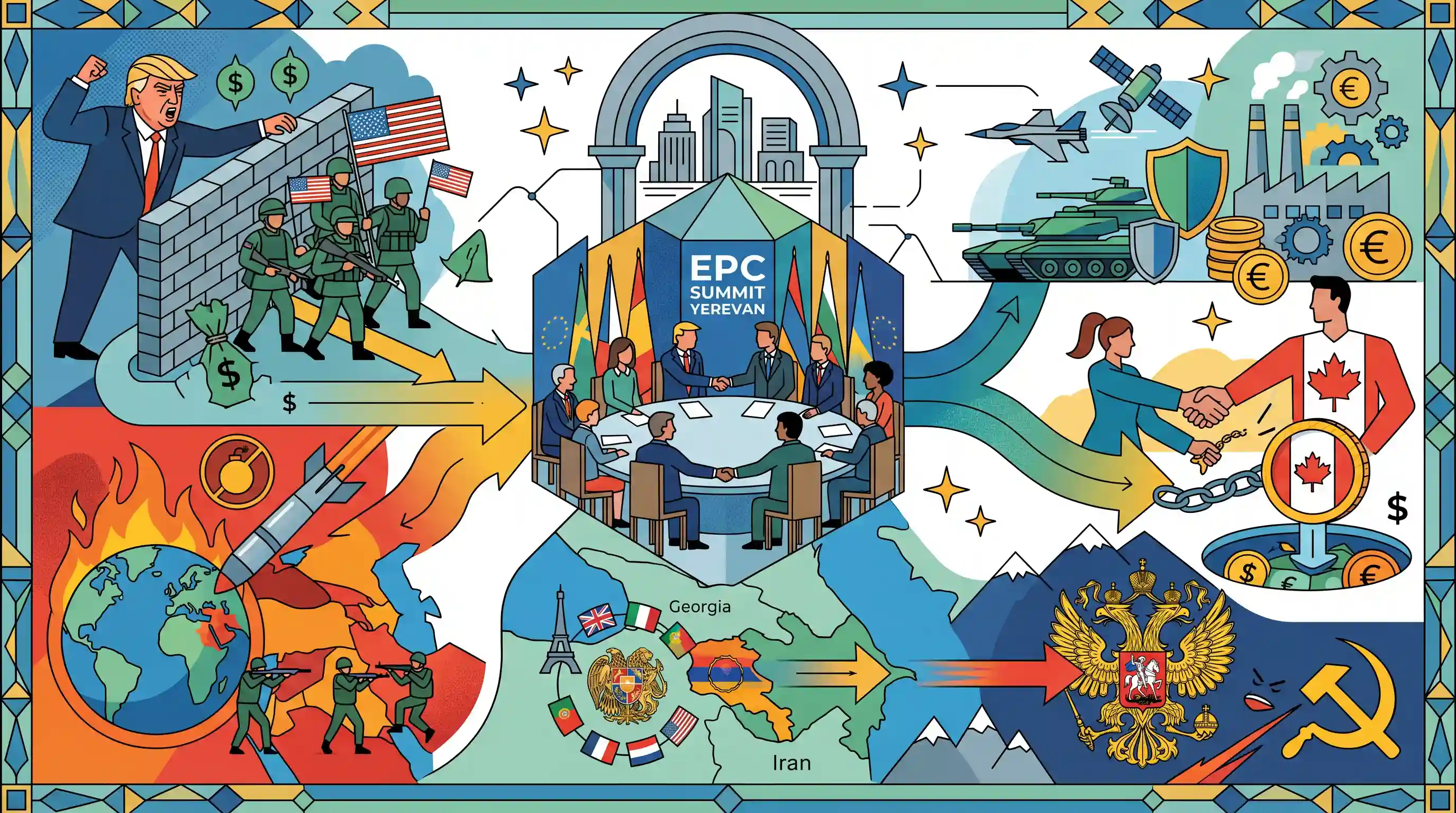
The European Political Community (EPC) summit in Yerevan, Armenia, served as a platform for European nations and Canada to consolidate their transatlantic ties in response to mounting global geopolitical pressures. The impending return of Donald Trump to the US presidency, with his isolationist policies and threats to scale back military deployments in Europe, alongside the destabilizing US-Israeli war on Iran, has forced Europe to seek stronger defense and economic self-reliance. Canada's unprecedented participation and pledge to join the EU's defense financing scheme highlight a growing non-US Western solidarity. Simultaneously, the summit underscores host Armenia's strategic pivot away from Russia and towards Western integration amidst the evolving geopolitics of the South Caucasus.
Key Points
- The European Political Community (EPC) summit in Yerevan saw European nations and Canada align closely against geopolitical uncertainties fueled by the US-Israeli conflict with Iran and incoming US President Donald Trump's isolationist approach.
- Canada became the first non-European country to participate in the EPC, with emissary Mark Carney pledging Canada's inclusion in an EU defence financing scheme, highlighting growing non-US transatlantic solidarity.
- Trump's proposed policies—such as imposing trade tariffs, cutting military support, and pulling US troops from Germany—are pushing NATO and European partners to bolster their defense self-reliance.
- Armenia's hosting of the summit emphasizes its strategic 'diversification' policy, moving away from Russia’s sphere of influence toward Western integration, following Moscow's failure to intervene in the Nagorno-Karabakh conflict with Azerbaijan.
- The EPC, originally formed by French President Emmanuel Macron as an anti-Putin coalition following the invasion of Ukraine, has now evolved to partly counterbalance Trump's inward-looking US agenda.
Important Terms
European Political Community (EPC)

A platform for political and strategic discussions on Europe's future, launched in 2022. It includes EU members and non-EU states like the UK, Turkey, and (as a guest) Canada.
UPSC context
GS Paper II: Regional and global groupings. Important for understanding post-Ukraine European security architecture and non-traditional alliances.
Security Action for Europe (SAFE)
A €150-billion European Union loan program under the 'Readiness 2030' plan designed for joint defense procurement and rearming Europe. Canada is the first non-European participant.
UPSC context
GS Paper II: Effect of policies of developed countries on India. Tests awareness of shifting global defense financing and strategic autonomy.
South Caucasus
The geopolitical region between the Black and Caspian Seas, comprising Armenia, Azerbaijan, and Georgia. It serves as a strategic corridor between Europe and Asia.
UPSC context
GS Paper II: Regional geopolitics. Significant for India's strategic interests in Armenia and connectivity via the INSTC.
Collective Security Treaty Organization (CSTO)
A Russian-led military alliance of post-Soviet states. Armenia has recently distanced itself from the bloc, seeking western security alternatives after the alliance failed to intervene against Azerbaijan.
UPSC context
GS Paper II: International groupings and agreements. Tests understanding of the decline of Russian influence in its traditional 'near abroad.'
International North-South Transport Corridor (INSTC)
A 7,200-km multi-modal transport network linking India to Europe via Iran and the South Caucasus, providing an alternative to the Suez Canal.
UPSC context
GS Paper III: Infrastructure and Connectivity. A core interest for India's trade diversification and strategic outreach to Central Asia.
Prelims Trap
"The European Political Community (EPC) is an institutional organ of the European Union."
The EPC is an intergovernmental forum distinct from the EU. It was formed in 2022 to include non-EU European states (like the UK, Ukraine, and Turkey) and now Canada.
Static Concepts Connected
What is the Collective Security Treaty Organization (CSTO)?
- Origin: An intergovernmental military alliance in Eurasia formed in 1992 (Tashkent Treaty), led by Russia.
- Collective Defense: Under Article 4, an aggression against one signatory is perceived as an aggression against all, mirroring NATO's Article 5.
- Membership: Russia, Belarus, Kazakhstan, Kyrgyzstan, Tajikistan, and Armenia (though Armenia has recently distanced itself/suspended participation).
What is the geopolitical significance of the South Caucasus?
- Geographical Buffer: A critical land bridge comprising Armenia, Azerbaijan, and Georgia, nestled between the Black Sea and the Caspian Sea.
- Energy Corridor: It serves as a vital transit route for Caspian basin oil and gas (e.g., Baku-Tbilisi-Ceyhan pipeline) to reach Western markets without crossing Russia.
Cross-Topic Patterns
Armenia and India's INSTC ambitions
India increasingly supplies defense equipment to Armenia and views it as a strategic node to extend the International North-South Transport Corridor (INSTC) to Europe, bypassing rival corridors.
Middle-power autonomous defense networks
Europe and Canada forming non-US defense funding pacts mirrors Indo-Pacific trends, where middle powers (like Japan and Australia) build autonomous security webs to hedge against US isolationism.

Map-based prelims questions on South Caucasus borders often merge with CSTO/EPC membership facts; expect this intersection in 2026.
Linked PYQs · 5
Linked PYQs · 5
- 2023MainsGS2
‘The expansion and strengthening of NATO and a stronger US-Europe strategic partnership works well for India.’ What is your opinion about this statement ? Give reasons and examples to support your answer.
- 2025MainsGS2
"The reform process in the United Nations remains unresolved, because of the delicate imbalance of East and West and entanglement of the USA vs. Russo-Chinese alliance.” Examine and critically evaluate the East-West policy confrontations in this regard.
- 2023PrelimsGS1
Consider the following pairs: Regions often mentioned in news Reason for being in news 1. North Kivu and Ituri : War between Armenia and Azerbaijan 2. Nagorno-Karabakh : Insurgency in Mozambique 3. Kherson and Zaporizhzhia : Dispute between Israel and Lebanon How many of the above pairs are correctly matched?
- 2022PrelimsGS1
Consider the following countries: 1. Armenia 2. Azerbaijan 3. Croatia 4. Romania 5. Uzbekistan Which of the above are members of the Organization of Turkic States?
- 2018MainsGS2
In what ways would the ongoing US-Iran Nuclear Pact Controversy affect the national interest of India? How should India respond to this situation?
