Eurasian Otter Sighting and Wetland Conservation in Kashmir
Source:Indian Express ↗
Why It Matters
Indicator species and sightings of animals thought to be 'locally extinct' are prime targets for UPSC Prelims (e.g., questions on species behavior, habitat, and conservation status). Furthermore, understanding the ecological role of otters provides excellent fodder for Mains GS3 answers on riverine health and wetland conservation.
Summary
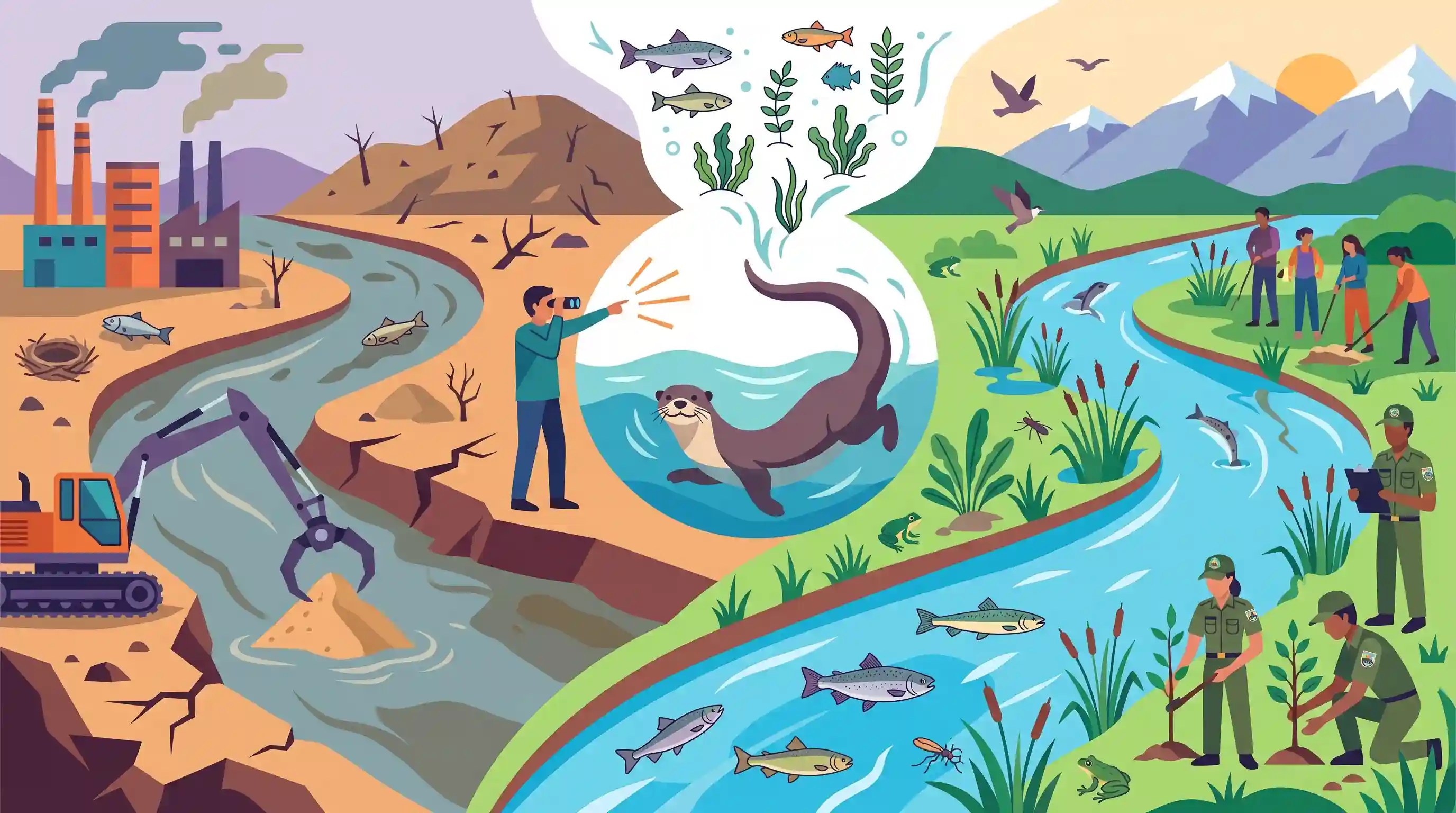
A rare sighting of the Eurasian otter in Kashmir has revived hopes for the species' comeback in the region, where it was long considered locally extinct. As an apex predator and vital bio-indicator of aquatic health, the otter's presence suggests potential resilience in local wetland and riverine ecosystems. However, the species continues to face significant threats from habitat degradation, pollution, and sand mining, highlighting the need for reinforced conservation strategies under the Wildlife (Protection) Act and broader wetland management frameworks.
Key Points
- The Eurasian otter (Lutra lutra), previously feared to be locally extinct in the region, has been recently sighted in the Kashmir Valley.
- India is home to three otter species: the Smooth-coated otter, the Asian small-clawed otter, and the Eurasian otter.
- Otters act as apex predators in freshwater networks and are critical bio-indicators; their presence is a strong sign of healthy, unpolluted aquatic ecosystems with adequate prey bases.
- The Eurasian otter is classified as 'Near Threatened' on the IUCN Red List and is strictly protected under India's Wildlife (Protection) Act, 1972, as well as CITES Appendix I.
- The rare sighting underscores the urgent need to protect Kashmir's riverine and wetland habitats from severe ongoing threats such as unregulated sand mining, poaching for pelts, and water pollution.
Important Terms
Wildlife (Protection) Act, 1972

India's primary legal framework for protecting plant and animal species, establishing various schedules that determine the degree of protection and penalties for offenses.
UPSC context
GS Paper III: Biodiversity. Essential for understanding Indian conservation laws, protected area networks, and species-specific protection levels.
Eurasian otter
A semi-aquatic carnivorous mammal (Lutra lutra) and apex predator whose presence indicates high-quality, unpolluted freshwater ecosystems.
UPSC context
GS Paper III: Environment. Important as a 'bio-indicator' and 'apex predator' recently sighted in Kashmir after presumed local extinction.
IUCN Red List
The world's most comprehensive inventory of the global conservation status of biological species, maintained by the IUCN.
UPSC context
GS Paper III: Environment. Tests knowledge of species' threat status (e.g., Near Threatened for Eurasian otters) to prioritize global conservation.
CITES
An international agreement ensuring that global trade in wild animal and plant specimens does not threaten their survival.
UPSC context
GS Paper III: Environment. Crucial for questions on international wildlife trade regulations and species protection categories (Appendices I, II, and III).
Bio-indicator
Organisms, like the Eurasian otter, whose health and population status are used to monitor and assess the overall health of an ecosystem.
UPSC context
GS Paper III: Environment. A key ecological concept testing the ability to link specific species to environmental quality assessments.
Prelims Trap
"The Eurasian otter is endemic to the Himalayan region and is listed as Critically Endangered."
It has one of the widest global distributions among mammals (Europe, Asia, Africa) and is listed as Near Threatened, not Critically Endangered.
Static Concepts Connected
What makes a species a 'bio-indicator' in ecosystem monitoring?
- High sensitivity: They are highly sensitive to environmental changes, making their presence or absence a reliable proxy for ecosystem health.
- Apex accumulation: As top predators in freshwater webs, otters accumulate toxins, reflecting the overall water quality, heavy metal pollution, and prey base health.
Which otter species are found in India and what are their typical habitats?
- Smooth-coated otter: Found throughout India in major rivers and lakes; well-adapted to live in both fresh and brackish water environments.
- Asian small-clawed: Found primarily in the Himalayan foothills and the Western Ghats; it is the smallest otter species globally.
- Eurasian otter: Adapted to cold climates; primarily restricted to the Himalayas and high-altitude water bodies in India.
Cross-Topic Patterns
Riverine health + Sand mining impacts
Unregulated sand mining directly destroys otter breeding dens and alters river hydrology, bridging biodiversity conservation with the regulation of minor minerals and environmental impact assessments.
WPA 2022 amendments + CITES overlaps
The 2022 amendment to the Wildlife (Protection) Act merged schedules; mapping CITES Appendix I species like the Eurasian otter to the new Schedule I/II is a recurring prelims theme.

Expect a multi-statement question matching India's three otter species to their geographic ranges, IUCN statuses, and bio-indicator roles.
Linked PYQs · 4
Linked PYQs · 4
- 2023PrelimsGS1
Which one of the following makes a tool with a stick to scrape insects from a hole in a tree or a log of wood?
- 2022PrelimsGS1
"If rainforests and tropical forests are the lungs of the Earth, then surely wetlands function as its kidneys." Which one of the following functions of wetlands best reflects the above statement?
- 2023MainsGS3
Comment on the National Wetland Conservation Programme initiated by the Government of India and name a few India's wetlands of international importance included in the Ramsar Sites.
- 2020PrelimsGS1
If a particular plant species is placed under Schedule VI of The Wildlife Protection Act, 1972, what is the implication?
