Rare Migratory Duck Sighting in Kaziranga Signals Climate Shift
Source:The Hindu ↗
Why It Matters
This highlights the real-world indicators of climate change (range shifts in migratory species) and provides concrete examples of critical wetland habitats and protected areas in India, which are frequent topics in UPSC Prelims and Mains (Environment and Ecology).
Summary
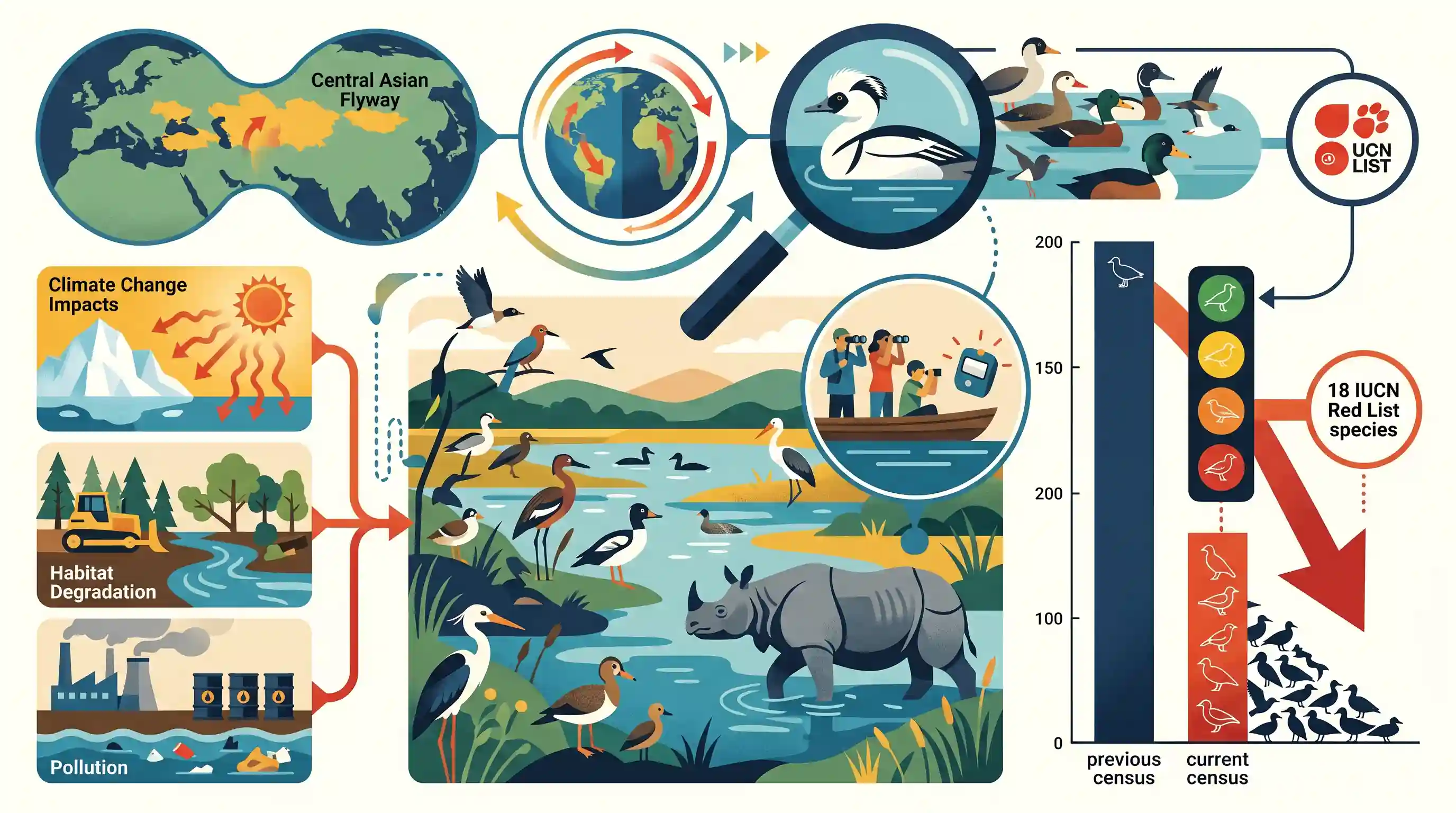
The spotting of a rare Eurasian diving duck, or Smew, during the seventh waterbird census at Kaziranga National Park has sparked concerns about climate-induced shifts in migratory bird patterns. The census recorded over 105,000 birds from 107 species across wetlands in Kaziranga, Laokhowa, and Burhachapori sanctuaries, including 18 IUCN Red List species. The overall decline in bird numbers compared to previous counts underscores the growing threats migratory species face, such as climate change, habitat degradation, and pollution, particularly along the Central Asian Flyway.
Key Points
- The sighting of the rare Eurasian diving duck (Smew) in Kaziranga highlights climate-driven shifts in the range of migratory birds.
- The 7th waterbird census at Kaziranga recorded 105,540 birds across 107 species, a decline from previous years, signaling potential environmental stress.
- The census covered wetlands (beels) across Kaziranga, Laokhowa, and Burhachapori, emphasizing the critical role of these habitats within the Central Asian Flyway.
- Eighteen species listed on the IUCN Red List of Threatened Species were observed, underscoring the area's importance for global biodiversity conservation.
- Migratory birds face mounting threats along their routes, including climate change, habitat loss, and oil pollution, necessitating better protection of their refuelling stops.
Important Terms
Central Asian Flyway (CAF)

A major migratory route covering 30 countries between the Arctic and Indian Oceans. It supports 270+ waterbird populations, including many globally threatened species that winter in the Indian subcontinent.
UPSC context
GS III: Biodiversity & Environment. Crucial for understanding migratory patterns and the Convention on Migratory Species (CMS).
Asian Waterbird Census (AWC)
An annual citizen-science program, part of the International Waterbird Census (IWC), coordinated in India by BNHS and Wetlands International to monitor waterbird populations and wetland health.
UPSC context
GS III: Conservation. Essential for evaluating wetland health and biodiversity trends across Indian protected areas.
IUCN Red List
Established in 1964, it is the world's most comprehensive inventory of the global conservation status of biological species, categorizing them by extinction risk.
UPSC context
GS III: Environmental Degradation. Key for Prelims questions on the status of Indian fauna and flora.
Bombay Natural History Society (BNHS)
Founded in 1883, it is India’s premier non-governmental organization for wildlife research. It acts as the national partner for BirdLife International and co-coordinates waterbird censuses.
UPSC context
GS III: Biodiversity. Knowledge of major institutional frameworks and NGO contributions to Indian conservation.
Smew (Mergellus albellus)
A small black-and-white diving duck (Mergellus albellus) that breeds in the Eurasian taiga. As a rare winter visitor, its shifting presence indicates climate-driven migration changes.
UPSC context
Prelims: Species in News. Tests identification of migratory behavior and avian habitat requirements in Indian wetlands.
Laokhowa and Burhachapori Wildlife Sanctuaries
Twin protected areas in Assam serving as a vital ecological buffer and wildlife corridor connecting Kaziranga National Park with Orang National Park.
UPSC context
Prelims: Geography/Protected Areas. Important for location-based questions and understanding landscape-level conservation in Northeast India.
Prelims Trap
The Asian Waterbird Census is a statutory survey conducted annually by the MoEFCC.
The Asian Waterbird Census is a citizen-science programme coordinated in India by the Bombay Natural History Society (BNHS) and Wetlands International, not a statutory government survey.
Static Concepts Connected
What is the Central Asian Flyway (CAF) and its conservation framework?
- Geographic Scope: Spans from the Arctic Ocean to the Indian Ocean, covering 30 countries and serving as a major global route for migratory waterbirds.
- India's Role: India is a core wintering destination and spearheads the institutional framework for CAF conservation under the UN Convention on Migratory Species (CMS).
- CMS Framework: The Bonn Convention (CMS) is the only global environmental treaty specializing in the conservation of migratory species, their habitats, and migration routes.
How are Kaziranga, Laokhowa, and Burhachapori ecologically connected?
- Brahmaputra Landscape: Kaziranga, Laokhowa, and Burhachapori are situated along the Brahmaputra floodplains, predominantly on its southern bank, hosting critical interconnected wetland ecosystems (beels).
- Corridor Function: Laokhowa and Burhachapori function as essential buffer zones and wildlife connectivity corridors linking the Kaziranga Tiger Reserve with Orang National Park.
Cross-Topic Patterns
Climate Change & Species Range Shifts
The Smew's unusual arrival demonstrates climate-induced 'range shifts', linking core geography (thermal regimes) with biodiversity. Species migrate to novel latitudes as their traditional wintering habitats alter.
Citizen Science in Global Conservation
The Asian Waterbird Census illustrates how citizen-science initiatives (led by BNHS) supply critical raw data for international frameworks, directly shaping both IUCN Red List assessments and UN CMS policies.

Expect a multi-statement question in 2026 linking the Central Asian Flyway, BNHS's role in the waterbird census, and Assam's corridors.
Linked PYQs · 4
Linked PYQs · 4
- 2022PrelimsGS1
"If rainforests and tropical forests are the lungs of the Earth, then surely wetlands function as its kidneys." Which one of the following functions of wetlands best reflects the above statement?
- 2023MainsGS3
Comment on the National Wetland Conservation Programme initiated by the Government of India and name a few India's wetlands of international importance included in the Ramsar Sites.
- 2017MainsGS3
'Climate change' is a global problem. How India will be affected by climate change? How Himalayan and coastal states of India will be affected by climate change?
- 2020PrelimsGS1
Which one of the following protected areas is well-known for the conservation of a sub-species of the Indian swamp deer (Barasingha) that thrives well on hard ground and is exclusively graminivorous?
