European Union Technological Sovereignty and Digital Autonomy
Source:The Hindu ↗
Why It Matters
Highlights the global shift towards 'technological sovereignty' and digital protectionism. For UPSC aspirants, this illustrates the geopolitical weaponization of technology and supply chains, directly relevant to India's own initiatives like the Digital Personal Data Protection Act, the India Semiconductor Mission, and data localization debates.
Summary
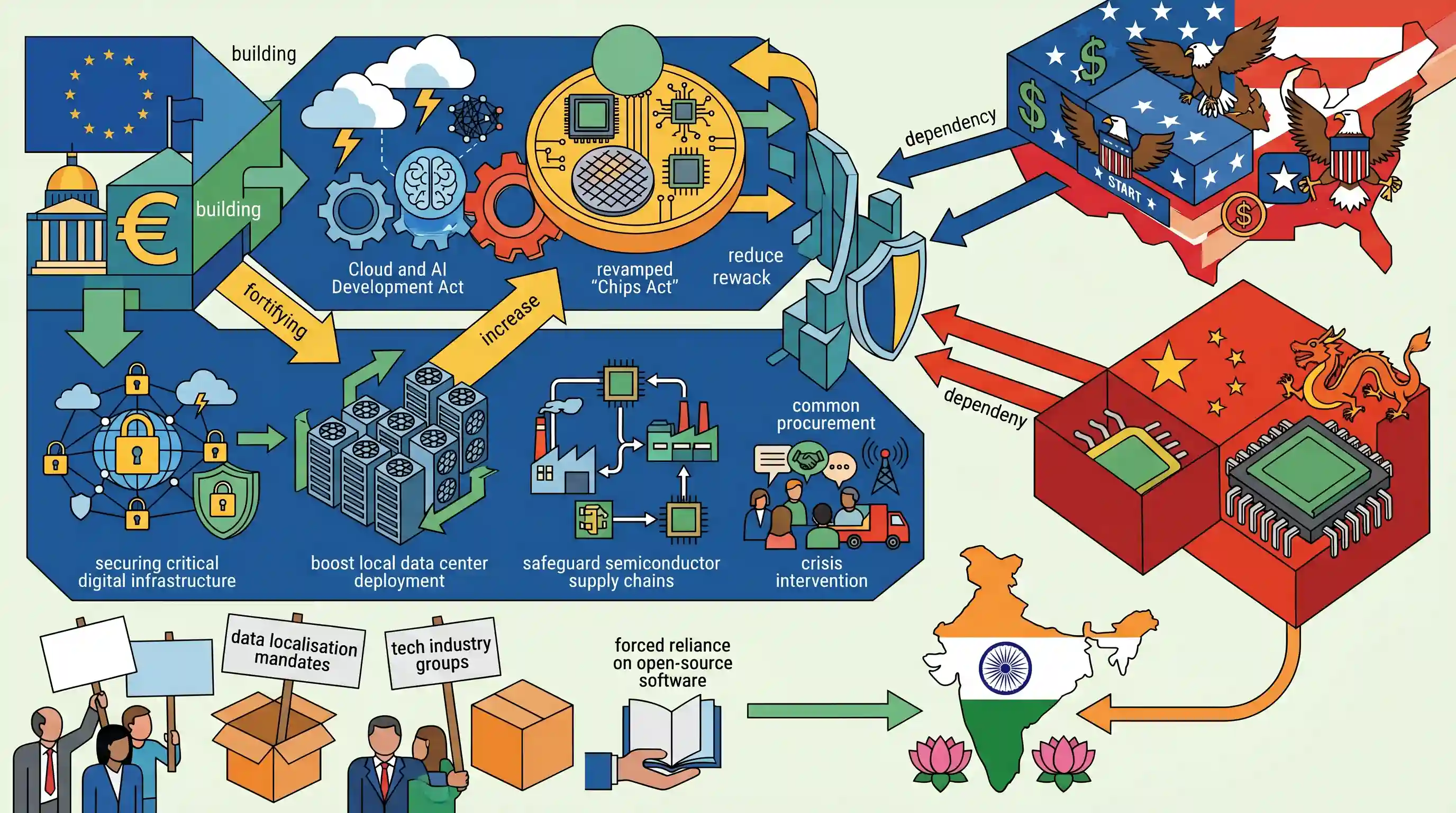
The European Union is advancing a "technological sovereignty" strategy to decrease its structural dependence on U.S. digital technology and Chinese semiconductors. Highlighting vulnerabilities exposed by shifting transatlantic dynamics and U.S. 'America First' policies, the EU plans to introduce a 'Cloud and AI Development Act' and a revamped 'Chips Act'. These measures aim to secure critical digital infrastructure, boost local data center deployment, and safeguard semiconductor supply chains through common procurement and crisis intervention. However, the proposals have sparked concerns from tech industry groups over potential data localisation mandates and forced reliance on open-source software.
Key Points
- The European Union is preparing a technological sovereignty package to reduce its reliance on U.S. cloud/digital services and Chinese semiconductors.
- A proposed Cloud and AI Development Act aims to accelerate data center deployment and promote EU self-sufficiency in digital infrastructure.
- A new Chips Act will ensure the security of semiconductor supply chains, allowing for crisis intervention and centralized procurement.
- The push for tech autonomy is driven by fears of a U.S. 'kill switch' under an 'America First' policy, which could abruptly cut off Europe's access to vital digital platforms.
- The tech industry, including representatives of major U.S. companies, has raised concerns over potential data localisation requirements and mandates favoring open-source software over commercial solutions.
Important Terms
technological sovereignty

The capacity of a state or region to develop, control, and govern critical technologies (hardware and software) independently to ensure strategic autonomy and national security.
UPSC context
GS Paper 2 & 3: Strategic autonomy; India's indigenous technology development and self-reliance (Atmanirbharta).
EU Chips Act
A major EU regulation aimed at doubling the bloc's global semiconductor market share to 20% by 2030 through massive investment and supply chain resilience measures.
UPSC context
GS Paper 3: S&T and Economy; relevant to India Semiconductor Mission and global manufacturing shifts.
Cloud and AI Development Act
A proposed EU legislative framework designed to boost local data center capacity and reduce structural dependence on non-EU cloud providers for critical infrastructure and AI.
UPSC context
GS Paper 2: Effect of policies of developed countries on India's interests; global tech regulation trends.
digital sovereignty
A state's authority to govern its digital infrastructure, data flows, and online services according to domestic laws, protecting national security and citizen privacy.
UPSC context
GS Paper 3: Cyber security; critical for debates on data localization and the DPDP Act 2023.
semiconductor supply chain
The global network of design and production for microchips, currently a focal point of geostrategic competition due to high manufacturing concentration in East Asia.
UPSC context
GS Paper 3: Global Value Chains (GVCs); crucial for industrial growth and national security.
Prelims Trap
"The EU's 'technological sovereignty' policy completely bans non-EU cloud service providers from operating within European borders."
The policies target structural dependence and promote local deployment, but do not outright ban foreign firms. Complete bans would violate WTO digital trade norms and disrupt existing infrastructure.
Static Concepts Connected
What is Data Localisation and what are its key policy rationales?
- Definition: Storing and processing digital data within the physical borders of the country where it was originally generated.
- Sovereignty & Security: Ensures national laws apply to citizen data, shielding it from foreign surveillance and extraterritorial legal overreach (e.g., US CLOUD Act).
- Economic Advantage: Promotes the domestic growth of digital infrastructure like data centers, cloud computing hubs, and local AI capabilities.
What differentiates Open Source Software (OSS) from commercial Proprietary Software?
- Code Accessibility: OSS makes source code publicly accessible for inspection and modification, whereas proprietary software keeps it restricted and legally protected.
- Avoiding Vendor Lock-in: OSS prevents structural dependence on a single tech corporation, preventing monopolies and achieving true technological autonomy.
- Security Model: OSS relies on decentralized community vetting for security, unlike proprietary models governed solely by internal corporate patching.
Cross-Topic Patterns
EU Tech Sovereignty vs. India's DPDP Act
The EU's push for strict data localisation mirrors India's early drafts, though India's 2023 DPDP Act eventually relaxed this in favor of a negative-list approach for cross-border data transfers.
Global Semiconductor Nationalism
The EU Chips Act joins the US CHIPS Act and India Semiconductor Mission (ISM) in treating silicon manufacturing as a geopolitical security imperative rather than a pure free-market enterprise.

Expect a GS2 Mains question comparing how India (via DPDP/ISM) and the EU navigate 'Digital Sovereignty' amid US-China tech dominance.
Linked PYQs · 4
Linked PYQs · 4
- 2015MainsGS3
Discuss the advantages and security implications of cloud hosting of servers vis-a-vis in-house machine-based hosting for government businesses.
- 2025MainsGS3
India aims to become a semiconductor manufacturing hub. What are the challenges faced by the semiconductor industry in India? Mention the salient features of the India Semiconductor Mission.
- 2023MainsGS2
‘The expansion and strengthening of NATO and a stronger US-Europe strategic partnership works well for India.’ What is your opinion about this statement ? Give reasons and examples to support your answer.
- 2024MainsGS3
Describe the context and salient features of the Digital Personal Data Protection Act, 2023.
