Bilateral Trade Negotiations Between India and European Union
Source:Indian Express ↗
Why It Matters
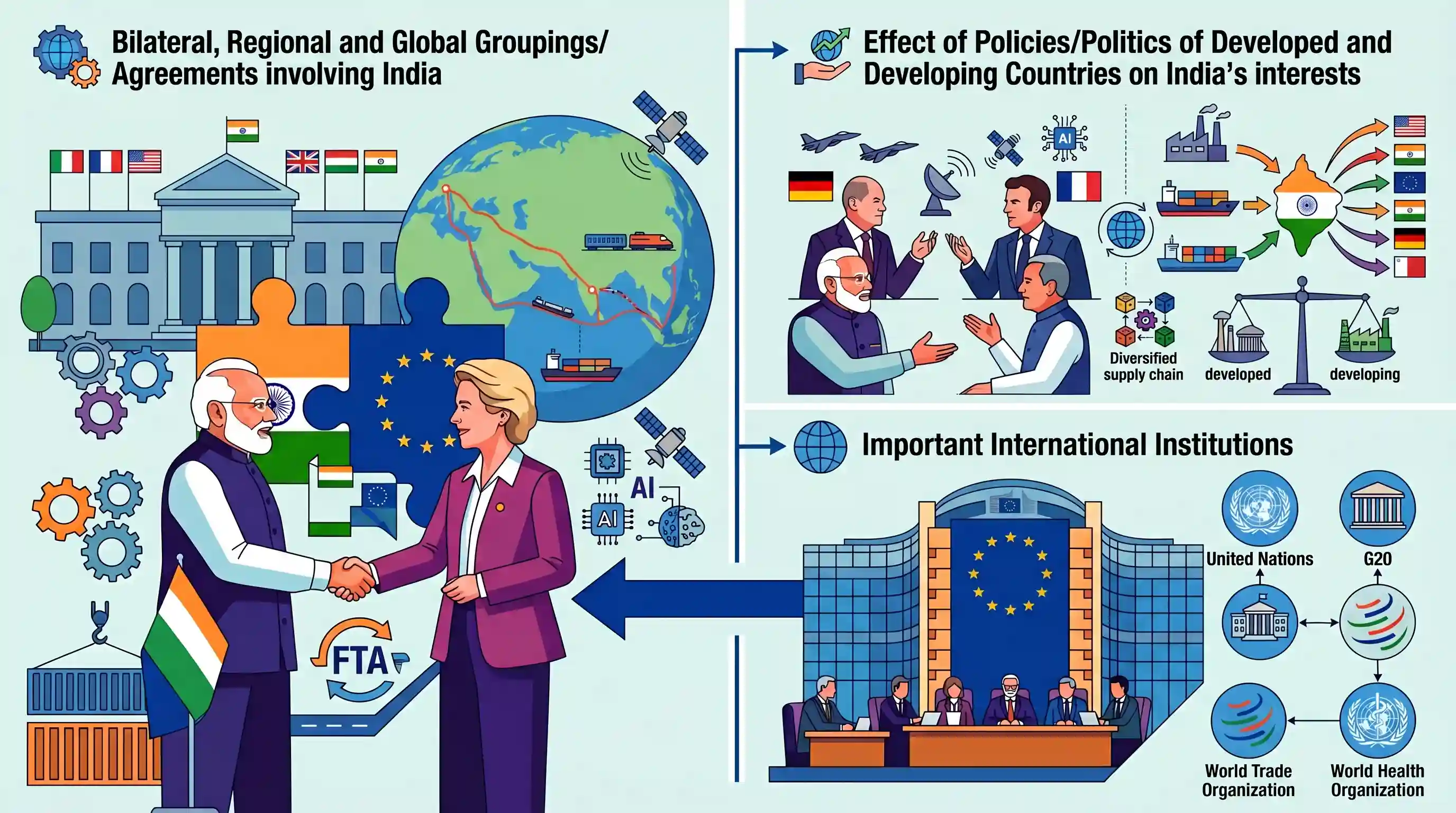
The anticipated India-EU FTA is critical for Indian exports and global supply chain integration. In tandem with projects like IMEC, it reflects India's proactive multi-alignment strategy to strengthen economic and strategic ties with major European economies and the broader Global North.
Summary
At the G7 Summit in Apulia, Italy, European Commission President Ursula von der Leyen announced that the EU aims to sign a comprehensive Free Trade Agreement (FTA) with India by the end of 2026. The bilateral meeting with Prime Minister Narendra Modi also covered advancements in the India-Middle East-Europe Economic Corridor (IMEC), highlighting a shared focus on connectivity, strategic partnerships, and diversified supply chains. Additionally, PM Modi held productive bilateral talks with German Chancellor Olaf Scholz and French President Emmanuel Macron regarding cooperation in technology, energy, and defense.
Key Points
- The European Union plans to conclude its Free Trade Agreement (FTA) negotiations with India by the end of 2026.
- The timeline was shared by European Commission President Ursula von der Leyen during a bilateral meeting with PM Narendra Modi at the G7 Summit in Italy.
- Both leaders reviewed progress on the India-Middle East-Europe Economic Corridor (IMEC), emphasizing connectivity and strategic economic ties.
- PM Modi engaged in bilateral dialogues with the leaders of Germany and France to bolster cooperation in defense, artificial intelligence, and energy.
Important Terms
India-EU Free Trade Agreement (FTA)

A comprehensive economic pact to reduce tariffs and trade barriers between India and the EU, enhancing market access for goods, services, and investments.
UPSC context
GS Paper 2 (IR); tests trade diplomacy and economic integration with India's largest regional partners.
India-Middle East-Europe Economic Corridor (IMEC)
A multimodal connectivity project linking India to Europe via the Middle East through ship-to-rail transit, pipelines, and data cables.
UPSC context
GS Paper 2 & 3 (IR/Infrastructure); vital for strategic connectivity and counter-balancing regional initiatives.
Group of Seven (G7)
An informal forum of seven advanced economies (US, UK, France, Germany, Italy, Canada, Japan) coordinating global policy on security and finance.
UPSC context
GS Paper 2 (Global Groupings); relevant for India’s engagement with influential Western blocs.
European Union (EU)
A political and economic union of 27 European member states operating an internal market; a major trading and technology partner for India.
UPSC context
GS Paper 2 (Bilateral/Regional Groupings); important for studying India’s engagement with major economic blocs.
Supply Chain Diversification
A strategy to reduce economic vulnerability by decreasing reliance on a single source for critical goods, ensuring resilience through multiple partners.
UPSC context
GS Paper 3 (Economy); crucial for India’s Aatmanirbhar Bharat goals and maintaining economic stability.
Prelims Trap
"The Broad-based Trade and Investment Agreement (BTIA) is currently being negotiated between India and the United Kingdom."
The BTIA is specifically the framework for the India-European Union (EU) FTA, initiated in 2007. The UK negotiations fall under a separate, post-Brexit bilateral FTA track.
Static Concepts Connected
What are the core pillars and hurdles of the India-EU BTIA?
- Origin & Scope: Launched in 2007, it aims to create a comprehensive trade pact covering goods, services, investment protection, and geographical indications.
- EU demands: The EU seeks significant tariff reductions on automobiles, wines, spirits, and dairy products, alongside stricter intellectual property rights.
- Indian demands: India demands easier mobility for its IT and service professionals (Mode 4 services) and recognition as a data-secure nation to boost tech exports.
What is the structure and geopolitical significance of IMEC?
- Key Participants: Includes India, UAE, Saudi Arabia, EU, France, Italy, Germany, and the US, launched on the sidelines of the G20.
- Multimodal network: Comprises an Eastern Corridor (sea route from India to Gulf) and a Northern Corridor (rail route from Gulf to Europe).
- Strategic goal: Acts as a transparent, democratic alternative to China's Belt and Road Initiative (BRI) while stimulating Middle East economic integration.
Cross-Topic Patterns
India-EU FTA vs CBAM (Carbon Tax)
The EU's Carbon Border Adjustment Mechanism (CBAM) acts as a non-tariff barrier for Indian steel and aluminum, complicating BTIA negotiations and bridging environmental policy with international trade dynamics.
Multialignment at the G7 Summit
India’s presence as a G7 "Outreach Country" allows it to leverage Western capital for projects like IMEC, while simultaneously maintaining its independent "Global South" leadership and strategic autonomy.

Expect a 2026 prelims multi-statement question linking the India-EU BTIA negotiations, CBAM (carbon tax), and IMEC connectivity nodes.
Linked PYQs · 2
Linked PYQs · 2
- 2017PrelimsGS1
'Broad-based Trade and Investment Agreement (BTIA)' is sometimes seen in the news in the context of negotiations held between India and
- 2022MainsGS2
How will I2U2 (India, Israel, UAE and USA) grouping transform India's position in global politics?
