European Union announces post conflict recovery package for Syria
Source:The Hindu ↗
Why It Matters
The geopolitical shift in Syria and its stabilization post-Assad has profound implications for Middle Eastern stability, international relations, refugee crisis management, and the EU's strategic engagement in the region.
Summary
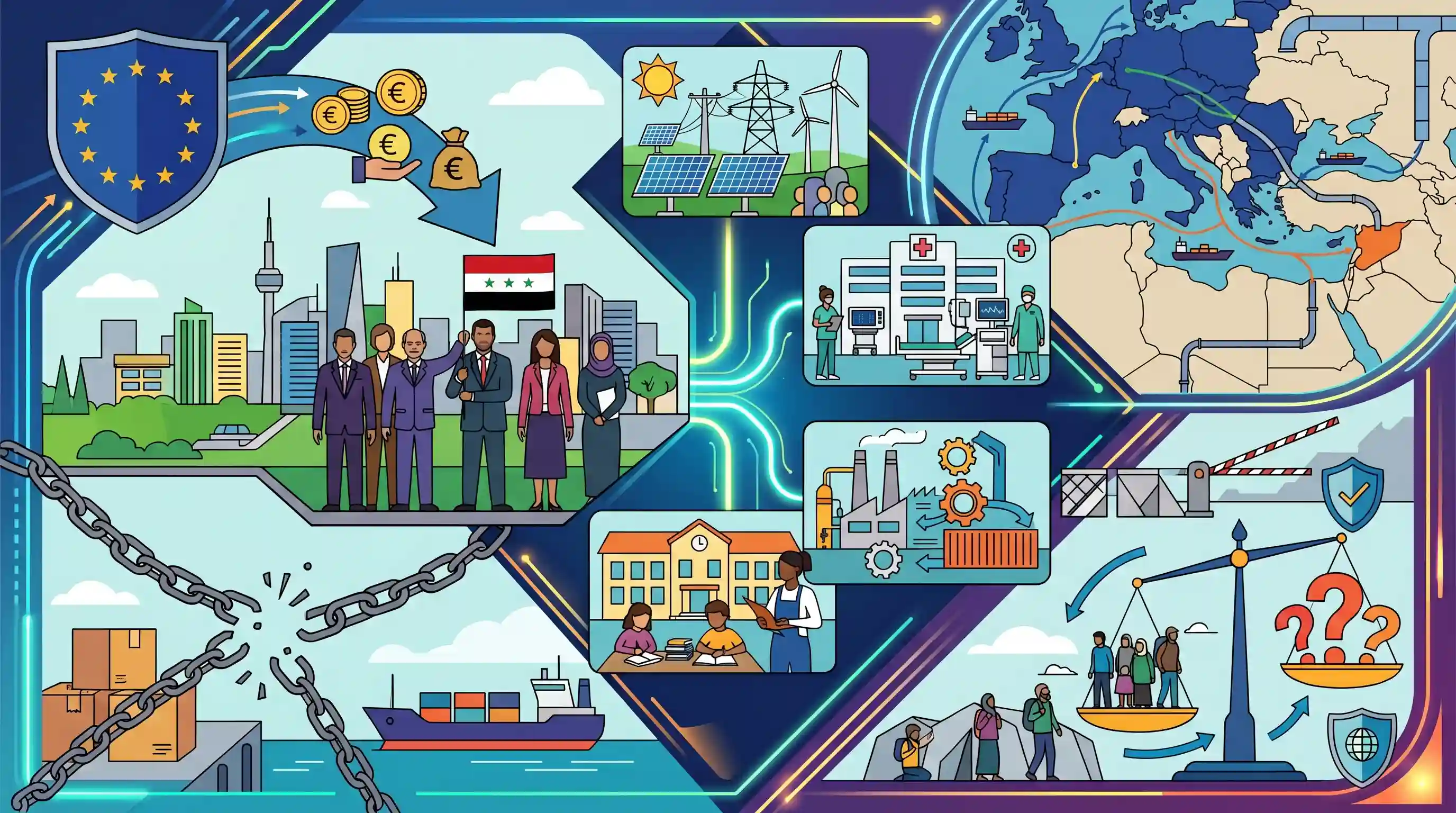
The European Union has announced a €175 million recovery package for Syria to support post-conflict reconstruction following the ousting of Bashar al-Assad and the formation of a transitional government. Announced by EU Commissioner Dubravka Suica in Damascus, the package focuses on key sectors like energy, health, education, and the economy, reinforcing a "Syria-owned and Syria-led" recovery. The EU has lifted economic sanctions to facilitate this process. Additionally, the EU aims to integrate Syria into regional Mediterranean initiatives and stresses that refugee returns must be safe, voluntary, and dignified, acknowledging that Syria is not yet officially designated a safe country for returns by the bloc.
Key Points
- The EU announced a €175 million recovery package for Syria to aid post-conflict reconstruction in sectors like energy, education, health, and human rights.
- EU Commissioner Dubravka Suica visited Damascus, making it the first high-level EU visit since a transitional government was established in March after Bashar al-Assad's ouster.
- The EU has lifted economic sanctions on Syria and is emphasizing a "Syria-owned and Syria-led" approach to its recovery.
- Ensuring safe, voluntary, and dignified returns for refugees is a priority, although Syria is not yet unanimously designated a safe country by all 27 EU member states.
- The EU is seeking to reintegrate Syria into regional initiatives, inviting the Syrian Foreign Minister to a ministerial meeting with Mediterranean partner countries in Brussels.
Important Terms
European Union (EU)

A supranational political and economic union of 27 member states. It functions as a single market and a major global actor in international diplomacy and humanitarian aid.
UPSC context
GS Paper II: Bilateral, regional, and global groupings and agreements involving India and/or affecting India’s interests.
European Commission
The executive branch of the European Union. It proposes legislation, implements decisions, upholds EU treaties, and manages the day-to-day business and funding distribution of the bloc.
UPSC context
GS Paper II: Important International institutions, agencies and fora—their structure, mandate.
West Asia Geopolitics
The strategic interplay between nations in the Middle East. It is a critical region for India due to energy security, trade routes, and a massive Indian diaspora.
UPSC context
GS Paper II: Effect of policies and politics of developed and developing countries on India’s interests.
Post-Conflict Reconstruction
The multi-faceted process of rebuilding infrastructure, political institutions, and the socio-economic fabric of a nation after conflict to ensure sustainable peace and stability.
UPSC context
GS Paper II: International relations; role of global aid in regional stability.
Safe, Voluntary, and Dignified Return
A core international law principle ensuring refugees return to their home country only by choice (voluntary), to secure conditions (safe), and with their human rights respected (dignified).
UPSC context
GS Paper II: International law, human rights, and the global refugee crisis.
Economic Sanctions
Commercial and financial penalties applied by countries or international organizations against states or entities to influence their behavior or enforce international legal standards.
UPSC context
GS Paper II: International relations; use of economic tools in global diplomacy.
Prelims Trap
The EU's recovery package mandates the immediate and involuntary repatriation of Syrian refugees from Europe.
The EU explicitly states that refugee returns must remain voluntary and dignified, as Syria is not yet officially designated a "safe country" by the bloc.
Static Concepts Connected
What is the legal framework governing refugees in India?
- Not a Signatory: India is not a party to the 1951 UN Refugee Convention or its 1967 Protocol, meaning it has no formal international obligation under these treaties.
- Foreigners Act, 1946: Refugees are legally categorized as 'foreigners'. Their entry, stay, and exit are governed by the Foreigners Act of 1946 and the Passport Act of 1920.
- Constitutional Protection: Article 21 (Right to Life) applies to non-citizens, offering implicit protection against non-refoulement, though the Executive retains broad powers regarding deportation.
What is the Union for the Mediterranean (UfM)?
- Origin: Established in 2008 as an intergovernmental organization, it was created to revitalize and build upon the Euro-Mediterranean Partnership (the Barcelona Process).
- Membership: It comprises 43 member states, including all 27 EU member states and 16 Mediterranean partner countries from North Africa, West Asia, and Southern Europe.
- Objective: It aims to promote stability, political dialogue, and regional economic integration across the Euro-Mediterranean region.
Cross-Topic Patterns
Refugee Convention vs. India's Domestic Law
The EU's emphasis on non-refoulement and safe returns contrasts with India's ad-hoc executive approach to refugees (e.g., Myanmar, Tibet), a frequent UPSC comparative polity theme.
Sanctions diplomacy and post-conflict transitions
Lifting EU sanctions to aid a 'Syria-led' recovery mirrors debates around unfreezing Afghan assets, highlighting how economic statecraft dictates post-war stabilization and humanitarian aid.

Syria's political transition and the 1951 Refugee Convention's non-refoulement principle are prime targets for a 2026 Prelims MCQ.
Linked PYQs · 2
Linked PYQs · 2
- 2025MainsGS2
"Energy security constitutes the dominant kingpin of India's foreign policy, and is linked with India's overarching influence in Middle Eastern countries.” How would you integrate energy security with India's foreign policy trajectories in the coming years?
- 2025MainsGS2
"With the waning of globalization, post-Cold War world is becoming a site of sovereign nationalism.” Elucidate.
