European Union Adopts Action Plan for Economic Competitiveness
Source:The Hindu ↗
Why It Matters
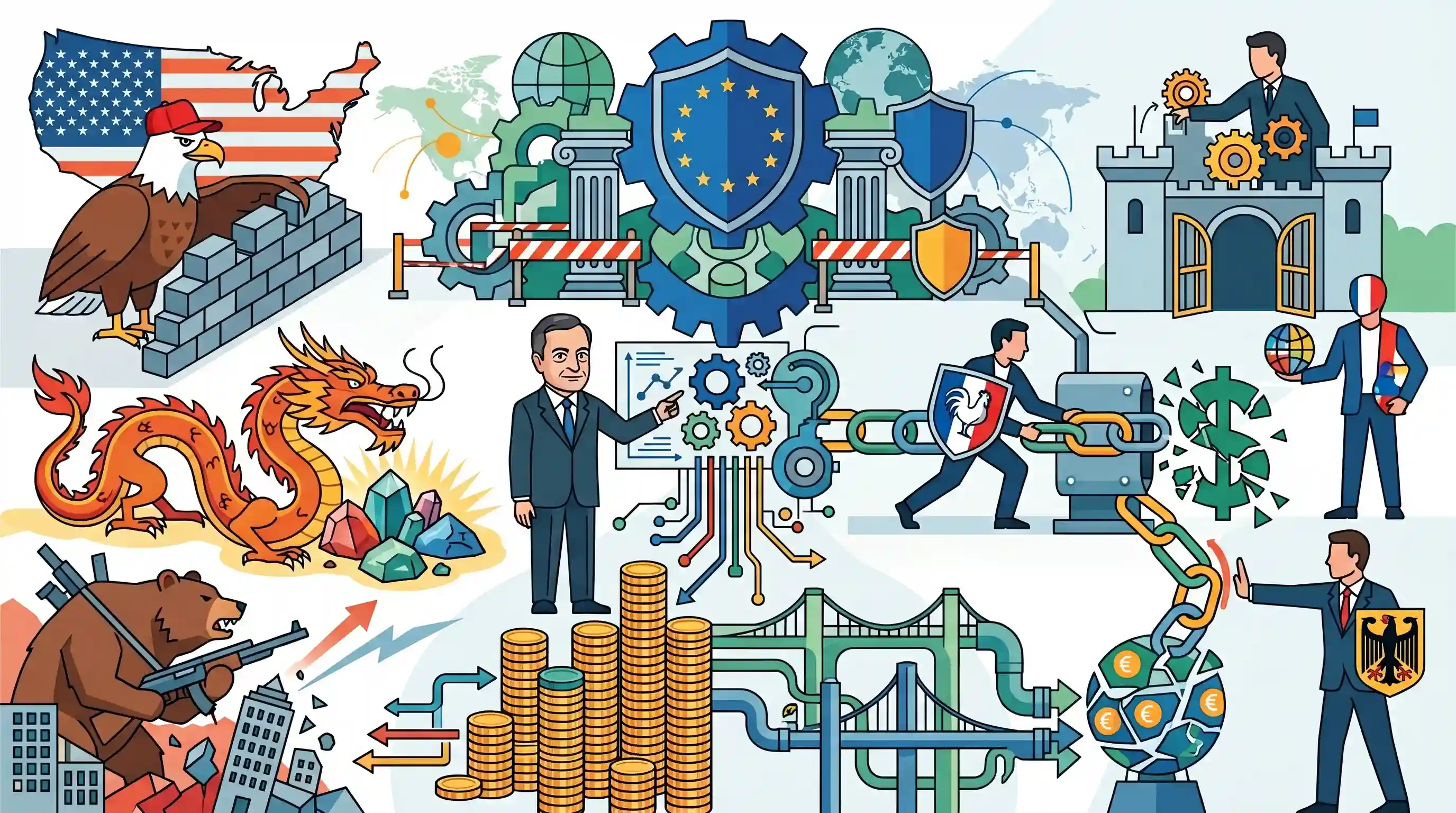
The structural shift of the European Union towards strategic autonomy, prompted by US and Chinese trade policies, is critical for understanding emerging global geo-economic frameworks, trade protectionism, and efforts to challenge the dominance of the US Dollar.
Summary
European Union leaders have agreed on a comprehensive action plan to enhance the bloc's economic competitiveness and achieve 'strategic autonomy' amid rising global protectionism. Driven by concerns over impending US tariffs under Donald Trump, China's grip on critical minerals, and Russian aggression, the plan draws heavily on Mario Draghi's recommendations for massive investments and deeper financial integration. While France is pushing for bold moves like Eurobonds and challenging the US dollar's dominance, ideological divides remain, with Germany and others resisting joint borrowing in favor of deregulation.
Key Points
- EU leaders have backed an action plan to structurally overhaul the bloc's economy to counter competitive and geopolitical pressures from the US, China, and Russia.
- The strategy relies on Mario Draghi's economic report, which calls for massive investments (€800 billion annually), deregulation, and creating 'European champions' to compete globally.
- French President Emmanuel Macron championed 'strategic autonomy,' advocating for joint EU borrowing (Eurobonds) and measures to challenge the hegemony of the US dollar.
- Internal divisions persist within the EU: France favors interventionism and joint debt, while Germany and northern states advocate primarily for deregulation and cutting red tape.
- China's restrictive export policies on critical minerals have further pushed the EU to focus on securing autonomous supply chains for its green and digital transitions.
Important Terms
Strategic Autonomy

The EU’s ability to act independently in security, economy, and technology without over-reliance on external powers, allowing the bloc to defend its interests in a multipolar world.
UPSC context
GS-2 (IR). Tests understanding of geopolitical positioning and sovereignty in global alliances.
Savings and Investment Union
A rebranded EU initiative (formerly Capital Markets Union) to integrate national financial markets, mobilizing private household savings to fund strategic investments like the green transition and defense.
UPSC context
GS-3 (Economy). Relevant for investment models and global financial market integration.
Eurobonds
Proposed government bonds issued jointly by eurozone countries involving shared debt liability. They aim to provide low-interest funding for collective projects and reduce financial fragmentation.
UPSC context
GS-3 (Economy). Tests knowledge of fiscal integration and international debt management.
De-dollarization
The global trend of reducing reliance on the US dollar in trade, reserves, and settlements to gain monetary independence and mitigate risks from US sanctions.
UPSC context
GS-2 (IR) & GS-3 (Economy). Vital for understanding shifts in the global financial order.
Critical Minerals
Minerals (like lithium and cobalt) essential for high-tech and green sectors that are vulnerable to supply disruptions due to concentrated geographic processing and extraction.
UPSC context
GS-1 (Geography) & GS-3 (Resource Security). Crucial for supply chain resilience topics.
European Commission
The executive arm of the EU, responsible for proposing legislation, managing the budget, and representing the bloc in international negotiations and trade.
UPSC context
GS-2 (IR). Tests understanding of the institutional framework of major regional organizations.
European Union
A supranational economic and political union of 27 member states that operate as a single market with coordinated policies on trade and security.
UPSC context
GS-2 (IR). Fundamental for understanding regionalism and its impact on global governance.
Prelims Trap
"Strategic Autonomy is exclusively an Indian foreign policy doctrine."
While famously associated with India's foreign policy post-Cold War, 'Strategic Autonomy' is now the central geopolitical framework of the European Union to reduce reliance on the US and China.
Static Concepts Connected
What is the difference between a traditional Eurobond and the proposed EU Eurobonds?
- Traditional Eurobond: A debt instrument denominated in a currency other than the home currency of the market in which it is issued (e.g., a US dollar bond issued in Japan).
- Indian Example: Masala bonds (Rupee-denominated bonds issued outside India) operate on the same principle as traditional Eurobonds.
- EU Political Eurobond: A proposed joint borrowing mechanism where EU member states issue pooled, mutually guaranteed sovereign debt to fund bloc-wide investments, heavily debated between France and Germany.
Why is China's grip on Critical Minerals a major geopolitical flashpoint?
- Upstream Monopoly: China controls roughly 60% of global rare earth mining and up to 90% of refining capacity, dominating the upstream supply chain.
- Downstream Vulnerability: Western green energy (EV batteries) and digital transitions (semiconductors) rely almost entirely on Chinese processed lithium, cobalt, and rare earth elements.
- Geopolitical Weaponization: China increasingly uses export licensing controls (e.g., on gallium, germanium, and antimony) to retaliate against Western tech and trade restrictions.
Cross-Topic Patterns
Strategic Autonomy: EU & India
Both the EU and India deploy 'strategic autonomy' to navigate US-China bipolarity, opening avenues for deeper EU-India technological, trade, and defense cooperation outside of American influence.
De-dollarization within the West
Typically championed by BRICS nations to bypass US sanctions, de-dollarization is now being debated within the core of the Western alliance (by France) to achieve European financial sovereignty.
Critical Minerals + State Subsidies
China's export restrictions on critical minerals parallel US tariffs, forcing the EU into massive state subsidies (€800B annually) and overturning decades of free-market deregulation.

Expect a 2026 Prelims question mapping 'Eurobonds' and 'Strategic Autonomy' to the EU, testing the assumption that they only relate to India/BRICS.
Linked PYQs · 5
Linked PYQs · 5
- 2025MainsGS2
"With the waning of globalization, post-Cold War world is becoming a site of sovereign nationalism.” Elucidate.
- 2025MainsGS3
What are the challenges before the Indian economy when the world is moving away from free trade and multilateralism to protectionism and bilateralism? How can these challenges be met?
- 2018MainsGS3
How would the recent phenomena of protectionism and currency manipulations in world trade affect macroeconomic stability of India?
- 2025PrelimsGS1
Consider the following statements : I. India has joined the Minerals Security Partnership as a member. II. India is a resource-rich country in all the 30 critical minerals that it has identified. III. The Parliament in 2023 has amended the Mines and Minerals (Development and Regulation) Act, 1957 empowering the Central Government to exclusively auction mining lease and composite license for certain critical minerals. Which of the statements given above are correct?
- 2015PrelimsGS1
The problem of international liquidity is related to the non-availability of
