European Union Leaders Debate Strategic Autonomy and Trade Policy
Source:The Hindu ↗
Why It Matters
The European Union's pivot towards potential protectionism ('European preference') or internal deregulation directly affects global supply chains and trade negotiations (like FTAs with India). Moreover, serious discussions about Eurobonds to challenge the US dollar's hegemony offer critical context for India's own internationalization of the Rupee and broader multipolar economic strategies.
Summary
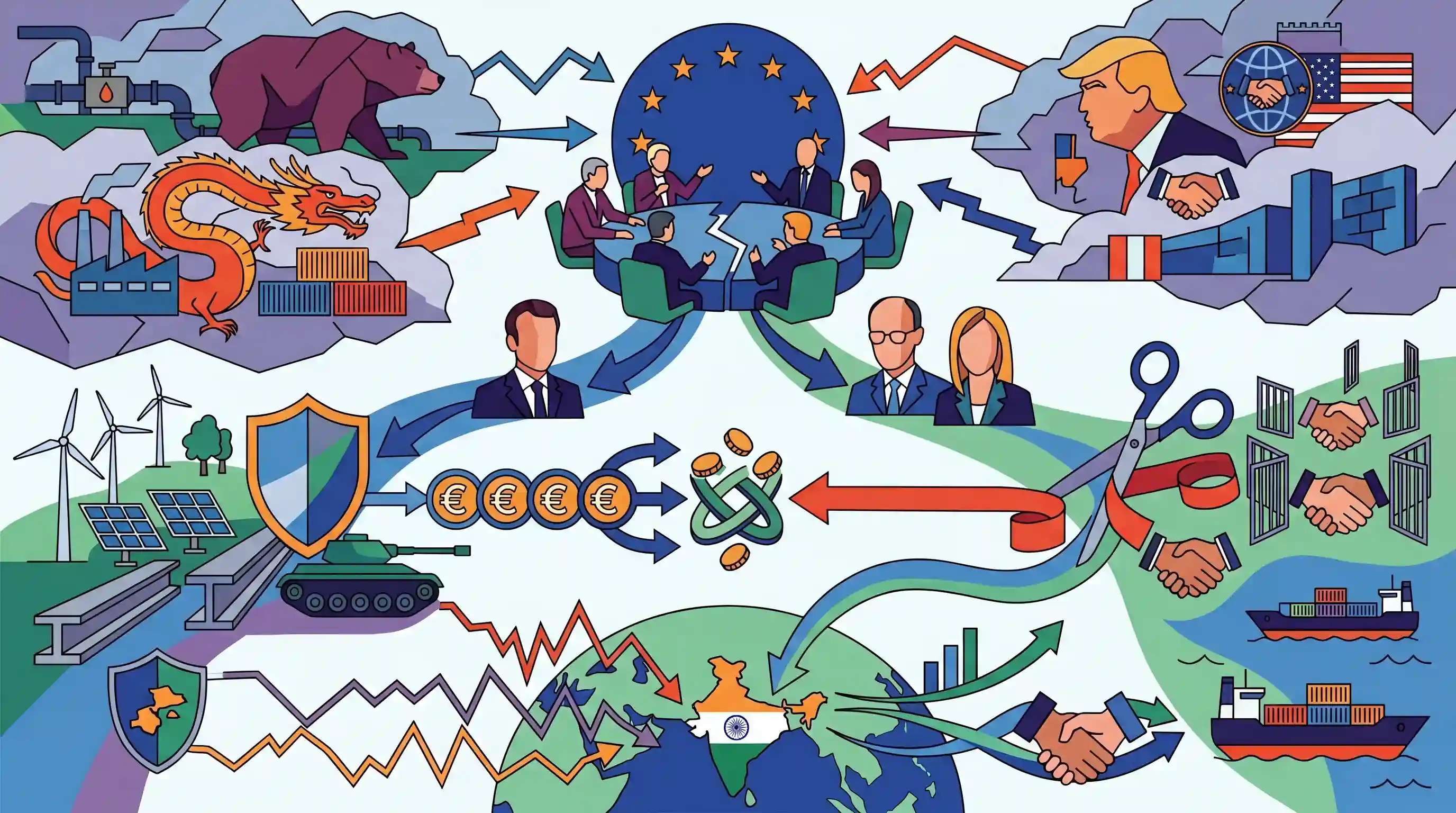
European Union leaders recently convened to discuss a unified strategy against mounting geopolitical and economic pressures from Russia, China, and Donald Trump. The summit exposed internal divisions on how to achieve economic security. French President Emmanuel Macron pushed for a 'European preference' industrial policy, urging protectionist measures for the EU's defense, clean tech, and steel sectors to counter unfair competition and subsidies from the US and China. He also proposed the issuance of 'Eurobonds' to fund large-scale investments and challenge the hegemony of the US dollar. In contrast, leaders like Germany's Friedrich Merz and Italy's Giorgia Meloni argued for economic deregulation, cutting red tape, and expanding the single market over adopting state-funded protectionism.
Key Points
- European Union leaders are strategizing to counter geopolitical and economic pressure from Russia, China, and the US (under Donald Trump).
- French President Macron advocated for 'European preference' and protectionist policies to shield domestic industries (clean tech, defense, steel) from heavily subsidized US and Chinese competition.
- Internal EU divisions persist, with Germany and Italy favoring deregulation, reducing red tape, and strengthening the EU single market rather than adopting protectionist trade barriers.
- Macron proposed issuing joint European debt ('Eurobonds for the future') to finance major investments and challenge the global hegemony of the US dollar.
- European Commission President Ursula von der Leyen emphasized that global political influence fundamentally relies on economic strength and global trade integration.
Important Terms
European Union (EU)

A supranational political and economic union of 27 European member states functioning through shared institutions and laws to promote peace, economic integration, and common values.
UPSC context
GS Paper II: International groupings and their impact on India’s strategic and economic interests.
Single Market
The EU’s internal market ensuring the 'four freedoms': free movement of goods, services, capital, and people, achieved by removing trade barriers and harmonizing regulations.
UPSC context
GS Paper III: Regional economic integration and its influence on global trade dynamics.
Protectionism
An economic policy that restricts international trade through tariffs, quotas, or subsidies to shield domestic industries and workers from foreign competition.
UPSC context
GS Paper III: Effects of developed countries' trade policies on India's export-oriented growth.
Eurobonds
Proposed joint sovereign debt instruments issued by eurozone states to pool debt, lower borrowing costs, and create a unified asset to rival the US dollar.
UPSC context
GS Paper III: Global financial architecture, sovereign debt management, and macroeconomic stability.
De-dollarization
The process of reducing reliance on the US dollar as the primary global reserve currency and medium of exchange to mitigate exposure to US-led sanctions and policy.
UPSC context
GS Paper III: Shifts in the international monetary system and the internationalization of the Rupee.
European Commission
The executive arm of the European Union responsible for proposing legislation, enforcing EU laws, implementing decisions, and managing the union's daily administration.
UPSC context
GS Paper II: Institutional framework and functioning of major international organizations.
Prelims Trap
"Eurobonds are sovereign debt instruments issued exclusively by the European Union."
A Eurobond is any bond issued in a currency not native to the country of issue. It is a market term, not exclusively an EU government instrument.
Static Concepts Connected
What distinguishes a Eurobond from a Foreign Bond?
- Eurobond: Denominated in a currency different from the market it is issued in (e.g., an Indian Rupee bond sold in London/Masala bond).
- Foreign Bond: Issued by a foreign entity in the domestic currency of the market it is sold in (e.g., a Samurai bond in Japan).
What are the stages of regional economic integration?
- Free Trade Area: Elimination of tariffs between member countries, while members maintain independent external tariffs.
- Customs Union: Adds a common external tariff applied to all non-member countries.
- Single Market: Adds the free movement of capital, labor, and services across member borders (e.g., the EU Single Market).
Cross-Topic Patterns
EU Protectionism & CBAM
'European preference' in steel aligns with the EU's Carbon Border Adjustment Mechanism (CBAM), directly threatening the competitiveness of India's metal exports.
Multi-polar De-dollarization
France's call for Eurobonds to challenge the US dollar's hegemony mirrors efforts by BRICS nations aiming to build parallel non-dollar financial architectures.

Expect a Mains GS3 question on how subsidy races in the US (IRA) and EU (European Preference) disrupt WTO norms and Indian exports.
Linked PYQs · 4
Linked PYQs · 4
- 2018MainsGS3
How would the recent phenomena of protectionism and currency manipulations in world trade affect macroeconomic stability of India?
- 2023PrelimsGS1
With reference to Central Bank digital currencies, consider the following statements: 1. It is possible to make payments in a digital currency without using US dollar or SWIFT system. 2. A digital currency can be distributed with a condition programmed into it such as a time-frame for spending it. Which of the statements given above is/are correct?
- 2015PrelimsGS1
The problem of international liquidity is related to the non-availability of
- 2017PrelimsGS1
The term 'Digital Single Market Strategy' seen in the news refers to
