EU leaders address economic security and geopolitical pressures
Source:The Hindu ↗
Why It Matters
Provides an excellent case study on the geopolitical shift from globalization to protectionism and economic nationalism. Crucial for GS-2 (IR - effect of policies and politics of developed countries) and GS-3 (Economy - changes in industrial policy and their effects on growth, global trade).
Summary
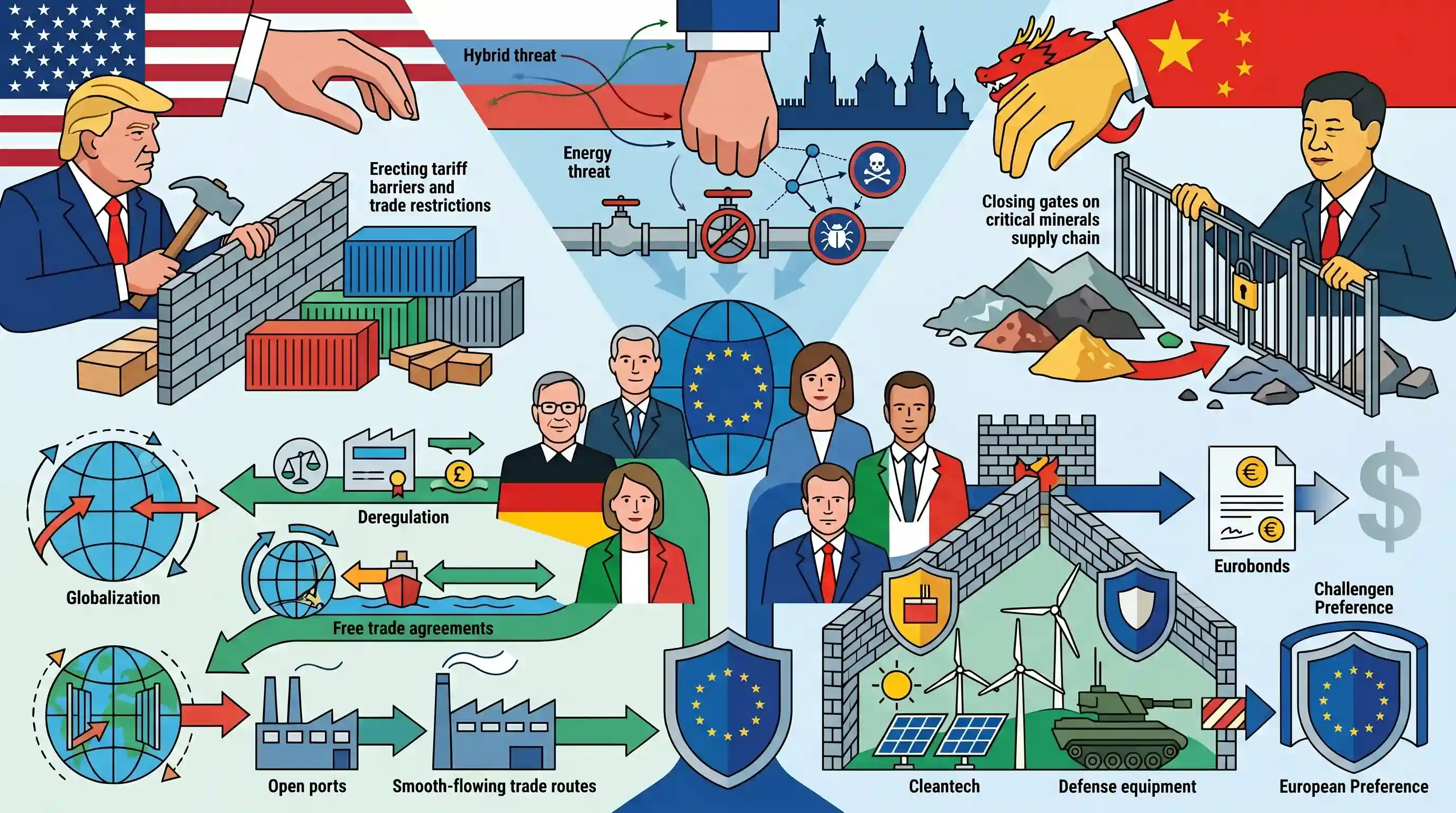
EU leaders are currently grappling with severe geoeconomic pressures from major global powers, prompting a fundamental reassessment of the bloc's approach to trade and diplomacy. Facing potential US tariffs under Donald Trump, China’s restrictions on critical minerals, and Russian hybrid threats, European nations are divided on the path forward. Germany and Italy favor deregulation and free trade deals, whereas France champions protectionism ("European preference") for strategic sectors like cleantech and defense, alongside proposals for Eurobonds to challenge US dollar dominance. This signals a pronounced shift towards economic security and strategic autonomy in the face of waning globalization and rising bilateralism.
Key Points
- European Union leaders are navigating immense geoeconomic pressure from the US (Trump's trade tariffs), China (restricting critical mineral exports), and Russia (hybrid threats).
- There is an ideological divide within the EU on responding to economic challenges: Germany and Italy advocate for deregulation and global trade deals, while France supports 'European preference' and protecting strategic sectors (defense, cleantech, steel).
- French President Emmanuel Macron has proposed issuing Eurobonds to challenge the hegemony of the US dollar and finance European defense and innovation initiatives.
- European Commission President Ursula von der Leyen emphasized that economic security is now foundational to global power, underscoring the shift away from traditional free trade principles.
Important Terms
Strategic Autonomy

The capacity of a state or bloc to pursue its national interests and foreign policy independently, without excessive reliance on other powers for security, economy, or technology.
UPSC context
GS Paper II: International Relations. Relevant for understanding India-EU relations and navigating a multipolar world order.
Eurobonds
Proposed joint debt instruments issued by the EU and backed by all member states, intended to pool sovereign risk and create a deep, liquid asset to challenge dollar dominance.
UPSC context
GS Paper II: Global Groupings. Tests knowledge of fiscal integration and shifts in the global financial architecture.
Critical Minerals
Minerals essential for high-tech and green energy industries (e.g., lithium, cobalt) that are highly vulnerable to supply chain disruptions due to geographical concentration or processing constraints.
UPSC context
GS Paper III: Economy/Environment. Vital for questions on energy transition, resource security, and supply chain resilience.
European Commission
The executive branch of the European Union responsible for proposing laws, implementing decisions, managing the budget, and representing the bloc in international trade negotiations.
UPSC context
GS Paper II: Important International Institutions. Tests understanding of the structural framework of major global economic blocs.
World Trade Organization (WTO)
The only global international organization dealing with the rules of trade between nations, providing a forum for trade negotiations and a mechanism for settling international disputes.
UPSC context
GS Paper II: International Institutions. Crucial for understanding global trade governance and the impact of protectionist trends.
Protectionism
Economic policy of shielding domestic industries from foreign competition by imposing tariffs, quotas, or subsidies, often used during trade wars or to ensure strategic autonomy.
UPSC context
GS Paper III: Indian Economy. Relevant for trade policy, globalization debates, and their impact on Indian exports.
Prelims Trap
"A Eurobond is inherently a sovereign bond issued by the European Union and denominated exclusively in Euros."
In global finance, a 'Eurobond' is simply a bond issued in a currency non-native to the market where it is issued. It has no mandatory geographical connection to Europe.
Static Concepts Connected
What does 'Strategic Autonomy' entail in contemporary International Relations?
- Core Definition: The ability of a state or bloc to pursue national interests and foreign policy decisions without external coercion.
- Economic Dimension: Reducing absolute import dependency on rival nations for critical sectors like defense, semiconductors, and green technology.
- Indian Context: India's shift from non-alignment to multi-alignment (e.g., buying Russian oil while deepening US defense ties) exemplifies this concept.
What drives the global push for 'De-dollarization'?
- Sanctions Shield: Protecting domestic economies from unilateral US financial sanctions and potential exclusion from the SWIFT messaging system.
- Currency Volatility: Insulating domestic inflation and preventing capital flight triggered by US Federal Reserve interest rate hikes.
- Trade Settlement: Promoting bilateral currency swaps and alternate mechanisms (like BRICS initiatives) to reduce transaction costs in regional trade.
Cross-Topic Patterns
Critical Minerals + WTO Security Exemptions
China's export restrictions on critical minerals test the WTO's national security exemptions (GATT Article XXI), directly connecting geoeconomic coercion to static international trade law.
Protectionism vs. Climate Targets
Tariffs and "European preference" for domestic cleantech protect local industries but inflate costs, creating a direct conflict between strategic autonomy and rapid renewable energy deployment.

Expect a multi-statement Prelims question testing the financial definition of 'Eurobond' alongside the EU's pursuit of Strategic Autonomy.
Linked PYQs · 5
Linked PYQs · 5
- 2025MainsGS2
"With the waning of globalization, post-Cold War world is becoming a site of sovereign nationalism.” Elucidate.
- 2023MainsGS2
‘The expansion and strengthening of NATO and a stronger US-Europe strategic partnership works well for India.’ What is your opinion about this statement ? Give reasons and examples to support your answer.
- 2025MainsGS3
What are the challenges before the Indian economy when the world is moving away from free trade and multilateralism to protectionism and bilateralism? How can these challenges be met?
- 2018MainsGS3
How would the recent phenomena of protectionism and currency manipulations in world trade affect macroeconomic stability of India?
- 2012PrelimsGS1
Recently, there has been a concern over the short supply of a group of elements called 'rare earth metals'. Why? 1. China, which is the largest producer of these elements, has imposed some restrictions on their export. 2. Other than China, Australia, Canada and Chile, these elements are not found in any country. 3. Rare earth metals are essential for the manufacture of various kinds of electronic items and there is a growing demand for these elements. Which of the statements given above is/are correct?
