India Criticizes European Union Carbon Tax on Steel in Berlin
Source:The Hindu ↗
આ શા માટે મહત્વનું છે
This article is crucial for understanding the friction between unilateral environmental regulations (like the EU's CBAM) and global trade rules, highlighting India's trade and climate diplomacy challenges.
સારાંશ
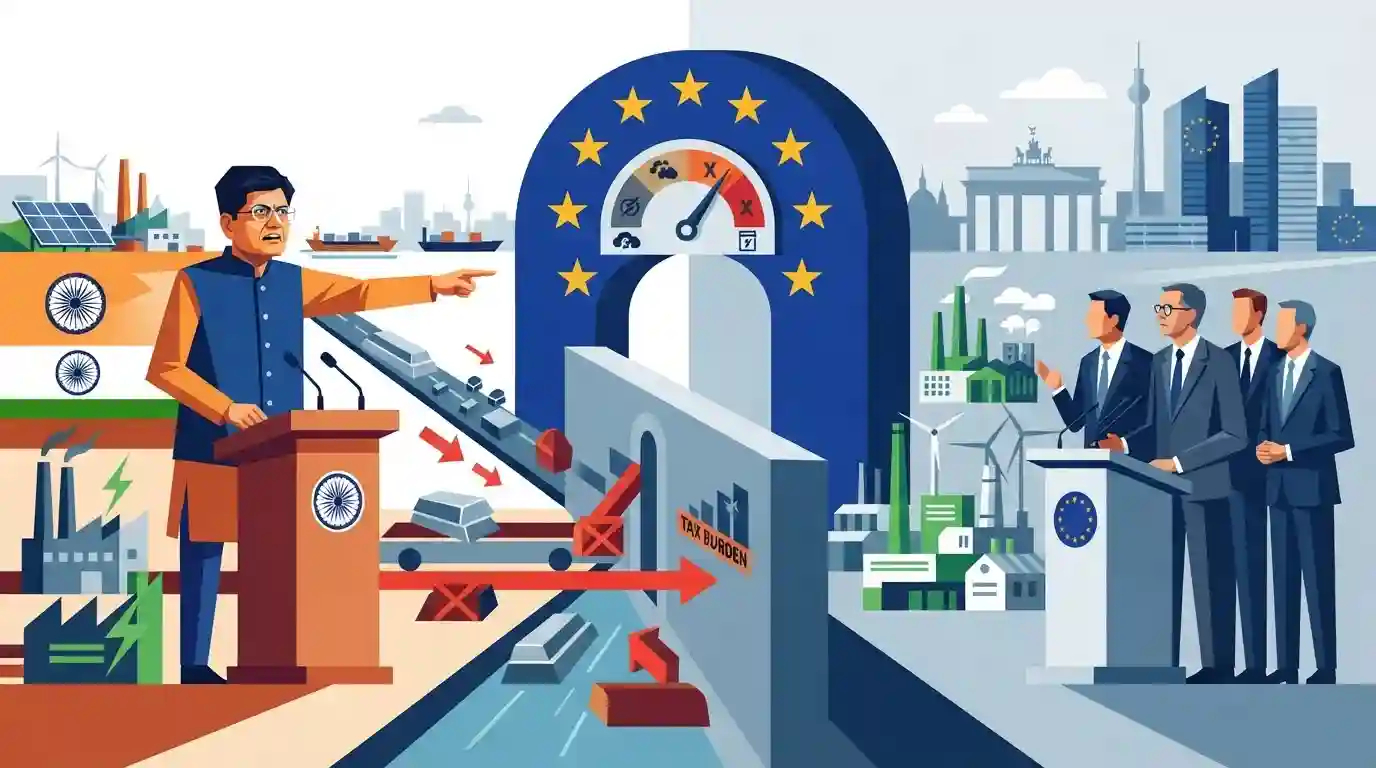
Union Minister Piyush Goyal, speaking in Berlin, criticized the European Union's carbon tax (CBAM) on steel, warning that it invites economic disaster and acts as a protectionist trade barrier that harms developing economies like India.
મુખ્ય મુદ્દા
- Union Minister Piyush Goyal criticized the European Union's carbon tax (Carbon Border Adjustment Mechanism - CBAM) on steel during his visit to Berlin, terming it an invitation to disaster.
- He argued that such unilateral trade measures impose unfair burdens on developing countries like India and disrupt global supply chains.
- India has raised concerns that CBAM acts as a non-tariff barrier, affecting its export competitiveness in sectors like steel and aluminium.
- The remarks highlight the tension between unilateral climate policies of developed nations and the principles of common but differentiated responsibilities (CBDR) in global climate governance.
મહત્વપૂર્ણ શબ્દો
Carbon Border Adjustment Mechanism (CBAM)

A climate policy instrument introduced by the European Union to place a carbon price on imports of carbon-intensive products like steel and cement, ensuring a level playing field.
UPSC context
GS Paper III (Environment & Ecology / Economy): Tests understanding of climate taxation, non-tariff trade barriers, and global trade dynamics for India.
Protectionist Trade Barrier
An economic policy where nations impose tariffs, duties, or non-tariff barriers to shield domestic industries from foreign competition, often criticized as distorting global trade.
UPSC context
GS Paper III (Economy - International Trade): Tests concepts of protectionism, WTO compatibility, and challenges faced by developing economies like India.
World Trade Organization (WTO)
An international economic organization that regulates global trade rules, provides a framework for negotiating trade agreements, and resolves trade disputes between member states.
UPSC context
GS Paper II & III (International Relations / Economy): Tests multilateral trade frameworks, dispute settlement, and trade rules affecting developing nations.
પ્રિલિમ્સ ટ્રેપ
CBAM is a multilateral tariff levied by the WTO to penalize developing countries for non-compliance with emission targets.
Aspirants often assume CBAM is a WTO-approved retaliatory tariff or a direct carbon tax collected inside India, whereas it is actually a unilateral EU import levy based on embedded emissions.
સંલગ્ન સ્થિર ખ્યાલો
What are the core operational principles and mechanisms of the EU Carbon Border Adjustment Mechanism (CBAM)?
- Carbon Pricing Equalization: The mechanism puts a carbon price on imports of carbon-intensive goods (steel, iron, cement, aluminium, fertilizers, electricity) into the EU.
- Preventing Carbon Leakage: It is designed to prevent carbon leakage, where European companies shift production abroad to countries with laxer emission constraints.
- Certificate Mechanism: Importers must buy digital CBAM certificates corresponding to the carbon price that would have been paid under EU ETS rules.
આંતર-વિષય પેટર્ન
CBAM: Where WTO Trade Law Meets Climate Equity
CBAM merges international trade law (WTO rules) with climate governance (UNFCCC/CBDR), testing India's diplomatic balancing act between green growth and export protectionism.

Expect statement-based questions pairing CBAM's WTO compatibility with the UNFCCC's CBDR principle and non-tariff barrier impacts.
સંલગ્ન PYQ · 3
સંલગ્ન PYQ · 3
- 2025MainsGS3
What are the challenges before the Indian economy when the world is moving away from free trade and multilateralism to protectionism and bilateralism? How can these challenges be met?
- 2025MainsGS3
What is Carbon Capture, Utilization and Storage (CCUS)? What is the potential role of CCUS in tackling climate change?
- 2021MainsGS3
Describe the major outcomes of the 26th session of the Conference of the Parties (COP) to the United Nations Framework Convention on Climate Change (UNFCCC). What are the commitments made by India in this conference?
