European Union Sanctions on Russian Oil and India Refinery
Source:The Hindu ↗
Why It Matters
The sanctioning of an Indian-based refinery by the EU and looming U.S. secondary sanctions directly challenge India's strategic autonomy and energy security. It serves as a prime case study for UPSC aspirants on balancing national economic interests (importing discounted Russian oil) against mounting Western geopolitical pressure and extraterritorial trade restrictions.
Summary
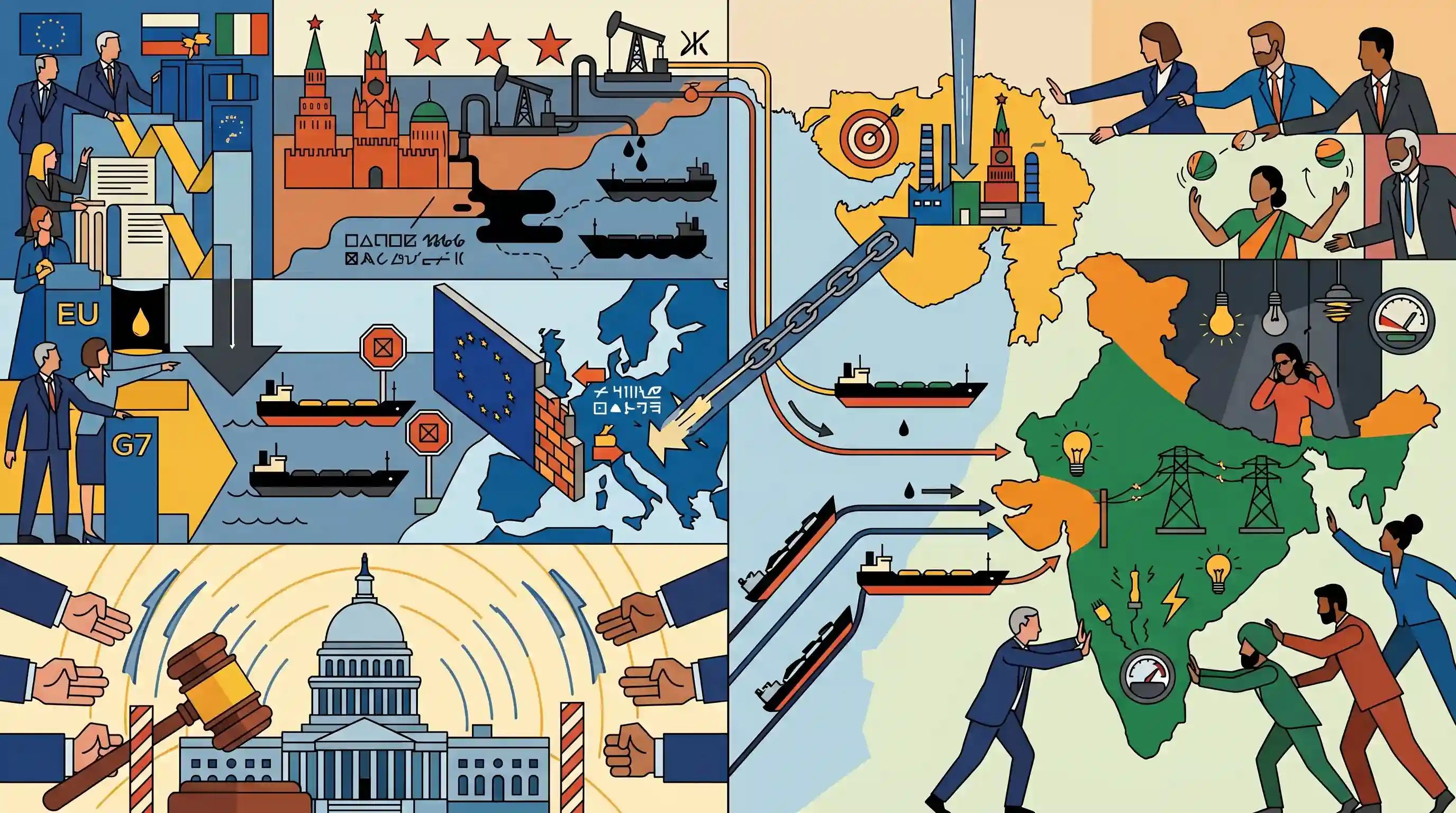
The European Union has introduced its 18th sanctions package against Russia, explicitly targeting the Gujarat-based Nayara Energy due to its significant ownership by the Russian state firm Rosneft. Concurrently, the G7 and EU have lowered the price cap on Russian crude oil to $47.6 per barrel and banned EU imports of refined products derived from Russian crude. The measures are aimed at curtailing Russia's oil revenues and combating its use of a 'shadow fleet' to bypass trade restrictions. Additionally, the U.S. Congress is debating secondary sanctions that could further pressure major buyers of Russian oil, including India, creating significant diplomatic and energy security challenges for New Delhi.
Key Points
- The European Union has sanctioned the Gujarat-based Nayara Energy, which is 49.13% owned by Russian state oil major Rosneft, as part of its 18th sanctions package.
- The G7 and EU lowered the price cap for Russian crude oil from $60 to $47.6 per barrel for vessels utilizing Western maritime shipping and insurance services.
- The EU enacted an import ban on refined petroleum products made from Russian crude oil to curb indirect Russian energy imports.
- New restrictions target Russia's 'shadow fleet' of tankers and impose transaction bans on the Nord Stream 1 and 2 pipelines.
- The U.S. Congress is exploring secondary sanctions that could explicitly penalize primary purchasers of Russian crude, including India, China, and Brazil.
Important Terms
Oil Price Cap

A mechanism where G7/EU countries ban essential services like insurance and shipping for Russian oil sold above a specific price, aimed at reducing war-funding revenues.
UPSC context
GS II (International Relations) & GS III (Economy); tests knowledge of global energy governance and economic warfare.
Secondary Sanctions
Economic penalties imposed on third-party entities (e.g., Indian banks or refiners) for conducting business with a primary sanctioned target, effectively enforcing compliance with unilateral laws globally.
UPSC context
GS II (IR); critical for India’s strategic autonomy and bilateral relations with the United States and Russia.
Shadow Fleet
A network of aging, substandard tankers with anonymous ownership used to transport sanctioned oil, often by disabling tracking systems and bypassing Western insurance.
UPSC context
GS III (Maritime Security/Environment); involves challenges in enforcing international trade laws and risks of environmental disasters.
Nayara Energy
An Indian downstream energy company (formerly Essar Oil) significantly owned by Russia's Rosneft (49.13%), making its Vadinar refinery a target for Western sanctions due to its Russian links.
UPSC context
GS II/III; highlights the impact of global geopolitics on domestic Indian industry and national energy security.
Extraterritorial Sanctions
The application of a country’s laws to people and entities outside its borders, often used via sanctions to pressure third countries into following its foreign policy.
UPSC context
GS II (IR/Legal); tests understanding of international law and challenges to the sovereignty of developing nations.
G7 (Group of Seven)
An informal bloc of advanced economies—Canada, France, Germany, Italy, Japan, the UK, and the USA, plus the EU—that coordinates global economic and security policies.
UPSC context
GS II (International Groupings); tests knowledge of global power structures and their influence on international trade norms.
Prelims Trap
India is legally bound under international law to enforce EU and US secondary sanctions against Russian oil.
India does not recognize unilateral or secondary sanctions imposed by individual countries or blocs (like the US/EU). India only recognizes UN Security Council (UNSC) sanctions.
Static Concepts Connected
How do extraterritorial (secondary) sanctions differ from primary sanctions?
- Primary sanctions: Prohibit entities strictly within the sanctioning country's jurisdiction from trading with the targeted nation.
- Secondary sanctions: Target third-country entities (e.g., an Indian refinery) doing business with the sanctioned nation, threatening them with exclusion from the sanctioning country's financial system.
How is the G7 oil price cap technically enforced on a global scale?
- Service denial: Prohibits Western companies from providing maritime transport, finance, or insurance for Russian oil sold above the agreed cap.
- Insurance monopoly: Relies on the overwhelming UK/EU dominance over global maritime insurance (P&I Clubs) to enforce compliance on non-Western shipping vessels.
Cross-Topic Patterns
Shadow fleets and UNCLOS environmental risks
The circumvention of sanctions using aging, uninsured vessels disabling AIS tracking directly links geopolitical conflict to marine environmental disaster risks under UNCLOS.
Rules of Origin and Refined Oil Exports
The EU ban on Indian refined products derived from Russian crude tests the 'Rules of Origin' concept, a staple of WTO and FTA negotiations.

Expect a 2026 prelims question testing the G7 price cap mechanism, focusing specifically on Western dominance in maritime insurance.
Linked PYQs · 3
Linked PYQs · 3
- 2025MainsGS2
"Energy security constitutes the dominant kingpin of India's foreign policy, and is linked with India's overarching influence in Middle Eastern countries.” How would you integrate energy security with India's foreign policy trajectories in the coming years?
- 2017MainsGS2
The question of India's Energy Security constitutes the most important part of India's economic progress. Analyze India's energy policy cooperation with West Asian countries.
- 2024PrelimsGS1
Consider the following statements : Statement-I : Sumed pipeline is a strategic route for Persian Gulf oil and natural gas shipments to Europe. Statement-II : Sumed pipeline connects the Red Sea with the Mediterranean Sea. Which one of the following is correct in respect of the above statements?
