European Union Syria Sanctions Relief and Post Conflict Diplomacy
Source:The Hindu ↗
Why It Matters
Understanding the dynamics of international sanctions and post-conflict diplomacy is vital for GS2. This event demonstrates how global powers use economic relief as leverage to enforce human rights and inclusive governance in volatile regions like the Middle East.
Summary
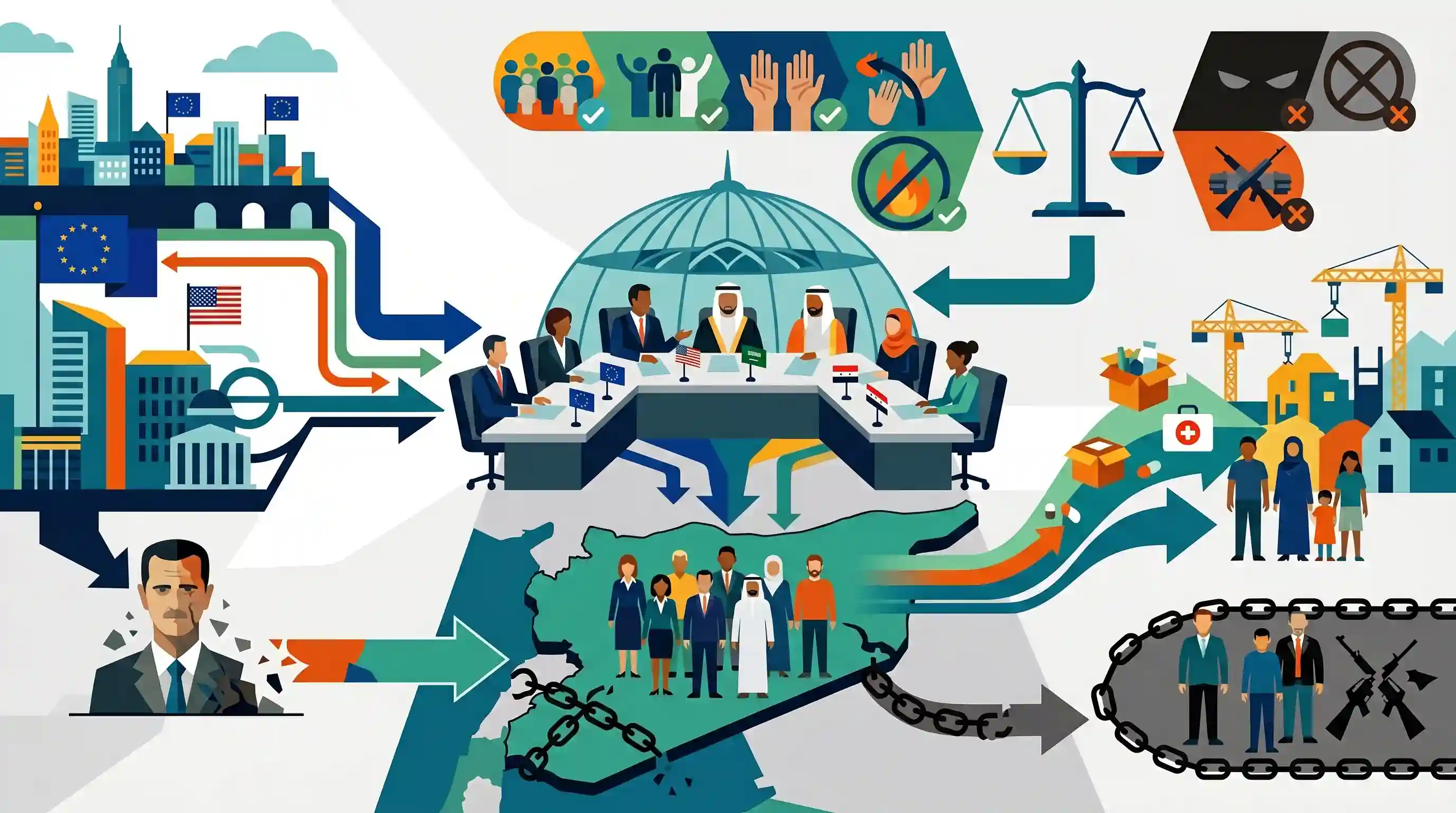
The European Union is evaluating the potential lifting or easing of sanctions on Syria after the ouster of President Bashar al-Assad. The decision hinges on whether the new HTS-led caretaker administration can ensure inclusive governance, respect human rights, and prevent radicalisation. As regional and Western leaders meet in Riyadh to coordinate their approach, countries like the US and Germany are considering targeted relief that supports the Syrian civilian population and enables humanitarian work, while maintaining penalties on former regime figures associated with human rights abuses.
Key Points
- EU foreign ministers are preparing to discuss the modification or lifting of sanctions on Syria following the fall of Bashar al-Assad's regime.
- Any sanctions relief is strictly conditional upon the new caretaker administration, led by Hayat Tahrir al-Sham (HTS), demonstrating inclusive governance, respecting minority and women's rights, and preventing radicalisation.
- The US has already provided limited exemptions to allow humanitarian aid and energy transactions with Syrian governing institutions.
- Germany advocated for a targeted approach: retaining sanctions against Assad's allies implicated in war crimes while lifting broad sanctions to alleviate civilian suffering.
- International diplomats are coordinating in Riyadh, indicating a unified regional and Western effort to manage Syria's transition.
Important Terms
Hayat Tahrir al-Sham (HTS)

An Islamist group, formerly al-Qaeda's Syrian wing (al-Nusra Front), which led the 2024 ouster of Bashar al-Assad. It now dominates Syria's transitional government while seeking removal from international terrorist lists.
UPSC context
GS Paper 2 (International Relations); tests knowledge of non-state actors, political transitions, and shifting power dynamics in West Asia.
EU-Syria Cooperation Agreement
A 1977 trade framework fully reinstated by the European Union in May 2026. Its reactivation ends 15 years of trade restrictions on Syrian oil, gold, and minerals, signaling normalized diplomatic relations.
UPSC context
GS Paper 2 (Bilateral and Regional Groupings); tests understanding of EU foreign policy and post-conflict economic reconstruction.
US General License 25 (GL 25)
A 2025 US Treasury authorization providing broad sanctions relief to Syria. It permits new investment, petroleum dealings, and transactions with the new government, while excluding figures from the former Assad regime.
UPSC context
GS Paper 2 (Effect of policies of developed countries); tests familiarity with economic statecraft and international sanctions regimes.
Caesar Syria Civilian Protection Act
2019 US legislation mandating sanctions on those aiding the Assad regime. Recent US re-engagement requires specific waivers of this Act to allow regional partners to participate in Syria's reconstruction.
UPSC context
GS Paper 2 (International Relations); tests understanding of secondary sanctions and their impact on regional geopolitics and humanitarian aid.
West Asian Geopolitics
A strategic region encompassing the Middle East where India has vital energy, diaspora, and security interests. Current Syrian transitions impact regional stability and India's "Link West" policy.
UPSC context
GS Paper 2 (International Relations); core area for India's interests, energy security, and regional stability questions.
Prelims Trap
The UN Security Council has unconditionally lifted all economic sanctions on Syria following Assad's ouster.
The sanctions being discussed for relief are unilateral (EU, US), not UN Security Council sanctions. Furthermore, relief is strictly conditional, not an absolute removal.
Static Concepts Connected
What is the difference between UN Sanctions and Unilateral Sanctions?
- UN Sanctions: Legally binding on all member states under Chapter VII of the UN Charter (via UNSC resolutions).
- Unilateral Sanctions: Imposed independently by individual countries or blocs (e.g., US Caesar Act, EU frameworks) without UN mandate.
- Secondary Sanctions: Unilateral measures penalizing third-party countries or foreign entities for trading with the sanctioned nation.
What are 'Smart' or 'Targeted' Sanctions?
- Core Focus: Aimed at specific individuals, entities, or sectors (like energy or military) rather than imposing a blanket embargo on an entire nation.
- Civilian Protection: Minimizes economic collateral damage to the civilian population while directly pressuring regime leaders or war criminals.
- Humanitarian Carve-outs: Explicit legal exemptions built into sanctions regimes allowing the flow of food, medicine, and essential aid.
Cross-Topic Patterns
Non-state actors transitioning to state rulers
The HTS transition in Syria mirrors the Taliban in Afghanistan. Both scenarios force global diplomacy to balance anti-terror redlines with pragmatic humanitarian and economic engagement.
Syria's transition & India's Gulf calculus
Western-Arab coordination in Riyadh directly impacts India’s strategic interests, as broad Gulf stability is fundamental to India's energy security and the safety of its massive diaspora.

Expect a Prelims question distinguishing between UNSC multilateral sanctions and unilateral mechanisms like the US Caesar Act or EU regimes.
Linked PYQs · 4
Linked PYQs · 4
- 2025MainsGS2
"Energy security constitutes the dominant kingpin of India's foreign policy, and is linked with India's overarching influence in Middle Eastern countries.” How would you integrate energy security with India's foreign policy trajectories in the coming years?
- 2012MainsGS2
How have the US sanctions against Iran affected India's bilateral relations with Iran?
- 2023PrelimsGS1
Consider the following pairs: Area of conflict mentioned in news Country where it is located 1. Donbas : Syria 2. Kachin : Ethiopia 3. Tigray : North Yemen How many of the above pairs are correctly matched?
- 2015PrelimsGS1
The area known as 'Golan Heights' sometimes appears in the news in the context of the events related to
