European Union and Mercosur Free Trade Agreement
Source:The Hindu ↗
Why It Matters
The EU-Mercosur pact serves as a prime case study for UPSC aspirants on the complexities of negotiating Free Trade Agreements (FTAs). It illustrates the persistent conflict between industrial export ambitions and domestic agricultural protectionism—a dilemma India itself faces in forums like RCEP and WTO. It also highlights geopolitical strategies like 'China Plus One', the operational dynamics of regional blocs (Mercosur, EU), and the strategic use of Geographical Indications (GIs) in trade diplomacy.
Summary
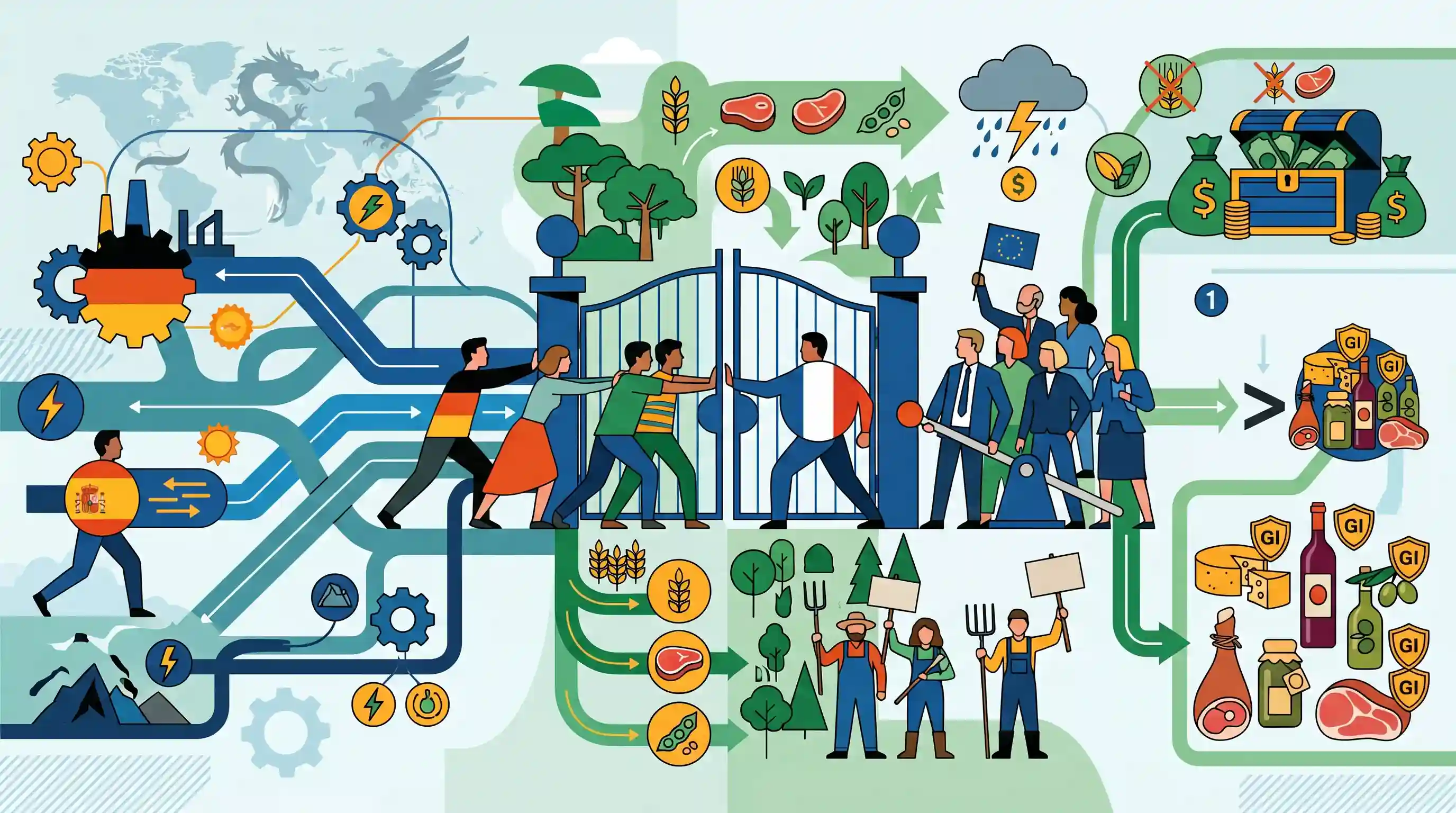
The European Union greenlit a landmark free-trade agreement with the Mercosur bloc, establishing one of the world's largest free-trade zones despite vehement opposition from France. Driven by nations like Germany and Spain, the EU sees the deal as a vital strategic instrument to diversify supply chains, secure critical raw materials, and counter economic pressures from China and the United States. Conversely, France and several other members opposed the influx of cheaper South American agricultural products, citing threats to domestic farmers' livelihoods and environmental standards. Ultimately, the European Commission bypassed the French veto using a qualified majority vote, coupling the deal with an agricultural crisis fund and safeguards for 340 European geographical indications.
Key Points
- The EU successfully passed a free-trade agreement with the Mercosur bloc (Argentina, Brazil, Paraguay, Uruguay), culminating 25 years of negotiations.
- The agreement creates a colossal free-trade zone of over 700 million consumers, designed to eliminate most tariffs and boost bilateral trade in machinery, vehicles, and services.
- Proponents like Germany and Spain view the deal as an essential strategic move to diversify supply chains, reduce dependency on China, and counter US protectionist tariffs.
- France led a block of opposing nations (including Poland, Ireland, and Austria), arguing that cheap South American agricultural imports would decimate European farmers and violate EU environmental standards.
- To assuage opposition, the European Commission pledged an agricultural crisis fund and enforced protections for 340 European geographical indications (GIs).
- France was overridden via the EU's qualified majority voting system, underscoring deep structural divides within the bloc between industrial export interests and agricultural protectionism.
Important Terms
EU-Mercosur Trade Deal

A free-trade agreement between the European Union and the Mercosur bloc (Argentina, Brazil, Paraguay, Uruguay, Bolivia) aimed at eliminating over 90% of tariffs to create a massive trans-continental trade zone.
UPSC context
GS Paper II: Bilateral, regional and global groupings and agreements; significant for India’s own trade negotiations with the EU.
Mercosur
The Southern Common Market, a South American regional trade bloc established in 1991 by the Treaty of Asunción to promote free trade and the fluid movement of goods, services, and people.
UPSC context
GS Paper II: Regional groupings; India maintains a Preferential Trade Agreement (PTA) with this bloc.
European Commission
The executive arm of the European Union responsible for proposing legislation, implementing decisions, and representing the bloc in international trade negotiations and external relations.
UPSC context
GS Paper II: Important International institutions, agencies and fora—their structure, mandate; often contrasted with the European Council.
Qualified Majority Voting (QMV)
An EU voting mechanism requiring 55% of member states (15 out of 27) representing at least 65% of the EU population to pass a proposal, effectively bypassing individual national vetoes.
UPSC context
GS Paper II: Comparison of the Indian constitutional scheme with that of other countries/entities; global governance mechanisms.
Geographical Indications (GIs)
An intellectual property (IP) label identifying a product as originating from a specific territory where its quality, reputation, or other characteristic is essentially attributable to its geographical origin.
UPSC context
GS Paper III: Issues relating to intellectual property rights; GS Paper I: Cultural and geographical significance of products.
Prelims Trap
The EU requires unanimous consent from all member states to sign international free trade agreements.
The EU uses Qualified Majority Voting (QMV) for certain policy areas like trade, allowing the bloc to adopt agreements without absolute unanimity, bypassing individual vetoes.
Static Concepts Connected
What is the Mercosur bloc and who are its core members?
- Nature: A prominent South American economic and political bloc established by the Treaty of Asunción in 1991, functioning as a customs union and free-trade area.
- Membership: The core founding members are Argentina, Brazil, Paraguay, and Uruguay.
How are Geographical Indications (GIs) protected globally and in India?
- WTO Framework: Governed globally by Article 22 of the WTO's Trade-Related Aspects of Intellectual Property Rights (TRIPS) agreement.
- Indian Law: Administered under the Geographical Indications of Goods (Registration and Protection) Act, 1999, enacted to comply with India's WTO obligations.
Cross-Topic Patterns
Environment as a Non-Tariff Barrier
France's citation of 'environmental standards' to block imports mirrors the EU's Carbon Border Adjustment Mechanism (CBAM), highlighting a rising trend of developed nations using climate norms as non-tariff trade barriers.
De-risking via Latin American minerals
Germany's push for the deal aims to secure South American critical minerals (e.g., from the Lithium Triangle) to reduce supply-chain dependence on China, reflecting global 'de-risking' strategies.

Expect a 2026 Prelims multi-statement question pairing Mercosur's exact membership with the WTO TRIPS framework for Geographical Indications.
Linked PYQs · 4
Linked PYQs · 4
- 1998PrelimsGS1
‘MERCOSUR’ consists of group of countries of
- 2020MainsGS2
Quadrilateral Security Dialogue (Quad)' is transforming itself into a trade bloc from a military alliance, in present times - Discuss.
- 2023MainsGS3
What are the direct and indirect subsidies provided to farm sector in India? Discuss the issues raised by the World Trade Organization (WTO) in relation to agricultural subsidies.
- 2016PrelimsGS1
The term 'Regional Comprehensive Economic Partnership' often appears in the news in the context of the affairs of a group of countries known as
