EU social media age restrictions and child protection
Source:Indian Express ↗
Why It Matters
This article is highly relevant for UPSC because the challenges faced by children in the digital era are a major point of discussion in public policy (as seen in recent Mains GS2 questions on NCPCR). The European Union's 'safe by design' model and shifting the burden of proof to platforms offer crucial policy templates that Indian legislators can draw upon while drafting rules under the Digital Personal Data Protection (DPDP) Act, 2023, and the upcoming Digital India Act. It also addresses the critical intersection of technology ethics, child developmental psychology, and global tech governance.
Summary
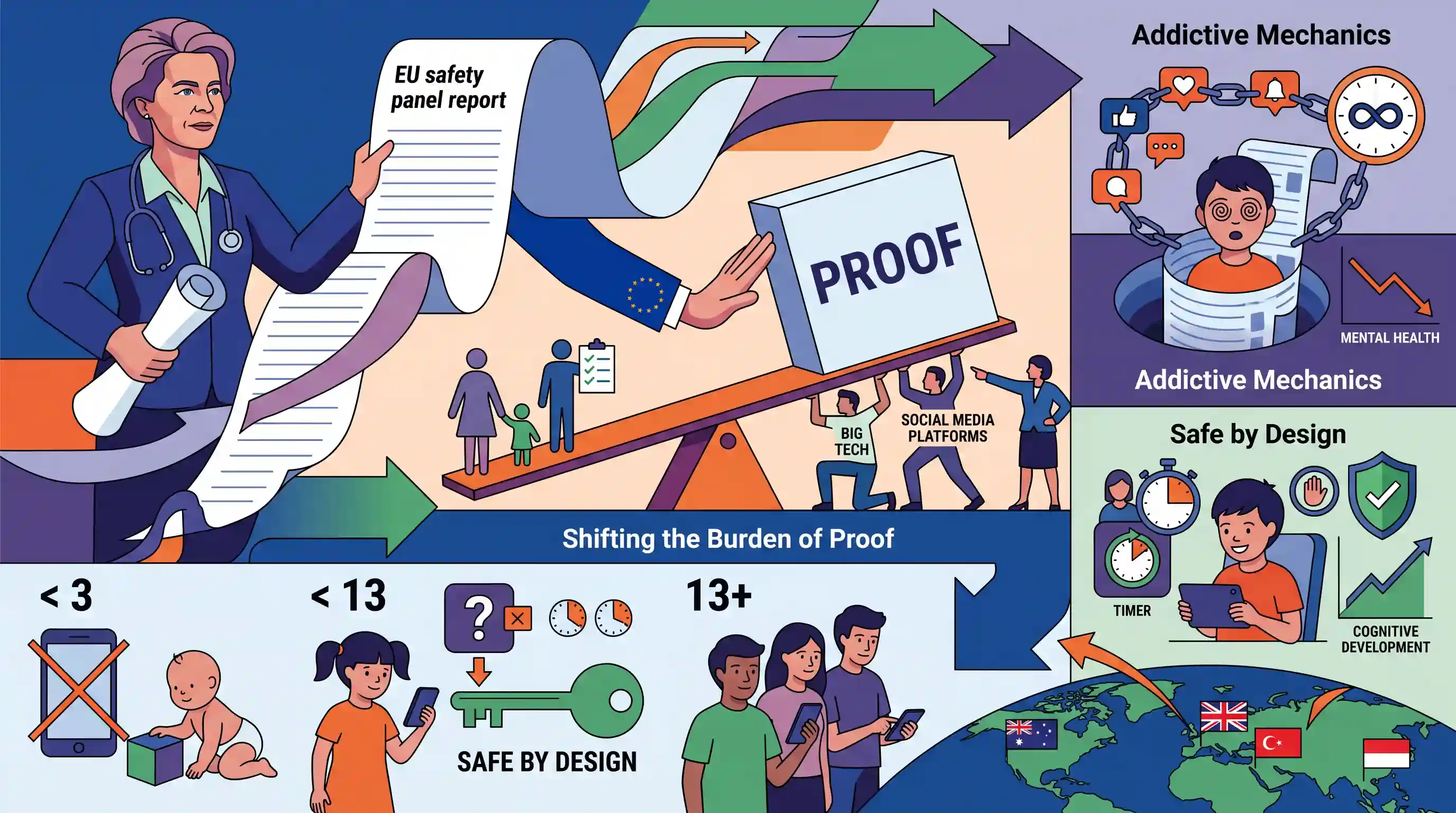
European Commission President Ursula von der Leyen has backed proposed regulations to restrict children's access to social media, based on an EU safety panel report. The report recommends forbidding access for children under 13 unless tech companies can prove their platforms are 'safe by design'—effectively shifting the burden of proof from parents and regulators to the platforms themselves. It also calls for a complete ban on screen time for children under three, addressing addictive mechanics like 'infinite scrolling', and phased access for older minors. This push mirrors global measures introduced in countries like Australia, the UK, Turkey, and Indonesia to protect minors' mental health and cognitive development from digital harms.
Key Points
- European Commission President Ursula von der Leyen advocated for social media age restrictions and limits for children, following recommendations from a special EU safety panel.
- The special EU panel recommended banning social media access for children under 13 until tech platforms can prove their services are safe.
- The proposal advocates for a 'safe by design' approach, shifting the burden of proof onto digital platforms and tech companies rather than parents, children, or regulators.
- Addictive platform design elements, such as 'infinite scrolling', are highlighted as critical features that need to be actively regulated or dismantled.
- The panel recommended zero screen time for children under three and gradual, phased access restrictions for children over 13.
- This aligns with a growing global regulatory trend, with countries like Australia, the UK, Turkey, and Indonesia passing or proposing bans/restrictions on social media use for minors under 15 or 16.
Important Terms
European Commission

The executive branch of the European Union responsible for proposing legislation, implementing decisions, upholding EU treaties, and managing the day-to-day administrative business of the union.
UPSC context
GS-II (International Relations): Important regional groupings and global bodies influencing digital governance and international regulatory standards.
European Union
A political and economic union of European countries that establishes common policies, promotes integration, and sets influential global regulatory standards in digital technology, privacy, and economic trade.
UPSC context
GS-II (International Relations): Regional groupings, global standard-setting bodies, and international policies impacting India's trade and data sovereignty.
Digital Services Act
A landmark European Union regulation that holds online platforms accountable for content moderation, algorithmic transparency, systemic risks, and the protection of minors online.
UPSC context
GS-III (Cyber Security & Tech Governance) and GS-II (Polity): Regulating Big Tech, social media harms, and digital rights.
Safe by Design
An engineering and regulatory approach requiring technology companies to proactively integrate safety, privacy, and risk-mitigation measures directly into their products' foundational architecture rather than managing issues retrospectively.
UPSC context
GS-III (Science and Technology) and GS-II (Governance): Technology policy, ethics in AI and algorithms, and digital consumer safety.
General Data Protection Regulation
The European Union's comprehensive data protection law that regulates how personal data is collected, stored, and processed, setting a global benchmark for privacy rights.
UPSC context
GS-II (Governance) and GS-III (Cyber Security): Frameworks for data privacy, rights of individuals, and India's DPDP Act comparative analysis.
Prelims Trap
Under India's DPDP Act, tracking and targeted advertising for minors are permissible if explicit parental consent is obtained.
Section 9 of the DPDP Act, 2023, imposes an absolute, non-waivable statutory prohibition on tracking or targeted advertising of minors, irrespective of parental consent.
Static Concepts Connected
What is the statutory framework for protecting children's data under India's DPDP Act 2023?
- Age Threshold: Defines a child as any individual who has not completed 18 years of age, setting a higher threshold than several Western laws.
- Parental Consent: Mandates obtaining verifiable parental consent (or consent of a lawful guardian) before processing any personal data of a child.
- Absolute Prohibitions: Strictly prohibits processing that is likely to cause an detrimental effect on the well-being of a child, alongside tracking/targeted ads.
What are 'Dark Patterns' and how does India regulate them?
- Definition: Deceptive UX/UI design practices (e.g., infinite scrolling, forced action) used to mislead users into actions against their best interest.
- Indian Regulation: The Central Consumer Protection Authority (CCPA) issued guidelines in 2023 prohibiting 13 specific dark patterns under unfair trade practices.
- Systemic Harm: They systematically exploit cognitive vulnerabilities, contributing to screen addiction and mental health degradation in minors.
Cross-Topic Patterns
Platform Liability vs. User Responsibility
The global pivot to 'safe by design' models transfers the regulatory and legal burden of minor safety from parents to Big Tech, redefining corporate liability in digital jurisprudence.
Digital Well-being as Article 21 Right
Mental health impacts of algorithmic features (like infinite scroll) are increasingly framed as violations of the Right to Health under Article 21, linking child psychology to constitutional law.

Comparative analysis of India's strict under-18 DPDP child protections vs global under-16/13 limits is highly likely in GS-2/GS-3 by 2026.
Linked PYQs · 2
Linked PYQs · 2
- 2025MainsGS2
The National Commission for Protection of Child Rights has to address the challenges faced by children in the digital era. Examine the existing policies and suggest measures the Commission can initiate to tackle the issue.
- 2024MainsGS3
Social media and encrypting messaging services pose a serious security challenge. What measures have been adopted at various levels to address the security implications of social media? Also suggest any other remedies to address the problem.
