Government Scheme to Support MSMEs Against EU Carbon Tax Burden
Source:Indian Express ↗
Why It Matters
The article highlights the intersection of international climate policy and global trade, demonstrating how environmental measures like carbon taxes (CBAM) can act as non-tariff barriers (protectionism). It is essential for understanding the challenges faced by India's MSME and manufacturing sectors in maintaining export competitiveness, and the government interventions required to protect them.
Summary
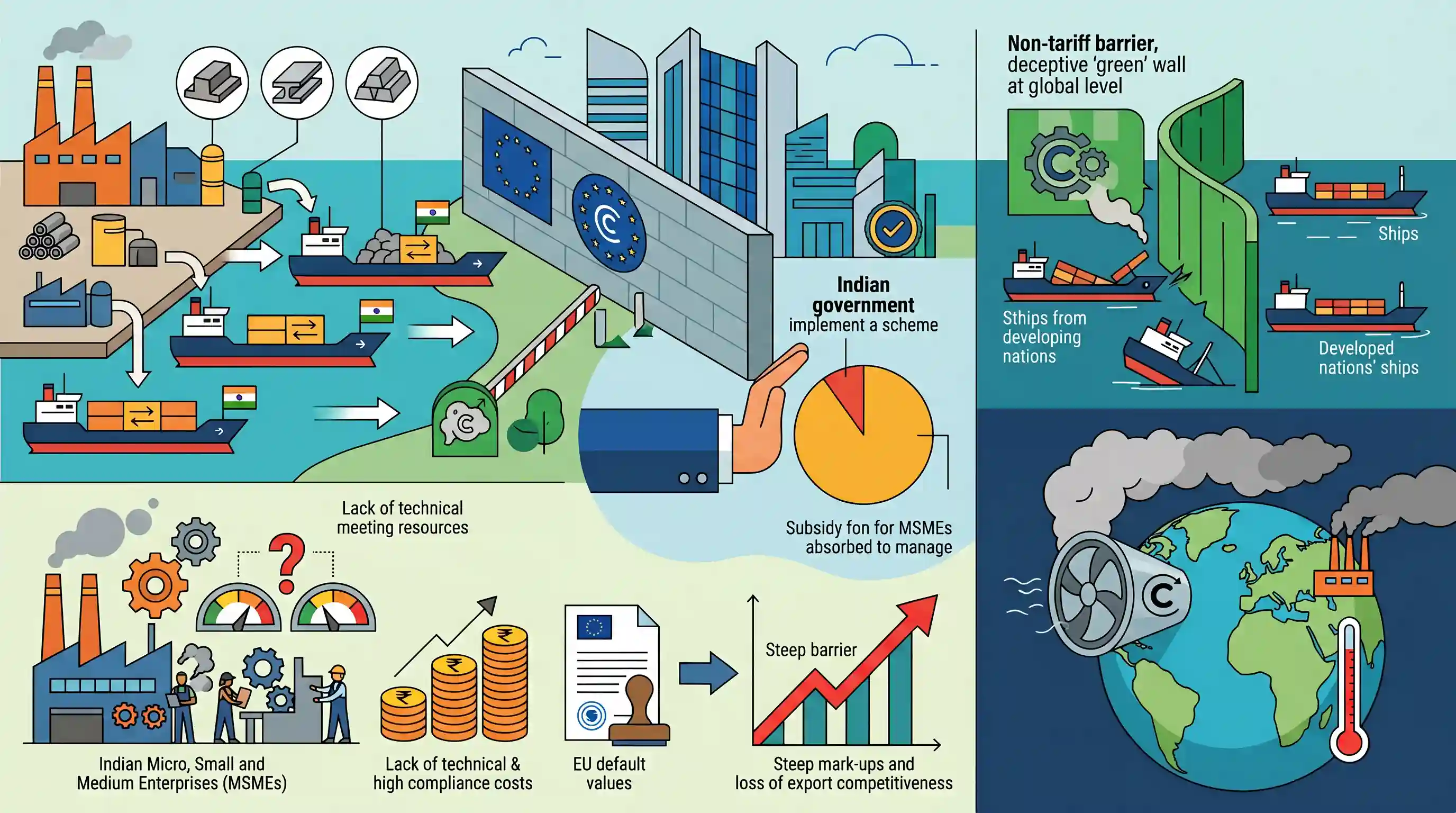
The European Union’s Carbon Border Adjustment Mechanism (CBAM) imposes carbon-pricing on imports, creating substantial compliance and financial hurdles for Indian exporters, particularly in the iron, steel, and aluminium sectors. With compliance costs running up to Rs 15-20 lakh annually per unit, Micro, Small and Medium Enterprises (MSMEs) are uniquely vulnerable as they lack the technical resources to accurately measure embedded emissions. Without precise data, exporters are forced to rely on the EU's "default values," which include steep mark-ups starting in 2026. Recognizing this threat to export competitiveness, the Indian government is devising a scheme to absorb up to 90% of MSMEs' compliance costs. Think tanks like ICRIER caution that CBAM acts as a protectionist non-tariff barrier, adversely affecting developing countries' trade while delivering negligible benefits to global climate change mitigation.
Key Points
- The EU’s Carbon Border Adjustment Mechanism (CBAM) will enforce carbon pricing on imports of carbon-intensive goods like iron, steel, and aluminium.
- Indian MSMEs face steep compliance costs (Rs 15-20 lakh annually) to measure and verify embedded carbon emissions, risking penalizing "default value" mark-ups if they fail to provide accurate data.
- To protect export competitiveness, the Indian government plans a scheme to absorb up to 90% of the CBAM compliance costs for MSMEs.
- India's iron and steel sector could suffer a 24% decline in exports to the EU, amounting to a 5.7% drop in global exports.
- Think tanks like ICRIER view CBAM as a protectionist trade barrier that harms developing economies while yielding negligible benefits for global carbon emission reductions.
Important Terms
Carbon Border Adjustment Mechanism (CBAM)

An EU policy imposing a carbon price on imports of carbon-intensive goods (like steel/aluminum) to match costs paid by domestic producers under the Emissions Trading System.
UPSC context
GS Paper 3 (Economy/Environment): Trade barriers, carbon leakage, and impact on India’s exports.
Micro, Small and Medium Enterprises (MSMEs)
Small-scale businesses defined by the MSMED Act (2006); revised (2020) based on investment (<₹50cr) and turnover (<₹250cr) limits. They contribute ~45% to India's total exports.
UPSC context
GS Paper 3 (Indian Economy): Growth, industrial policy, and employment generation.
ICRIER
A premier autonomous Indian think tank providing analytical research to inform economic policy, focusing on trade, investment, and international economic relations.
UPSC context
GS Paper 3 (Economy): Institutional role in policy research and international trade discourse.
Non-Tariff Barriers (NTBs)
Trade restrictions (like technical standards, licensing, or environmental regulations) other than customs duties that restrict imports or exports, often acting as disguised protectionism.
UPSC context
GS Paper 2/3: Global trade dynamics, WTO issues, and international relations.
Embedded Emissions
The total greenhouse gas emissions generated throughout a product's entire supply chain, including raw material extraction, manufacturing, and transportation to the consumer.
UPSC context
GS Paper 3 (Environment): Carbon accounting, life-cycle assessments, and climate mitigation.
Carbon Pricing
An instrument that captures the external costs of greenhouse gas emissions—usually via a tax or emissions trading system—to incentivize industries to reduce pollution.
UPSC context
GS Paper 3 (Environment): Climate change mitigation strategies and global environmental governance.
Prelims Trap
The Indian government will subsidize the carbon tax levied under the EU's CBAM for MSMEs.
The government plans to subsidize the **compliance and auditing costs** (measuring embedded emissions), not the actual carbon tax. Subsidizing the tax itself would trigger WTO countervailing duties.
Static Concepts Connected
What is Carbon Leakage in the context of climate economics?
- The Concept: It occurs when businesses relocate production from countries with strict greenhouse gas emission norms to nations with laxer environmental regulations.
- Economic Motivation: Companies relocate to avoid high domestic carbon pricing (like cap-and-trade or carbon taxes), seeking cheaper production costs abroad.
- The Countermeasure: Mechanisms like the EU's CBAM are designed to prevent leakage by taxing imported carbon-intensive goods to equalize costs.
How do Non-Tariff Barriers (NTBs) operate under WTO frameworks?
- Definition: Trade restrictions not involving traditional customs duties, including quotas, licensing, sanitary measures, and complex regulatory standards.
- Disguised Protectionism: Developed nations increasingly use environmental or labor standards (like CBAM) as NTBs to shield domestic industries from cheaper imports.
- WTO Rules: While the WTO allows measures for environmental protection under GATT Article XX, they must not arbitrarily discriminate between countries.
Cross-Topic Patterns
Green Protectionism vs. CBDR
CBAM unilaterally imposes developed-world carbon prices on developing nations, undermining the UNFCCC's core principle of Common But Differentiated Responsibilities (CBDR) under the guise of climate action.
MSME Vulnerability in Global Value Chains
MSMEs account for nearly 40% of India's exports but struggle with high ESG and emission compliance costs, necessitating targeted state subsidies to retain their global value chain integration.

Expect a 2026 Prelims question mixing CBAM's targeted sectors (iron, steel, aluminium) with WTO rules on non-tariff barriers.
Linked PYQs · 5
Linked PYQs · 5
- 2023MainsGS3
Faster economic growth requires increased share of the manufacturing sector in GDP, particularly of MSMEs. Comment on the present policies of the Government in this regard.
- 2025MainsGS3
What are the challenges before the Indian economy when the world is moving away from free trade and multilateralism to protectionism and bilateralism? How can these challenges be met?
- 2020PrelimsGS1
Which one of the following statements best describes the term 'Social Cost of Carbon'? It is a measure, in monetary value, of the
- 2011PrelimsGS1
Regarding “carbon credits”, which one of the following statements is not correct?
- 2025PrelimsGS1
Consider the following statements : Statement I: Article 6 of the Paris Agreement on climate change is frequently discussed in global discussions on sustainable development and climate change. Statement II: Article 6 of the Paris Agreement on climate change sets out the principles of carbon markets. Statement III : Article 6 of the Paris Agreement on climate change intends to promote inter-country non-market strategies to reach their climate targets. Which one of the following is correct in respect of the above statements?
