EU Carbon Border Adjustment Mechanism Impact on Steel Exports
Source:Indian Express ↗
ఇది ఎందుకు ముఖ్యం
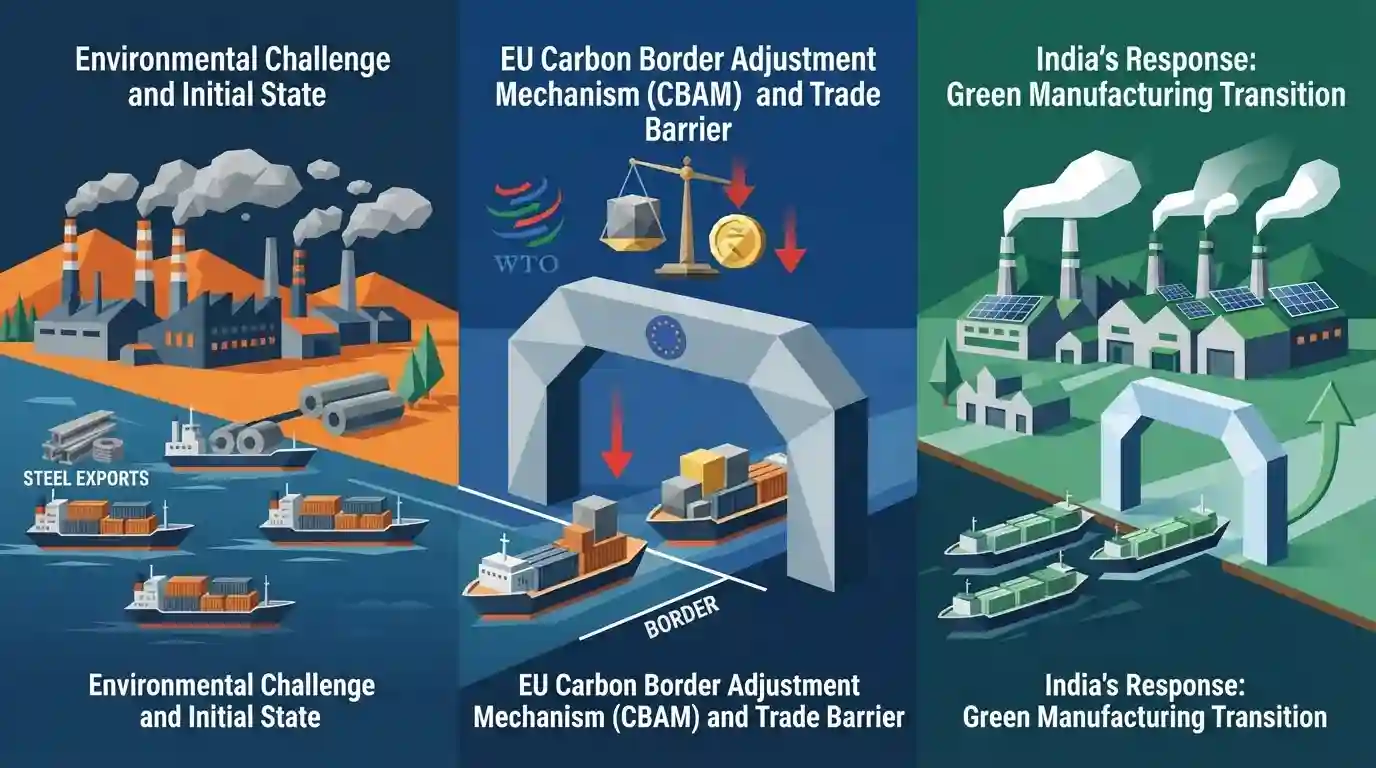
CBAM represents a major shift in global trade where environmental standards intertwine directly with trade competitiveness, heavily impacting developing nations like India and forcing a rethink of industrial decarbonization strategies.
సారాంశం
The article discusses the impact of the European Union's Carbon Border Adjustment Mechanism (CBAM) on India's steel exports, analyzing the trade and environmental challenges posed by carbon taxes, protectionism concerns, and the urgent need for India to adopt green manufacturing practices.
ముఖ్య అంశాలు
- The European Union's Carbon Border Adjustment Mechanism (CBAM) imposes carbon tariffs on carbon-intensive imports like steel and aluminum to prevent carbon leakage.
- Indian steel exports to the EU face significant competitiveness challenges due to high carbon intensity in domestic production processes.
- CBAM raises serious concerns regarding protectionism under the guise of environmental regulation and potential conflicts with WTO non-discrimination principles.
- India needs to transition towards green steel technology, energy efficiency, and renewable energy integration to sustain its export markets in Europe.
ముఖ్యమైన పదాలు
Carbon Border Adjustment Mechanism (CBAM)

A climate measure by the EU that levies a carbon tax on carbon-intensive imports like steel and cement to prevent carbon leakage and level the playing field.
UPSC context
GS Paper 3 (Environment/Economy): Tests understanding of green trade barriers, carbon taxes, and their impact on India's exports.
European Union
An economic and political union of 27 European member states that functions as a single internal market and a major global trading bloc.
UPSC context
GS Paper 2/3 (IR/Economy): Tests knowledge of major international groupings and bilateral trade dynamics with India.
WTO
A global international organization dealing with the rules of trade between nations, ensuring that trade flows as smoothly, predictably, and freely as possible.
UPSC context
GS Paper 3 (International Trade): Tests multilateral trade rules, protectionist disputes, and non-tariff barriers like CBAM compliance.
అనుసంధానమైన స్థిర భావనలు
What are the core principles of WTO law relevant to carbon border adjustments?
- National Treatment: National treatment requires imported goods to be treated no less favorably than domestic like-products.
- Most-Favoured-Nation: MFN treatment mandates that any advantage granted to products of one country must be extended to all WTO members.
- GATT Exceptions: GATT Article XX provides general exceptions for measures relating to the conservation of exhaustible natural resources, subject to the chapeau test.
What is the principle of Common but Differentiated Responsibilities (CBDR)?
- Historical Responsibility: Acknowledged under the UNFCCC, it assigns varying obligations to states based on historical responsibility for emissions and respective capabilities.
- Developing Nations Stand: Developing nations argue unilateral tariffs like CBAM violate CBDR by imposing equal financial burdens regardless of developmental stage.
అంతర-అంశ నమూనాలు
CBAM vs WTO Non-Discrimination Principles
CBAM mirrors traditional border adjustment measures, testing the fine line between legitimate environmental regulation and WTO-prohibited protectionist non-tariff barriers.
Green Steel vs Energy Security Trade-offs
India's coal-heavy steel industry highlights the immense structural challenge of decarbonizing core manufacturing while balancing energy security and export competitiveness.

CBAM, WTO non-discrimination principles, and the CBDR framework will likely feature in a multi-statement environment-trade policy MCQ.
అనుసంధాన PYQలు · 1
అనుసంధాన PYQలు · 1
- 2022MainsGS3
Discuss global warming and mention its effects on the global climate. Explain the control measures to bring down the level of greenhouse gases which cause global warming, in the light of the Kyoto Protocol, 1997.
