European Union Accuses TikTok of Addictive Algorithmic Design
Source:The Hindu ↗
Why It Matters
This highlights the growing global consensus on regulating Big Tech to protect children's mental health from algorithmic manipulation. It provides a comparative perspective (EU's Digital Services Act, Australia's ban) for India's evolving digital regulatory framework (like the Digital India Act) and issues handled by child rights commissions.
Summary
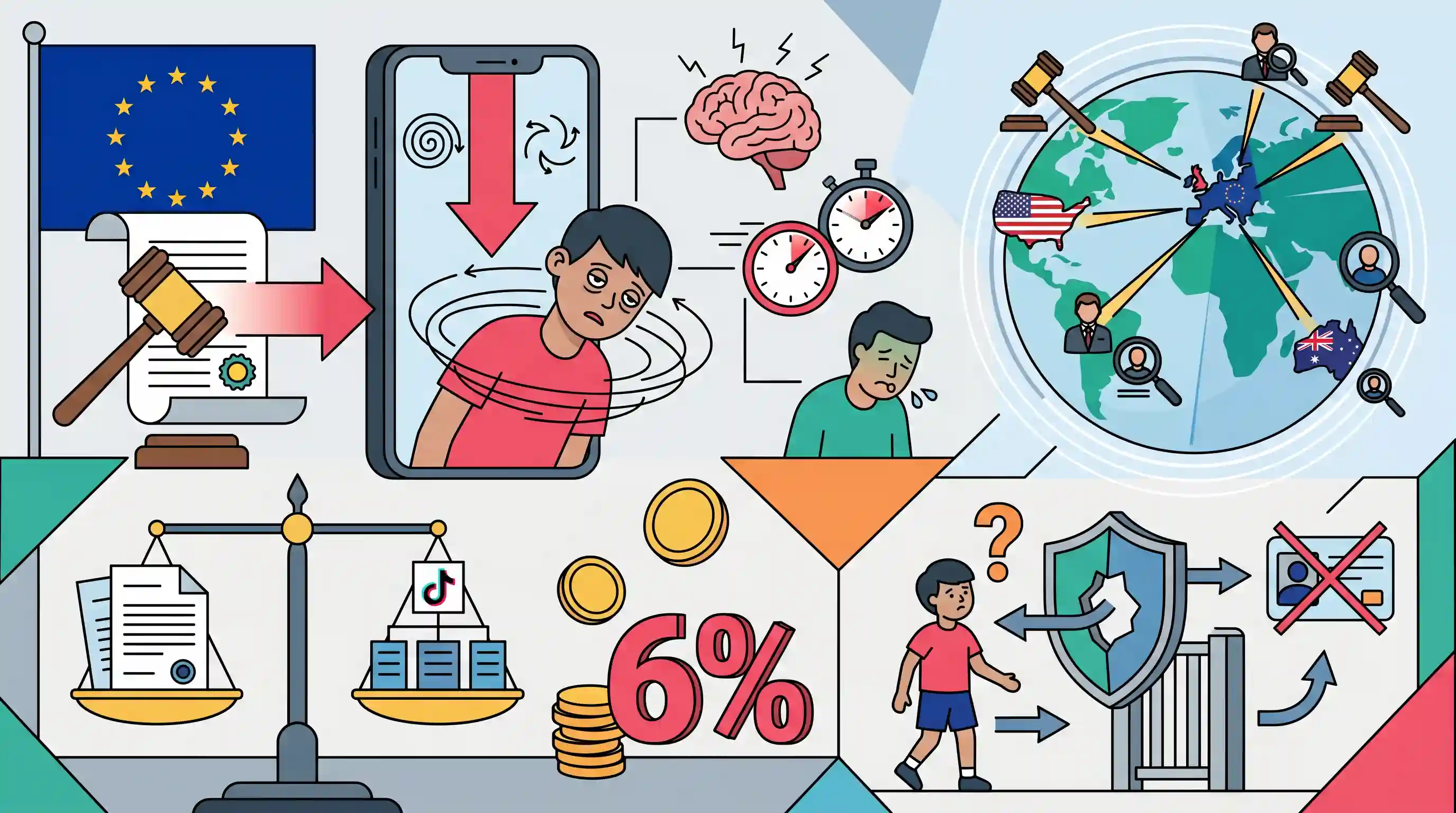
The European Commission has formally accused TikTok of breaching the bloc's Digital Services Act (DSA) by employing 'addictive design' features, such as infinite scrolling and autoplay, that pose severe risks to users' mental and physical health. The Commission stated that TikTok has not taken sufficient measures to assess or mitigate these risks, particularly for minors, nor has it implemented effective age-verification tools. If found guilty of violating the DSA, TikTok's parent company, ByteDance, could face fines of up to 6% of its global annual revenue. The EU's regulatory crackdown is part of an escalating global trend to hold major tech platforms accountable for their impact on children, mirroring similar legislative efforts and lawsuits in Australia, the US, and the UK.
Key Points
- The European Commission accused TikTok of violating the Digital Services Act (DSA) through algorithmic designs that foster addiction, such as autoplay and infinite scrolling.
- The EU highlighted that TikTok failed to adequately mitigate risks related to physical and mental well-being, specifically concerning sleep deprivation, anxiety, and the impact on children.
- TikTok's age-assurance systems were criticized as ineffective in preventing minors from accessing the platform or inappropriate content, exacerbating the risks of algorithmic manipulation.
- Under the DSA, non-compliance can result in substantial penalties, allowing the EU to fine parent company ByteDance up to 6% of its global annual revenue.
- The regulatory action aligns with a broader global push to protect youth online, including Australia's recent ban on social media for children under 16 and ongoing lawsuits against tech giants in the United States.
Important Terms
Digital Services Act (DSA)

A comprehensive EU regulation (2024) establishing safety, transparency, and accountability rules for online intermediaries. It mandates content moderation and risk assessments for 'Very Large Online Platforms' (VLOPs).
UPSC context
GS-II (Global Governance) & GS-III (Tech Regulation). Relevant for comparative analysis with India’s IT Rules 2021.
European Commission
The EU's executive arm that proposes laws and monitors implementation. Under the DSA, it centrally supervises major tech platforms and can impose fines up to 6% of global revenue.
UPSC context
GS-II (International Institutions). Tests knowledge of global regulatory bodies and their impact on digital diplomacy.
Addictive Design
Manipulative UI/UX features, such as infinite scroll or autoplay, designed to maximize user engagement. These often exploit cognitive biases, potentially harming mental health or subverting user autonomy.
UPSC context
GS-IV (Ethics) & GS-II (Social Justice). Relates to India’s 'Guidelines for Prevention and Regulation of Dark Patterns 2023'.
ByteDance
The Beijing-headquartered parent company of TikTok. It is central to global debates on data sovereignty, algorithmic transparency, and the national security implications of cross-border data flows.
UPSC context
GS-III (Internal Security) & GS-II (IR). Pertains to tech-sovereignty and India’s ban on certain Chinese apps.
TikTok
A short-video platform serving as a primary case study for platform regulation, child online protection, and the ethical challenges of highly personalized recommendation algorithms.
UPSC context
GS-II (Vulnerable Sections - Children) & GS-IV (Digital Ethics). Highlights challenges of regulating social media impact.
European Union (EU)
A 27-member political and economic union. It acts as a global 'normative power' in digital governance, setting international standards for privacy (GDPR) and platform liability (DSA).
UPSC context
GS-II (Regional Groupings). Critical for understanding global regulatory trends and India-EU bilateral tech cooperation.
Prelims Trap
The Digital Services Act (DSA) is a global UN framework or an Indian digital law.
The DSA is strictly a European Union (EU) legislation. Do not confuse it with India's pending Digital India Act (DIA) or UN guidelines.
Static Concepts Connected
What are 'Dark Patterns' in digital user interfaces?
- Definition: Manipulative design tactics (like infinite scrolling or forced continuity) that trick users into unintended actions or foster behavioral addiction.
- India's Action: The Central Consumer Protection Authority (CCPA) issued guidelines to ban 13 specific types of dark patterns under the Consumer Protection Act, 2019.
How does India legally regulate minors' access to digital platforms?
- DPDP Act 2023: Requires data fiduciaries to obtain verifiable parental consent before processing personal data of individuals under 18 years of age.
- Behavioral Tracking: The DPDP Act specifically prohibits platforms from tracking, behaviorally monitoring, or directing targeted advertising at children.
Cross-Topic Patterns
Tech Corporate Ethics vs Child Welfare
Algorithmic manipulation ('infinite scroll') to maximize engagement maps directly to GS4 Ethics: the conflict between corporate profit maximization and societal/child well-being.
EU DSA vs India's DPDP Act
While the EU's DSA focuses on algorithmic transparency and platform accountability, India's DPDP Act addresses child protection primarily through strict verifiable parental consent mechanisms.

Expect a GS2/GS3 Mains question linking 'Dark Patterns', algorithmic addiction, and child mental health with India's regulatory frameworks.
Linked PYQs · 3
Linked PYQs · 3
- 2025MainsGS2
The National Commission for Protection of Child Rights has to address the challenges faced by children in the digital era. Examine the existing policies and suggest measures the Commission can initiate to tackle the issue.
- 2025MainsGS4
In the present digital age, social media has revolutionised our way of communication and interaction. However, it has raised several ethical issues and challenges. Describe the key ethical dilemmas in this regard.
- 2024MainsGS3
Social media and encrypting messaging services pose a serious security challenge. What measures have been adopted at various levels to address the security implications of social media? Also suggest any other remedies to address the problem.
