Ethanol Blended Petrol Pricing and Consumer Impact in India
Source:Indian Express ↗
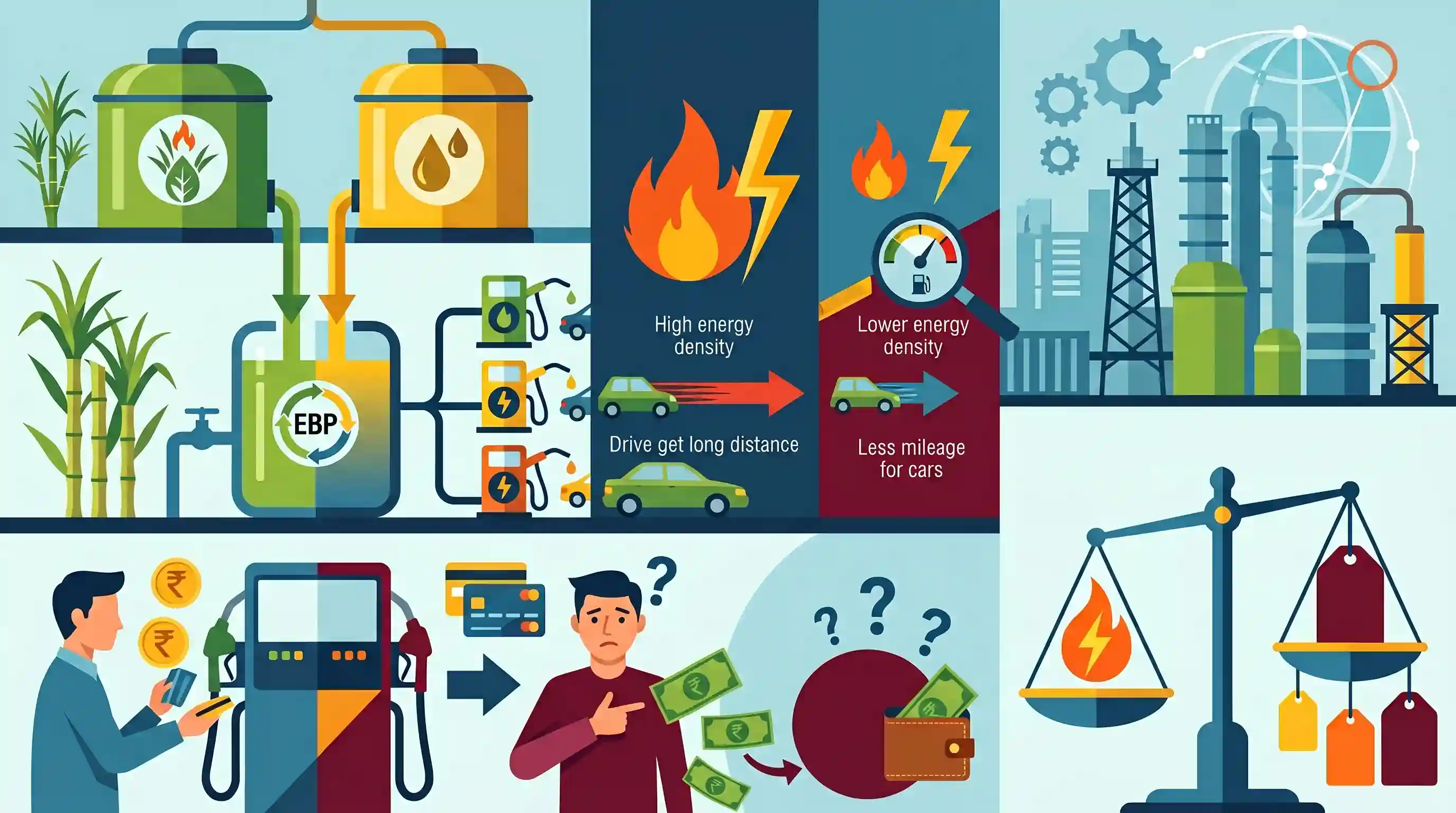
Why It Matters
Biofuels are a major component of India's climate targets, agriculture economy (sugarcane/grain surplus), and import substitution strategy. Understanding the economic mechanics of pricing blended fuels is crucial for evaluating the real-world impact of the policy on inflation and consumer welfare, directly overlapping with GS3 Economy and Environment.
Summary
The article highlights a critical but often overlooked aspect of India's Ethanol Blended Petrol (EBP) programme: the lack of transparency in the pricing of blended fuel. As India pushes towards its E20 (20% ethanol blending) target by 2025, consumers are increasingly purchasing petrol mixed with ethanol. However, ethanol possesses roughly 33% lower energy density than pure petrol, meaning blended fuel inherently yields lower mileage. Because Oil Marketing Companies (OMCs) typically sell E20 at the same per-litre price as unblended or E10 petrol, consumers bear a hidden cost, effectively paying more per unit of energy. The author argues that true energy security and policy fairness require calorific value-based pricing, ensuring consumers are not financially penalized for the reduced fuel efficiency of ethanol blends.
Key Points
- India is rapidly advancing its Ethanol Blended Petrol (EBP) programme, targeting a 20% ethanol blend (E20) by 2025 to reduce crude oil imports and carbon emissions.
- Ethanol has approximately 33% lower calorific value (energy density) than pure petrol, which results in proportionately lower fuel efficiency (mileage) for vehicles running on E20.
- Currently, there is a lack of price differentiation at the pump; consumers pay the same volume-based price for blended petrol despite its lower energy yield.
- This uniform pricing structure creates an unacknowledged cost burden on consumers, who effectively subsidize the blending program through reduced vehicular mileage.
- The article advocates for pricing transparency and a transition to calorific value-based pricing, ensuring consumers do not bear a hidden economic cost for adopting greener fuels.
Important Terms
Ethanol Blended Petrol (EBP) Programme

A 2003 government initiative aimed at mixing ethanol with petrol to reduce India's heavy reliance on imported crude oil, lower carbon emissions, and support agricultural incomes.
UPSC context
GS Paper 3 (Energy/Economy); tests understanding of energy security strategies and sustainable fuel initiatives.
National Policy on Biofuels
A policy framework (amended in 2022) that categorizes biofuels into generations (1G, 2G, 3G) and advanced the 20% ethanol blending target to the 2025-26 supply year.
UPSC context
GS Paper 3 (Environment/Energy); focuses on government schemes for pollution control and climate commitments like Net Zero 2070.
Oil Marketing Companies (OMCs)
Public sector entities (like IOCL, BPCL, HPCL) responsible for procuring ethanol from distilleries and ensuring the retail availability of blended petrol across the country.
UPSC context
GS Paper 3 (Infrastructure/Energy); evaluates the role of state-owned enterprises in implementing central energy mandates.
E20 Fuel
A fuel mixture consisting of 20% ethanol and 80% petrol; it requires engine modifications for full compatibility and is the current nationwide target for 2025.
UPSC context
GS Paper 3 (Science & Tech); examines technological transitions in the transport sector and alternative energy adoption.
Calorific Value (Energy Density)
The measure of energy released during fuel combustion; ethanol’s lower energy density (roughly 33% less than petrol) leads to reduced vehicle mileage in high-blend fuels.
UPSC context
GS Paper 3 (Science); basic physical principles explaining why fuel efficiency varies between different chemical compositions.
Second-Generation (2G) Ethanol
Ethanol derived from non-food agricultural residues like rice straw and corn cobs, aimed at avoiding the 'food vs fuel' conflict and reducing stubble burning.
UPSC context
GS Paper 3 (Science/Environment); tests knowledge of advanced biofuel technology and its role in the circular bio-economy.
Prelims Trap
"Ethanol blending increases the calorific value of the fuel, thereby improving vehicular fuel efficiency."
Ethanol has ~33% lower energy density than pure petrol. Higher blends (like E20) inherently reduce vehicular mileage per litre, which is a hidden cost to consumers.
Static Concepts Connected
What are the permitted feedstocks for ethanol production in India?
- 1G (First Gen): Sugarcane juice, B-heavy/C-heavy molasses, surplus rice from FCI, and maize.
- 2G (Second Gen): Lignocellulosic biomass, agricultural waste (stubble), and bagasse.
- 3G (Third Gen): Algae and genetically modified organisms (mostly experimental/future focus).
What is calorific value-based pricing?
- Core Mechanism: Pricing commodities based on actual thermal energy yielded rather than physical volume (litres/kilograms).
- Consumer Protection: It prevents consumers from paying equal rates for lower-efficiency fuels (like E20), which yield less mileage than pure petrol.
Cross-Topic Patterns
Biofuels vs. Food Security debate
Diverting surplus rice and maize to ethanol production directly links GS-3 energy security targets to PDS pressures, MSP policies, and food inflation risks.
Flex-fuel vehicles and PLI Auto
Higher ethanol blends are corrosive to standard engines. This links the E20 mandate to India's push for Flex-Fuel Vehicles (FFVs) and the PLI scheme for the auto sector.

Expect a 2026 Prelims multi-statement question testing the calorific values of petrol vs ethanol alongside permitted 1G/2G feedstocks.
Linked PYQs · 4
Linked PYQs · 4
- 2025PrelimsGS1
Consider the following statements : Statement I: Of the two major ethanol producers in the world, i.e., Brazil and the United States of America, the former produces more ethanol than the latter. Statement II: Unlike in the United States of America where corn is the principal feedstock for ethanol production, sugarcane is the principal feedstock for ethanol production in Brazil. Which one of the following is correct in respect of the above statements?
- 2020PrelimsGS1
According to India's National Policy on Biofuels, which of the following can be used as raw materials for the production of biofuels ? 1. Cassava 2. Damaged wheat grains 3. Groundnut seeds 4. Horse gram 5. Rotten potatoes 6. Sugar beet Select the correct answer using the code given below:
- 2009PrelimsGS1
In the context of alternative sources of energy, ethanol as a viable bio-fuel can be obtained from
- 2023MainsGS3
Discuss several ways in which microorganisms can help in meeting the current fuel shortage.
