Macroeconomic Frameworks for Estimating India Potential Growth
Source:The Hindu ↗
Why It Matters
The concept of Potential GDP, savings rate, and capital-output ratio are core macroeconomic concepts explicitly mentioned in the GS3 syllabus and frequently tested by UPSC (e.g., Prelims 2018 on high capital-output ratio and Mains 2020 on potential GDP determinants). This analysis provides the analytical foundation needed to evaluate India's growth trajectory and formulate policies to overcome structural economic bottlenecks.
Summary
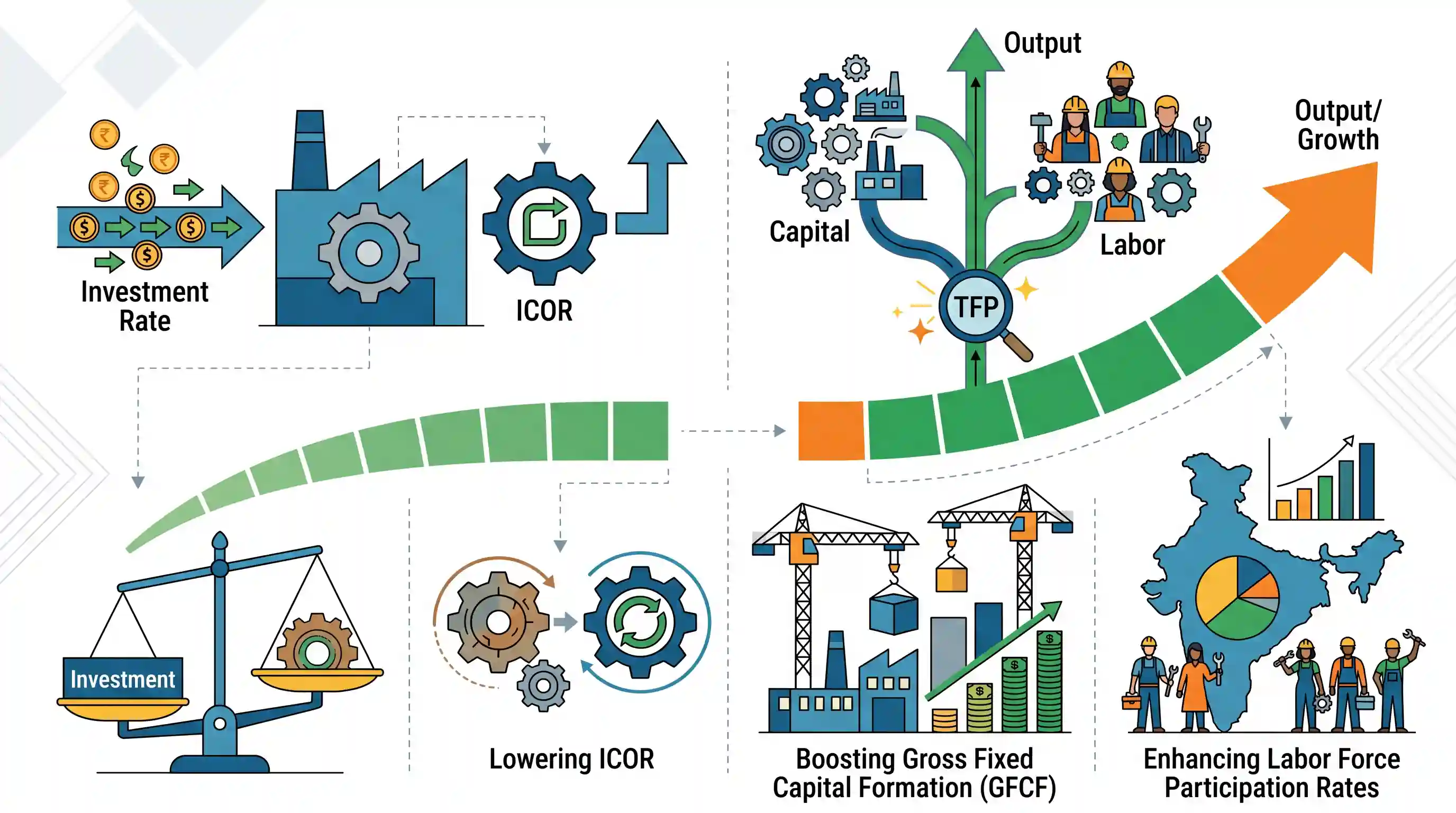
The article examines the macroeconomic frameworks used to estimate India's potential growth rate—the highest sustainable economic expansion possible without inducing excessive inflation. It juxtaposes the Harrod-Domar model, which hinges on the interplay between the investment rate and the Incremental Capital-Output Ratio (ICOR), against the production function approach encompassing capital, labor, and Total Factor Productivity (TFP). The analysis asserts that to elevate India's potential growth beyond the 6.5–7% baseline, structural interventions are imperative. These include boosting Gross Fixed Capital Formation (GFCF), addressing capital inefficiencies to lower the ICOR, and enhancing labor force participation rates. The insights directly address the barriers inhibiting India from fully realizing its potential GDP.
Key Points
- Potential growth rate is the maximum sustainable output an economy can achieve without triggering excess inflation, typically estimated using the Harrod-Domar or Production Function approaches.
- Under the Harrod-Domar model, economic growth is determined by the Investment Rate (Gross Fixed Capital Formation) divided by the Incremental Capital-Output Ratio (ICOR).
- For India to achieve an 8% growth trajectory, it requires a significant increase in the investment rate beyond the current ~32% level and an improvement in capital efficiency to lower the ICOR.
- High savings and capital formation may fail to yield high growth if the capital-output ratio is elevated, underscoring the need for infrastructural efficiency and reduced project gestation periods.
- Total Factor Productivity (TFP) and labor force participation (especially female workforce participation) are pivotal non-capital determinants that must be augmented to realize higher potential GDP.
Important Terms
Potential Growth Rate

The maximum sustainable rate at which an economy can grow without causing overheating or excessive inflation. It represents the economy's underlying productive capacity based on labor, capital, and efficiency.
UPSC context
GS3 (Growth, Planning). Vital for understanding the gap between actual performance and sustainable capacity and identifying structural bottlenecks.
Harrod-Domar Model
A growth model stating that economic expansion depends on the savings rate and capital productivity. It posits that higher savings and a lower capital-output ratio accelerate national income growth.
UPSC context
GS3 (Investment Models). Significant for understanding India's First Five-Year Plan and the relationship between savings and growth.
Incremental Capital-Output Ratio (ICOR)
A metric measuring the additional capital required to generate one unit of output. A lower ICOR signifies high capital efficiency, meaning less investment is needed for more growth.
UPSC context
GS3 (Growth and Development). Crucial for assessing investment efficiency and planning resource allocation to achieve GDP targets.
Total Factor Productivity (TFP)
The component of economic growth derived from efficiency and technological innovation rather than just increases in labor or capital inputs. It measures the effectiveness of resource utilization.
UPSC context
GS3 (Growth, Development). Important for evaluating long-term sustainability and the impact of structural reforms on economic efficiency.
Gross Fixed Capital Formation (GFCF)
A macroeconomic indicator representing the total value of net investment in fixed assets like infrastructure, machinery, and equipment within an economy during a specific period.
UPSC context
GS3 (Resource Mobilization). Key measure for tracking investment trends and the private sector's contribution to productive capacity.
Reserve Bank of India (RBI)
India’s central bank and monetary authority. It regulates the banking system, manages foreign exchange, and estimates potential growth to guide interest rate and inflation targeting decisions.
UPSC context
GS3 (Economy, Monetary Policy). Essential for topics on institutional frameworks, price stability, and macroeconomic management.
Prelims Trap
"A higher Incremental Capital-Output Ratio (ICOR) indicates better capital efficiency and leads to higher economic growth."
A high ICOR actually implies inefficiency. It means more capital is required to produce a single additional unit of output, which depresses the overall growth rate if investment remains constant.
Static Concepts Connected
What determines the Incremental Capital-Output Ratio (ICOR) and how does it impact growth?
- Definition: It measures the additional capital required to produce one additional unit of economic output.
- Growth Impact: An inverse relationship exists. Given a constant investment rate, a lower ICOR (higher efficiency) yields higher GDP growth.
- Influencing Factors: Technology upgrades, skilled labor, better infrastructure, and reduced project gestation periods help lower the ICOR.
What is the relationship between Potential GDP, Actual GDP, and the Output Gap?
- Potential GDP: The highest level of real output an economy can sustain over time without driving up inflation.
- Output Gap: The macroeconomic difference between actual GDP and potential GDP.
- Inflation Link: A positive output gap (actual > potential) causes demand-pull inflation, while a negative gap indicates underutilized resources and high unemployment.
Cross-Topic Patterns
Demographics, FLFP, and Total Factor Productivity
Low female workforce participation artificially restricts India's potential GDP by underutilizing the labor factor in the production function, acting as a structural bottleneck to Total Factor Productivity (TFP).
Gati Shakti's impact on India's ICOR
Schemes like PM Gati Shakti aim to reduce logistics costs and project delays. Macroeconomically, this directly targets lowering India's ICOR to boost potential growth without requiring a higher savings rate.

Expect a multi-statement Prelims question linking ICOR, Total Factor Productivity, and inflation triggers during high-growth periods.
Linked PYQs · 3
Linked PYQs · 3
- 2020MainsGS3
Define potential GDP and explain its determinants. What are the factors that have been inhibiting India from realizing its potential GDP?
- 2017MainsGS3
Among several factors for India's potential growth, savings rate is the most effective one. Do you agree? What are the other factors available for growth potential?
- 2018PrelimsGS1
Despite being a high saving economy, capital formation may not result in significant increase in output due to
