Statistical Database Overhaul for Accurate Macroeconomic Data
Source:The Hindu ↗
Why It Matters
Accurate and up-to-date economic statistics are vital for the formulation of sound monetary and fiscal policies. For UPSC aspirants, understanding the differences between CPI, WPI, and PPI, as well as concepts like base year revision and the double-deflator method, is crucial for both Prelims and Mains (GS Paper 3) as they directly relate to national income accounting and inflation targeting.
Summary
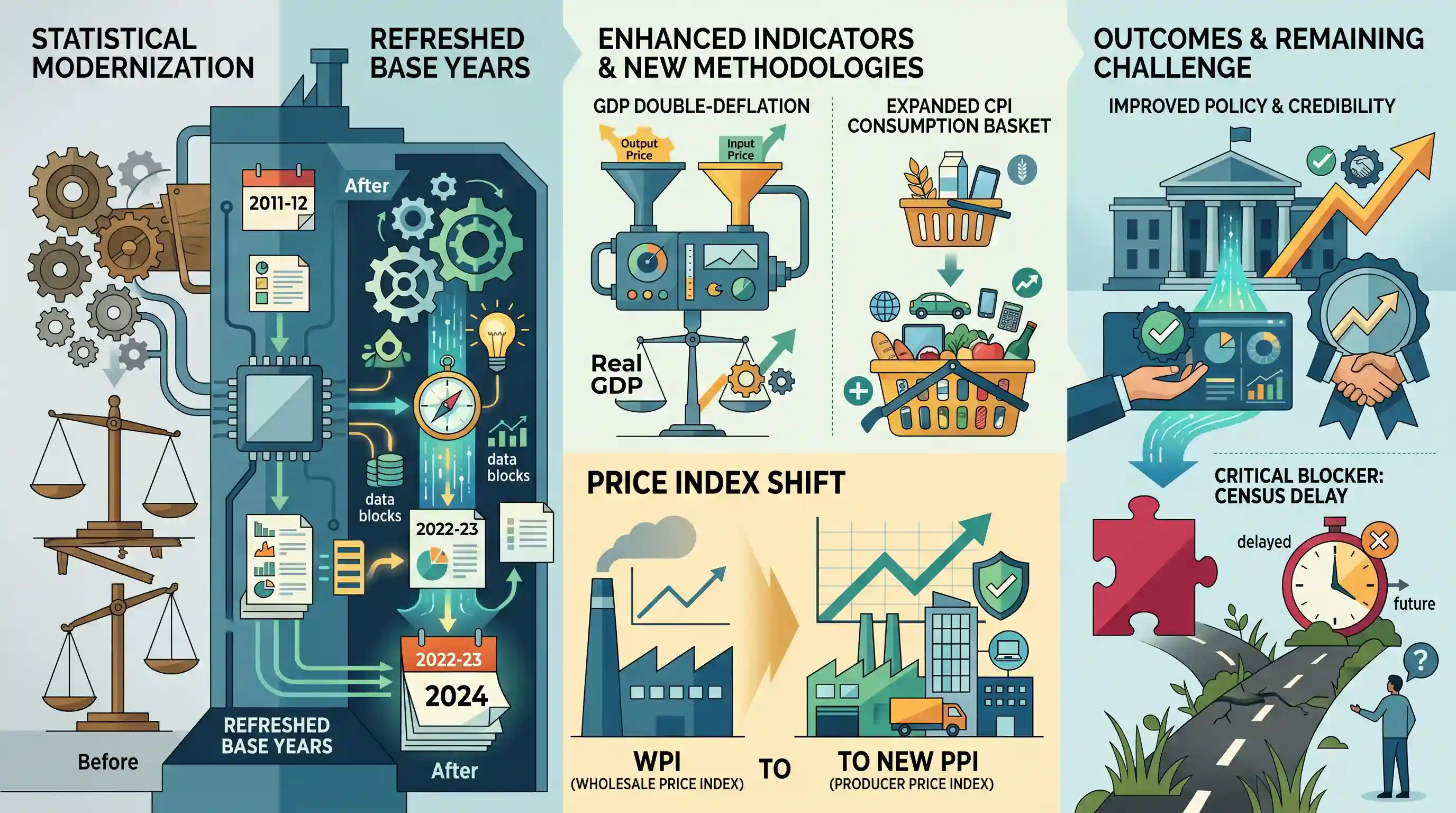
India's statistical infrastructure is undergoing a long-overdue overhaul with the government advancing the base years for key economic indicators including GDP, CPI, and IIP. The updates aim to modernize macroeconomic measurement by introducing methodologies like the double-deflator approach for GDP, expanding the CPI consumption basket, and launching a new Producer Price Index (PPI) to replace the WPI. These critical upgrades are expected to improve policy formulation and restore the credibility of Indian data, addressing concerns previously raised by institutions like the IMF. However, a complete statistical modernization also hinges on the timely execution of the delayed decadal Census.
Key Points
- The Indian government is initiating a major upgrade of its macroeconomic statistical databases by advancing the base years for GDP, IIP, and CPI.
- The GDP base year will shift to 2022-23 and will incorporate a 'double-deflator approach' to more accurately reflect value addition by accounting for distinct input and output price trends.
- The Consumer Price Index (CPI) base year is being updated to 2024, expanding its basket of goods and services to better track modern consumption patterns, including out-of-pocket health expenditures.
- The Index of Industrial Production (IIP) base year is also moving to 2022-23 to mirror current manufacturing and industrial activities.
- The Commerce Ministry has introduced a Producer Price Index (PPI) which is intended to gradually replace the Wholesale Price Index (WPI) over the next five years.
- These upgrades are critical to restoring the credibility of India's official data, which had drawn a recurring 'C' grade from the IMF due to obsolescence.
- A robust statistical framework will also require the timely release of the long-delayed Census data to provide accurate demographic foundations.
Important Terms
Gross Domestic Product (GDP)

The total market value of all final goods and services produced within a country's borders; recently rebased to 2022-23 to accurately reflect India's post-pandemic economic structure.
UPSC context
GS-3: Indian Economy; essential for understanding National Income Accounting and growth trends.
Consumer Price Index (CPI)
A measure of retail-level price changes for a basket of consumer goods and services; used by the RBI as the primary anchor for monetary policy.
UPSC context
GS-3: Inflation; critical for monetary policy and cost-of-living assessments.
Producer Price Index (PPI)
An upcoming indicator measuring average price changes received by domestic producers for their output, excluding indirect taxes and trade margins, intended to replace the Wholesale Price Index.
UPSC context
GS-3: Economic Reforms; represents a shift toward global standards in inflation measurement.
Double-deflator approach
A statistical method that separately deflates the value of output and the value of intermediate inputs to calculate real Gross Value Added, preventing growth overestimation.
UPSC context
GS-3: National Income; a technical methodology key to improving GDP data credibility.
Index of Industrial Production (IIP)
A composite indicator measuring short-term volume changes in the production of industrial products across mining, manufacturing, and electricity sectors.
UPSC context
GS-3: Industrial Sector; used to assess industrial growth and high-frequency economic health.
Base Year
The reference point (e.g., 2022-23 for GDP/IIP) against which economic variables are compared to measure real growth by filtering out inflation.
UPSC context
GS-3: Statistics; fundamental for interpreting all macroeconomic indices and growth rates.
Wholesale Price Index (WPI)
Measures price changes of goods at the wholesale level (bulk sales); it excludes services and is being phased out in favor of the PPI.
UPSC context
GS-3: Inflation; historically used for deflating nominal GDP before the shift to double-deflation.
Prelims Trap
The 'double-deflator' approach calculates real GDP by adjusting nominal GDP using a weighted average of both the WPI and CPI.
It actually involves separately deflating the value of outputs and the value of intermediate inputs using distinct price indices to accurately calculate real GVA.
Static Concepts Connected
What is the double-deflation method in Gross Value Added (GVA) calculation?
- Output adjustment: Deflates the gross value of output using an output price index.
- Input adjustment: Deflates intermediate inputs separately using relevant input price indices.
- Primary benefit: Prevents GVA overestimation or underestimation when raw material costs fall but final product prices remain rigid.
How does the Producer Price Index (PPI) fundamentally differ from the Wholesale Price Index (WPI)?
- Sector coverage: PPI captures price changes across both goods and services, whereas the traditional WPI framework exclusively tracks goods.
- Tax exclusion: PPI generally measures basic prices received by producers excluding indirect taxes, making it a purer metric of producer inflation.
Cross-Topic Patterns
Monetary policy & new CPI basket
The RBI's Monetary Policy Committee relies strictly on CPI. Altering the 2024 basket's food and health weights will shift baseline inflation readings, directly impacting repo rate decisions and real interest rates.
Census delays & social welfare
Modernizing macro-indicators clashes with delayed demographic data. Missing 2021 Census figures directly hamper NFSA beneficiary updates, delimitation exercises, and accurate per-capita GDP targeting for government schemes.

Expect a multi-statement question in 2026 comparing the new PPI framework with WPI, alongside the double-deflator method's impact on GVA.
Linked PYQs · 3
Linked PYQs · 3
- 2020PrelimsGS1
Consider the following statements: 1. The weightage of food in Consumer Price Index (CPI) is higher than that in Wholesale Price Index (WPI). 2. The WPI does not capture changes in the prices of services, which CPI does. 3. Reserve Bank of India has now adopted WPI as its key measure of inflation and to decide on changing the key policy rates. Which of the statements given above is/are correct?
- 2021MainsGS3
Explain the difference between computing methodology of India's Gross Domestic Product (GDP) before the year 2015 and after the year 2015.
- 1997PrelimsGS1
In India, inflation is measured by the
