Essential Commodities Act and Inflation Management
Source:Indian Express ↗
Why It Matters
Understanding the Essential Commodities Act is critical for GS3, as it bridges statutory governance with macroeconomic inflation control and agricultural supply chain management. It highlights how domestic policy responds to global geopolitical shocks.
Summary
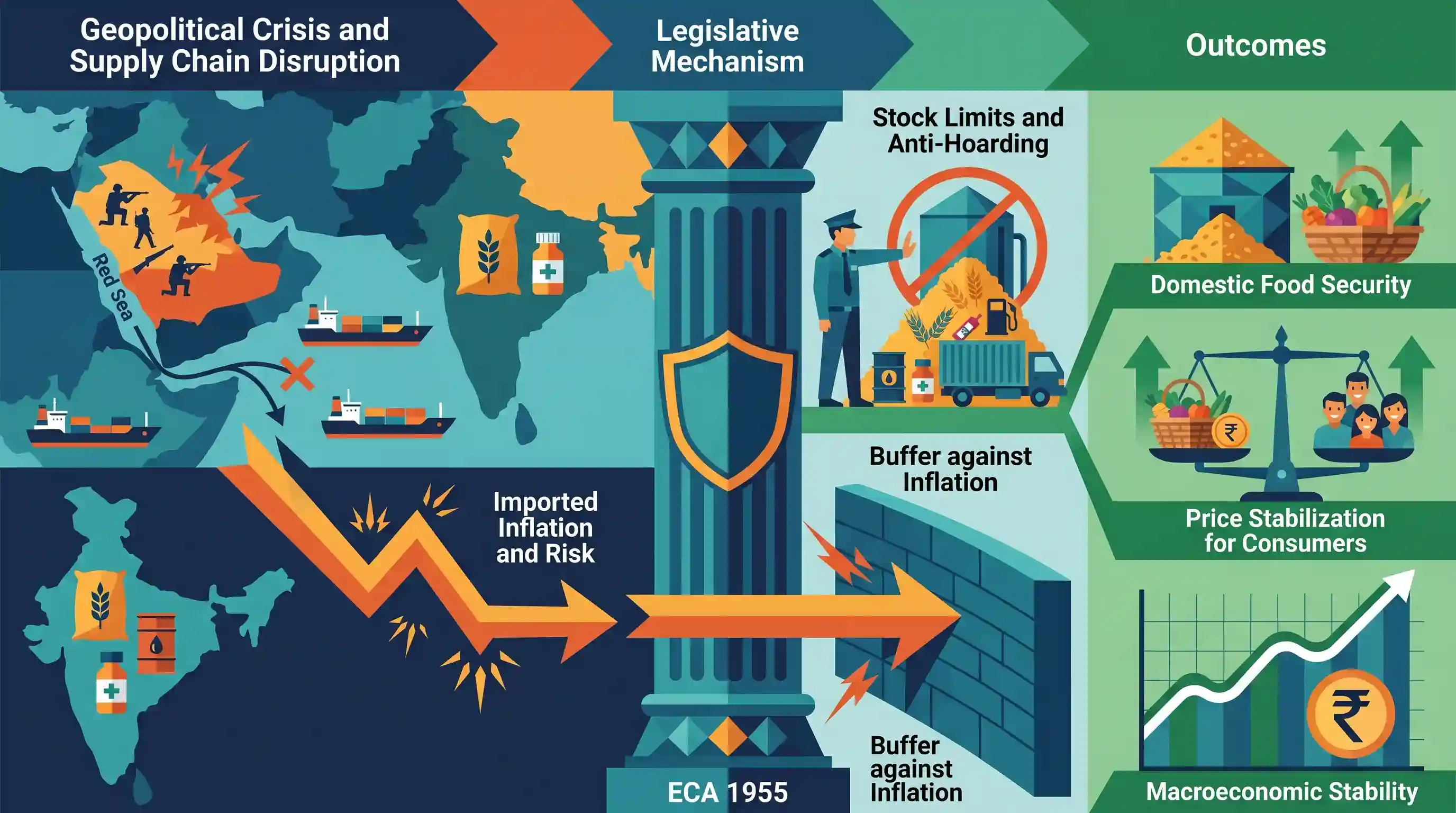
The Essential Commodities Act (ECA), 1955, is a primary legislative mechanism used by the Indian government to manage the supply and pricing of critical goods, such as foodstuff, fuel, and drugs. Amidst the ongoing West Asian crisis—which has disrupted maritime shipping routes like the Red Sea and heightened inflation risks—the ECA is invoked to impose stock limits and deter hoarding. This statutory intervention acts as a buffer against imported inflation and supply chain disruptions, ensuring domestic food security and stabilizing prices for consumers.
Key Points
- The Essential Commodities Act (ECA), 1955 grants the central government the power to declare certain items as 'essential' to regulate their supply, production, and distribution.
- It is a crucial tool to prevent hoarding and black-marketing, ensuring consumer access to essential commodities at fair prices.
- The ongoing West Asian crisis and disruptions in Red Sea shipping routes have strained global supply chains, increasing the risk of domestic price inflation for imported goods like edible oils and fuels.
- By imposing stock limits under the ECA, the government can buffer domestic markets from external supply shocks and artificial scarcity.
Important Terms
Essential Commodities Act (ECA), 1955

A 1955 law empowering the Central Government to regulate the production, supply, distribution, and pricing of commodities like food, fuel, and drugs to ensure public availability.
UPSC context
GS Paper 3 (Economy/Agriculture); tests government intervention mechanisms for price stability and market regulation.
Stock Limits
Statutory ceilings on the maximum quantity of essential goods traders can legally store, implemented to release supplies into the market and prevent artificial price hikes.
UPSC context
GS Paper 3 (Supply Chain); evaluates administrative tools used to prevent artificial scarcity and manage food inflation.
Hoarding
The act of accumulating and withholding essential goods from the market to create artificial shortages, aiming to profit from subsequent price spikes.
UPSC context
GS Paper 3 (Food Security); focuses on socio-economic offenses and the legal deterrents provided under the ECA.
Imported Inflation
Inflationary pressure caused by rising costs of imported inputs (e.g., crude oil) or domestic currency depreciation, which increases the retail price of imported goods.
UPSC context
GS Paper 3 (Macroeconomics); tests understanding of external shocks and their impact on the Consumer Price Index (CPI).
Food Security
Ensured physical and economic access to sufficient, safe, and nutritious food for all, maintained via buffer stocks, PDS, and price regulations under the ECA.
UPSC context
GS Paper 3 (Agriculture); core to discussions on public distribution, agricultural marketing, and welfare state responsibilities.
Black Marketing
The illegal trade of essential goods at prices exceeding government-fixed rates, often occurring during periods of scarcity or stringent price controls.
UPSC context
GS Paper 3 (Economy); tests the legal framework (e.g., PBMMSEC Act 1980) for ensuring fair distribution of goods.
Prelims Trap
State governments can independently add items to the list of essential commodities to control local inflation.
Only the Central Government holds the power to add or remove items from the Schedule of the ECA, 1955, even though State governments execute the orders and impose stock limits.
Static Concepts Connected
What is the mechanism of the Essential Commodities Act, 1955?
- Central Power: The Union government can notify any commodity as 'essential' by amending the Act's Schedule.
- Delegated execution: Powers are predominantly delegated to State Governments/UTs to issue control orders, issue licenses, and impose stock limits.
- Covered items: Currently includes drugs, fertilizers, foodstuffs (edible oils, pulses), petroleum and petroleum products, and raw jute.
What is Imported Inflation and how does it manifest?
- Definition: A general and sustainable price increase within a country due to a rise in costs of imported products or raw materials.
- Primary Drivers: Triggered by global supply shocks, international commodity price surges, geopolitical crises (e.g., Red Sea shipping reroutes), or domestic currency depreciation.
- Indian Vulnerability: India is particularly vulnerable via its heavy reliance on imported crude oil, edible oils, and fertilizers.
Cross-Topic Patterns
Red Sea crisis & domestic CPI
Disruption in maritime chokepoints like the Bab-el-Mandeb strait directly feeds into India's domestic CPI inflation via elevated freight, insurance costs, and delayed shipments.
Farmer incomes vs. Consumer inflation
Imposing ECA stock limits often crashes farm-gate prices, highlighting the classic policy friction between inflation targeting for consumers, farmer income welfare, and free-market agriculture.

A linked question covering Red Sea chokepoint geography, the mechanics of imported inflation, and statutory responses like the ECA is highly probable for Prelims 2026.
Linked PYQs · 5
Linked PYQs · 5
- 2015PrelimsGS1
In India, markets in agricultural products are regulated under the
- 2025MainsGS3
Elaborate the scope and significance of supply chain management of agricultural commodities in India.
- 2024MainsGS3
What are the causes of persistent high food inflation in India? Comment on the effectiveness of the monetary policy of the RBI to control this type of inflation.
- 2024MainsGS3
Elucidate the importance of buffer stocks for stabilizing agricultural prices in India. What are the challenges associated with the storage of buffer stock? Discuss.
- 2014MainsGS3
There is also a point of view that Agricultural Produce Market Committees (APMCs) set up under the State Acts have not only impeded the development of agriculture but also have been the cause of food inflation in India. Critically examine.
