India Space Sector Commercialization and Launch Vehicle Capacity
Source:The Hindu ↗
ఇది ఎందుకు ముఖ్యం
The commercialization of space and the entry of private start-ups (IN-SPACe, NSIL) are key components of India's current Science and Technology strategy. Understanding the economic bottlenecks, such as high launch costs and low frequency, is crucial for GS-3 answers on space technology and infrastructure.
సారాంశం
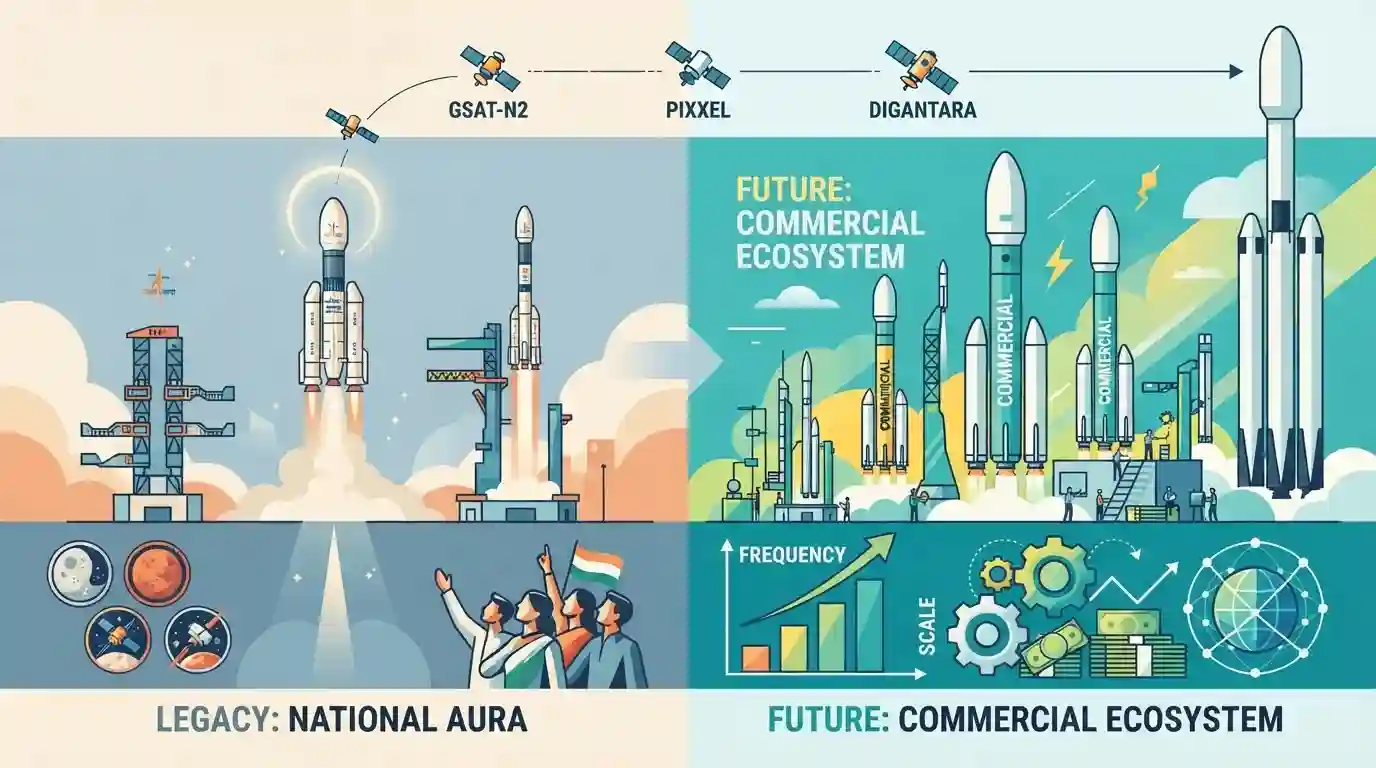
The editorial evaluates the current trajectory of India’s space sector, emphasizing the urgent need to transition from a legacy of building "national aura" to establishing a competitive, business-driven ecosystem. Despite recent achievements and the celebration of National Space Day, India suffers from a low launch cadence and a high cost-per-kg to low-earth orbit compared to global competitors. This lack of scale and heavy-lift capacity forces Indian payloads, including the GSAT-N2 satellite and start-ups like Pixxel and Digantara, to rely on foreign providers like SpaceX. The article argues that the true measure of success for India's space sector will not be romanticized lunar bases, but the ability to provide economical, frequent commercial launches that generate jobs, capital, and tax revenues.
ముఖ్య అంశాలు
- Historically, India’s space programme has been a source of national pride, but the focus must now shift towards building a sustainable business engine for the private sector.
- Indian space launches currently face a high cost-per-kg to low-earth orbit (approx. $13,302), significantly more than the U.S. and China, driven by low launch frequency.
- The lack of frequent flights and adequate heavy-lift capabilities (like those beyond LVM-3) forces Indian payloads (like GSAT-N2) and start-ups (Pixxel, Digantara) to rely on foreign rockets such as SpaceX’s Falcon 9.
- To secure a larger share of the global space economy, India must prioritize economies of scale, economical heavy-lift commercial launches, job creation, and tax revenues over purely ornamental space exploration.
ముఖ్యమైన పదాలు
National Space Day

Celebrated annually on August 23rd in India to commemorate the historic soft landing of the Chandrayaan-3 spacecraft on the Moon's south-polar region in 2023.
UPSC context
GS-3 (Science & Tech); tests awareness of major national technological milestones, space policy, and scientific achievements.
Chandrayaan-3
India's third lunar exploration mission by ISRO that achieved a historic soft landing near the lunar south pole on August 23, 2023, making India the fourth nation to land on the Moon.
UPSC context
GS-3 (Science & Tech); tests knowledge of indigenous space missions, lunar exploration milestones, and self-reliance in science.
GSAT-N2
A 4,700 kg high-throughput Ka-band communication satellite developed by ISRO and successfully launched in November 2024 via SpaceX's Falcon 9 rocket under a commercial contract with NewSpace India Limited.
UPSC context
GS-3 (Science & Tech); tests understanding of satellite communication infrastructure, heavy-lift commercial launches, and private international partnerships.
Pixxel
A leading Indian private space-technology startup building a commercial constellation of advanced, high-resolution hyperspectral imaging satellites to provide detailed planetary earth observation data.
UPSC context
GS-3 (Private Sector Space Participation); tests awareness of private commercial space ventures, indigenization of technology, and remote sensing.
Digantara
An Indian space-technology startup specializing in Space Situational Awareness (SSA) and space traffic management, famously launching Mission SCOT to track orbital debris and resident space objects.
UPSC context
GS-3 (Space Security/Debris); tests understanding of space debris, Space Situational Awareness systems, and startup-led solutions for orbital safety.
ISRO
India's premier national space agency, established in 1969 under the Department of Space, responsible for conducting space research, executing planetary exploration, and developing launch vehicles.
UPSC context
GS-3 (Science & Tech); tests foundational knowledge of Indian institutions, indigenous space programs, and technological achievements.
ప్రిలిమ్స్ ఉచ్చు
"NSIL exclusively uses ISRO's indigenous launch vehicles for placing all Indian government payloads into orbit."
NSIL actively partners with foreign providers like SpaceX for payloads exceeding ISRO's capacities, such as the 4,700 kg GSAT-N2 satellite.
అనుసంధానమైన స్థిర భావనలు
What are the payload capabilities of India's LVM-3 rocket?
- GTO Capacity: Can carry payloads up to 4,000 kg (4 tonnes) into Geosynchronous Transfer Orbit (GTO).
- LEO Capacity: Capable of placing up to 8,000 kg (8 tonnes) into Low Earth Orbit (LEO).
- Three Stages: Comprises two solid strap-on motors, a liquid core stage, and an indigenous cryogenic upper stage.
What are the roles of IN-SPACe and NSIL under the Indian Space Policy 2023?
- IN-SPACe: Acts as the single-window autonomous regulator to authorize, promote, and supervise private non-governmental entities in space.
- NSIL: The commercial public-sector arm handling business operations, satellite launches, and manufacturing under a demand-driven model.
- ISRO: Transitions away from routine manufacturing/launches to focus exclusively on advanced R&D and deep-space exploration.
అంతర-అంశ నమూనాలు
Space FDI and commercial expansion
Connects India's push for space commercialization with the 2024 amendment allowing up to 100% FDI in the space sector (via automatic route for specific sub-sectors) to boost domestic start-ups.
Space Debris and Situational Awareness (SSA)
Startups like Digantara launching debris-trackers link commercial space expansion with the critical need for Space Situational Awareness (SSA), tying into ISRO's Project NETRA and global space traffic management.

Expect multi-statement questions testing LVM-3 payload limits (4,000kg to GTO) against the distinct regulatory mandates of NSIL & IN-SPACe.
అనుసంధాన PYQలు · 3
అనుసంధాన PYQలు · 3
- 2016MainsGS3
Discuss India's achievements in the field of Space Science and Technology. How the application of this technology has helped India in its socio-economic development?
- 2018PrelimsGS1
With reference to India's satellite launch vehicles, consider the following statements: 1. PSLVs launch the satellites useful for Earth resources monitoring whereas GSLVs are designed mainly to launch communication satellites. 2. Satellites launched by PSLV appear to remain permanently fixed in the same position in the sky, as viewed from a particular location on Earth. 3. GSLV Mk III is a four-staged launch vehicle with the first and third stages using solid rocket motors; and the second and fourth stages using liquid rocket engines. Which of the statements given above is/are correct?
- 2019MainsGS3
What is India's plan to have its own space station and how will it benefit our space programme?
