Direct Military Escalation Deepens Israel Iran Strategic Crisis
Source:The Hindu ↗
Why It Matters
The transition from 'shadow wars' to direct state-on-state confrontation between Israel and Iran fundamentally alters the security architecture of West Asia. For UPSC aspirants, understanding this conflict is crucial due to its profound implications for India's strategic interests, its diaspora in the Middle East, and the potential disruption of global energy supply chains and maritime choke points like the Strait of Hormuz.
Summary
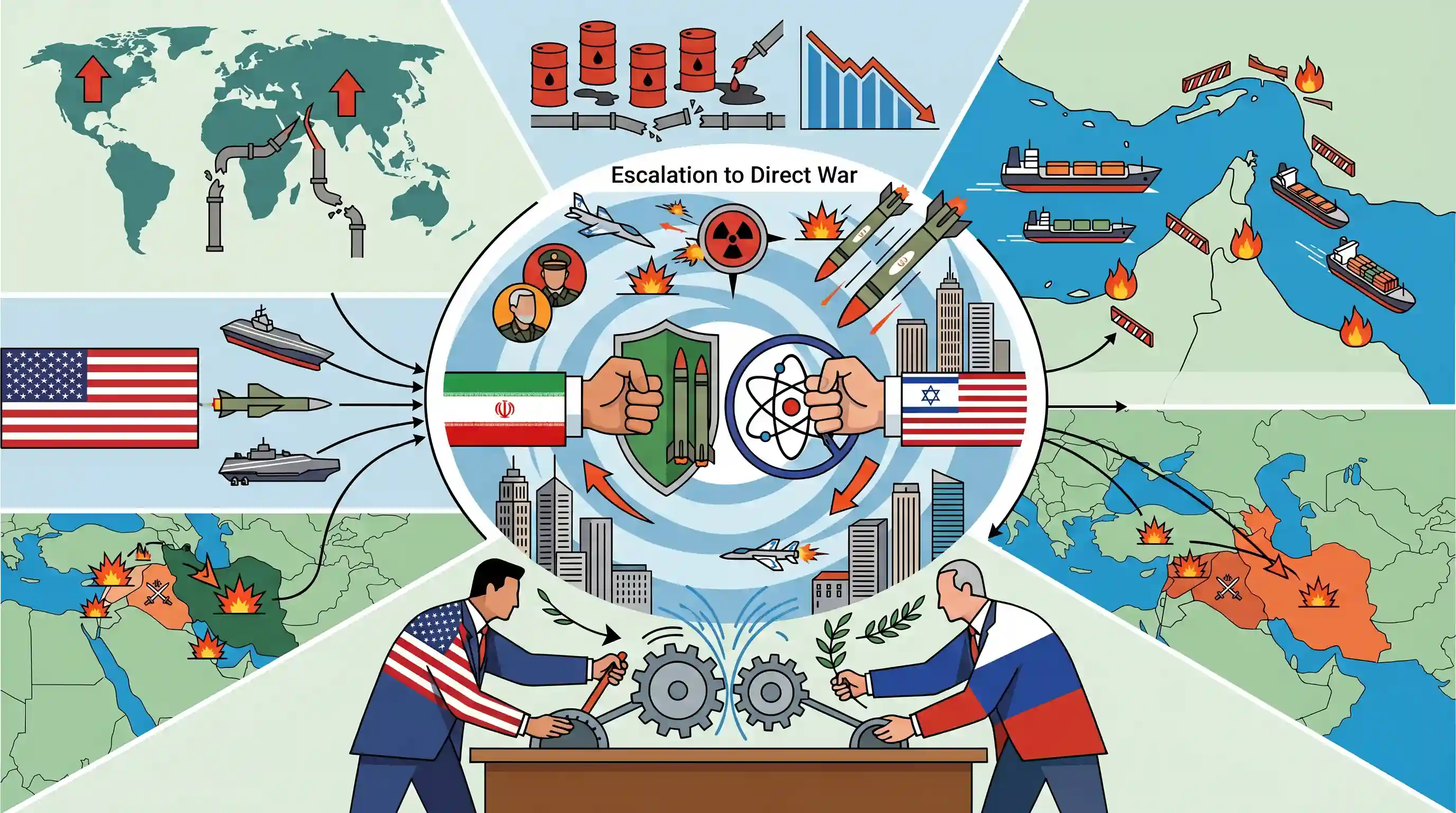
The editorial highlights the perilous escalation in the Israel-Iran conflict, marking a profound shift from covert proxy warfare to direct, intense military engagement. Israel’s preemptive attacks on Iran’s nuclear capabilities and top generals have triggered massive retaliatory ballistic missile strikes by Tehran on major Israeli cities. The conflict dynamics have evolved: Iran now seeks 'deterrence through offence', while Israel and the U.S. push for complete Iranian capitulation regarding its nuclear programme. This escalating spiral risks drawing in the United States and threatens vital global economic chokepoints like the Strait of Hormuz and the Persian Gulf. Preventing a disastrous broader regional war and a subsequent global energy crisis requires immediate, coordinated diplomatic intervention by major powers, particularly the U.S. and Russia.
Key Points
- Direct military confrontation has replaced proxy warfare, with Israel attacking Iranian nuclear infrastructure and leadership, and Iran retaliating with massive ballistic missile barrages on Israeli cities.
- Iran has adopted a new strategy of 'deterrence through offence', shifting away from restraint and directly utilising its ballistic missile arsenal to establish new red lines.
- The U.S., under President Donald Trump, and Israel are pursuing maximum pressure, aiming for a total halt to Iranian nuclear enrichment and potential regime change.
- The escalating conflict severely threatens global energy security, as Iranian retaliation could target critical maritime choke points like the Strait of Hormuz and the Gulf of Oman.
- Urgent diplomatic mediation, requiring coordination between the U.S. and Russia, is essential to halt the escalation spiral and prevent a catastrophic regional war.
Prelims Trap
"Unlike Israel, Iran has formally withdrawn from the Nuclear Non-Proliferation Treaty (NPT)."
Iran withdrew from the JCPOA commitments, not the NPT. Iran remains a signatory to the NPT, whereas Israel has never signed it.
Static Concepts Connected
Which water bodies do the Strait of Hormuz and Gulf of Oman connect?
- Strait of Hormuz: Connects the Persian Gulf to the Gulf of Oman. It is bordered by Iran to the north and Oman (Musandam peninsula) to the south.
- Gulf of Oman: Connects the Strait of Hormuz to the Arabian Sea. It is bordered by Iran and Pakistan to the north, and Oman and the UAE to the south.
What are the technical thresholds for Uranium Enrichment?
- Low-Enriched (LEU): Under 20% U-235 concentration. Typically, commercial nuclear power plants require uranium enriched to about 3-5%.
- Highly Enriched (HEU): Contains 20% or more U-235. Often used in research reactors and for producing medical isotopes.
- Weapons-grade: Generally considered to be 90% or higher U-235 enrichment, the threshold required to manufacture a viable nuclear explosive device.
Cross-Topic Patterns
Energy Security & India's SPR capacity
Escalation at the Strait of Hormuz directly threatens India's crude imports, spotlighting the urgent need to expand India's current 5.33 MMT Strategic Petroleum Reserves (Mangaluru, Padur, Visakhapatnam).
Decline of UNSC in conflict resolution
The shift to direct military strikes bypasses UN mechanisms, highlighting the paralysis of the UNSC and reliance on hard-power alliances or bilateral mediation (US-Russia) for crisis management.

Map-matching questions pairing West Asian chokepoints (Hormuz, Bab el-Mandeb) with respective border states are highly likely in 2026.
Linked PYQs · 3
Linked PYQs · 3
- 2018MainsGS2
“India’s relations with Israel have, of late, acquired a depth and diversity, which cannot be rolled back.” Discuss.
- 2025MainsGS2
"Energy security constitutes the dominant kingpin of India's foreign policy, and is linked with India's overarching influence in Middle Eastern countries.” How would you integrate energy security with India's foreign policy trajectories in the coming years?
- 2024PrelimsGS1
Consider the following statements : Statement-I : Sumed pipeline is a strategic route for Persian Gulf oil and natural gas shipments to Europe. Statement-II : Sumed pipeline connects the Red Sea with the Mediterranean Sea. Which one of the following is correct in respect of the above statements?
