HCES Data and Convergence of Cereal Consumption in India
Source:The Hindu ↗
Why It Matters
The article provides critical empirical evidence (HCES data) of the success of India's welfare schemes (PDS, PMGKAY) in ensuring basic food security. It is highly relevant for GS2 (poverty, hunger, welfare schemes) and GS3 (PDS, food security, economic growth), highlighting the policy transition needed from calorie sufficiency to nutritional adequacy.
Summary
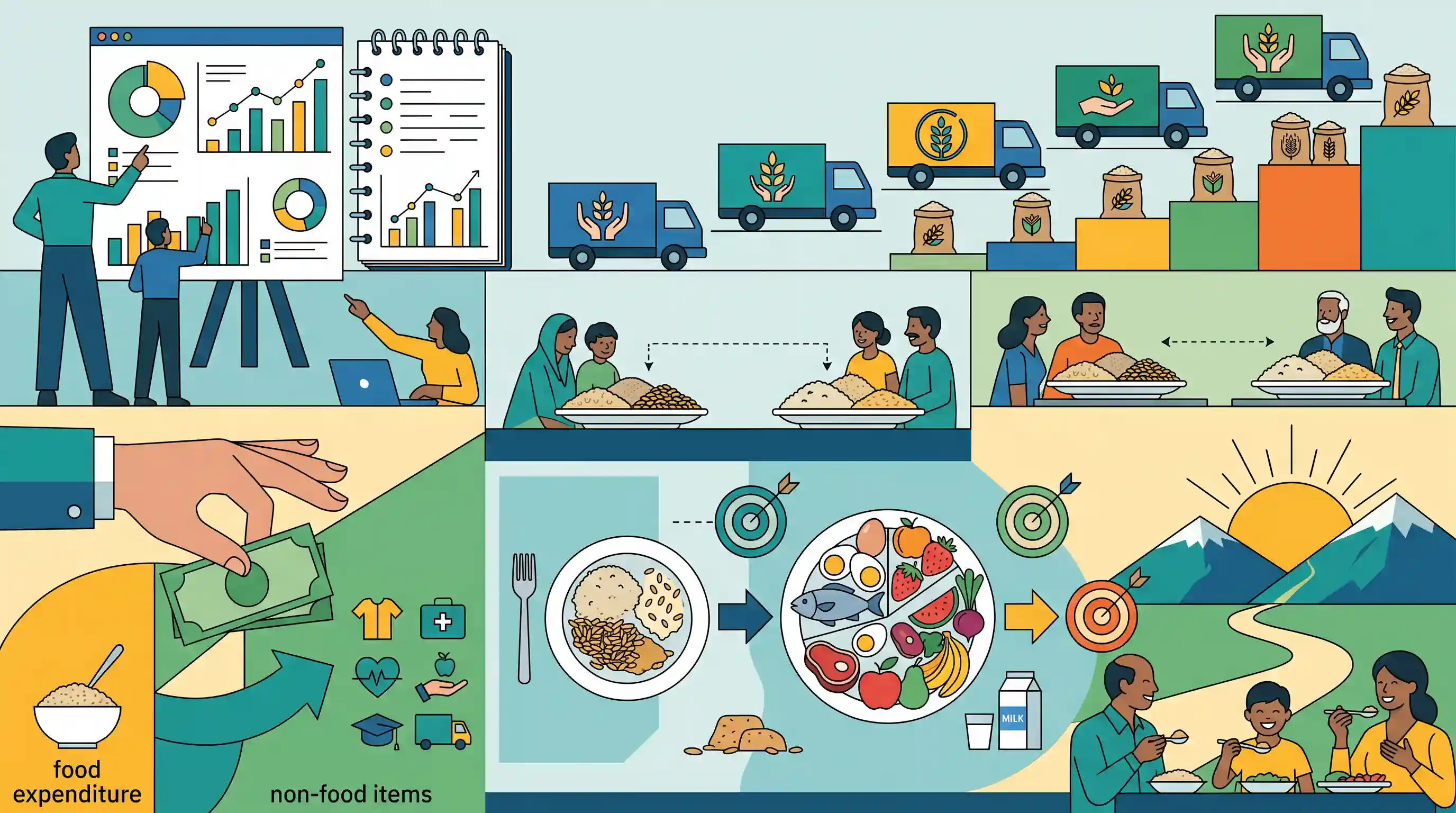
The article analyzes the findings of the Household Consumption Expenditure Survey (HCES) 2022-23 to highlight a significant trend in India's food consumption: the equalisation of primary food consumption (cereals) across different income classes and regions. It credits free food grain distribution programs like the Pradhan Mantri Garib Kalyan Anna Yojana (PMGKAY) and an effective Public Distribution System (PDS) for this convergence. While food security in terms of basic calories is largely met, leading to a decline in the overall share of food expenditure, the focus must now shift toward nutritional security—ensuring access to proteins, fruits, and vegetables to combat malnutrition and hidden hunger. The data reflects how social welfare schemes have effectively bridged the gap in primary caloric intake between the rich and the poor, freeing up household income for non-food essentials.
Key Points
- The Household Consumption Expenditure Survey (HCES) 2022-23 reveals a convergence in primary food (cereal) consumption across income classes and the rural-urban divide in India.
- Government welfare initiatives, particularly free food grain distribution under the PMGKAY and a robust Public Distribution System (PDS), have been instrumental in closing the basic calorie intake gap between the rich and the poor.
- With basic cereal needs met through state support, the overall share of household expenditure on food has declined, allowing low-income households to allocate funds toward non-food essentials like education and healthcare.
- While calorie-based 'food security' has largely been achieved, the policy focus must urgently shift toward 'nutritional security' to ensure equitable access to proteins, vitamins, and minerals, combating stunting and hidden hunger.
Important Terms
Pradhan Mantri Garib Kalyan Anna Yojana (PMGKAY)

A welfare scheme providing 5 kg of free foodgrains per month to ~81 crore NFSA beneficiaries. Originally a COVID-19 relief measure, it is now extended until December 2028.
UPSC context
GS Paper 2 (Social Justice/Welfare Schemes) and GS Paper 3 (Food Security). Tests understanding of government safety nets.
National Food Security Act (NFSA), 2013
A 2013 law providing legal entitlement to subsidized foodgrains for 67% of India's population (75% rural, 50% urban), shifting food security from welfare to a rights-based approach.
UPSC context
GS Paper 2 (Governance/Statutory Bodies) and GS Paper 3 (Food Security/Buffer Stocks). Central to India's hunger-reduction framework.
Public Distribution System (PDS)
The administrative mechanism for distributing essential foodgrains and commodities to the poor at subsidized prices via a nationwide network of Fair Price Shops.
UPSC context
GS Paper 3 (Public Distribution System- objectives, functioning, limitations, revamping). Key topic for agriculture and economics.
Household Consumption Expenditure Survey (HCES)
A periodic survey by the National Statistical Office (NSO) measuring household spending patterns. The 2022-23 data is crucial for poverty estimation and CPI weight revision.
UPSC context
GS Paper 3 (Indian Economy/Poverty/Inflation). Essential for understanding socio-economic trends and data-driven policymaking.
Nutritional Security
A shift from merely providing sufficient calories (food security) to ensuring access to a balanced diet rich in proteins and micronutrients for optimal health.
UPSC context
GS Paper 2 (Health/Hunger). Tests ability to distinguish between caloric sufficiency and overall dietary quality.
Hidden Hunger
A condition of micronutrient deficiency (e.g., lack of iron or zinc) occurring despite adequate calorie intake, usually due to a lack of dietary diversity.
UPSC context
GS Paper 2 (Social Justice/Issues relating to hunger). High-frequency concept for essays and health-related questions.
Prelims Trap
"Per capita cereal consumption has steadily increased in rural India over the last decade."
HCES data actually shows a historical decline in per capita cereal consumption (now <10 kg/month in rural areas), reflecting dietary diversification rather than volume increases.
Static Concepts Connected
What is Engel's Law and how does it relate to HCES?
- Engel's Law: An economic theory stating that as household income increases, the percentage of income spent on food decreases.
- HCES Evidence: India's food expenditure share falling below 50% (rural) and 40% (urban) in HCES reflects this law, indicating rising real incomes and evolving consumption patterns.
How does "Hidden Hunger" differ from basic undernourishment?
- Undernourishment: A chronic deficiency of basic calories or energy intake, largely mitigated in India through PDS cereal distribution.
- Hidden Hunger: A chronic lack of essential vitamins and minerals (like iron and zinc), causing anemia and stunting even when a person consumes adequate calories.
Cross-Topic Patterns
HCES trends and CPI basket revision
The decline in food expenditure share in HCES strengthens the macroeconomic case for reducing food's weightage (currently ~45.8%) in the Consumer Price Index (CPI) to better reflect actual inflation.
Consumption shift vs. MSP policy mismatch
While consumption increasingly favors proteins and horticulture, India's MSP and public procurement remain heavily skewed toward cereals, highlighting an ongoing agricultural policy mismatch.

Expect a Prelims question linking HCES 2022-23 food expenditure trends with Engel's Law, CPI weightage, and poverty lines.
Linked PYQs · 4
Linked PYQs · 4
- 2022MainsGS3
What are the major challenges of Public Distribution System (PDS) in India ? How can it be made effective and transparent ?
- 2024MainsGS2
Poverty and malnutrition create a vicious cycle, adversely affecting human capital formation. What steps can be taken to break the cycle ?
- 2019MainsGS2
There is a growing divergence in the relationship between poverty and hunger in India. The shrinking of social expenditure by the government is forcing the poor to spend more on non-food essential items squeezing their food-budget. - Elucidate.
- 2020PrelimsGS1
Consider the following statements: 1. The weightage of food in Consumer Price Index (CPI) is higher than that in Wholesale Price Index (WPI). 2. The WPI does not capture changes in the prices of services, which CPI does. 3. Reserve Bank of India has now adopted WPI as its key measure of inflation and to decide on changing the key policy rates. Which of the statements given above is/are correct?
