Engineering Projects India Bikaner Solar Project Partners
Source:now-solar ↗
Why It Matters
Rajasthan leads the country in solar energy potential and capacity. Major projects in Bikaner-Jaisalmer belt, grid connectivity via corridors, and partnership models between central PSUs (like EPI) and private entities are frequent themes in Rajasthan economy, geography, and infrastructure-related questions for RPSC RAS Prelims.
Summary
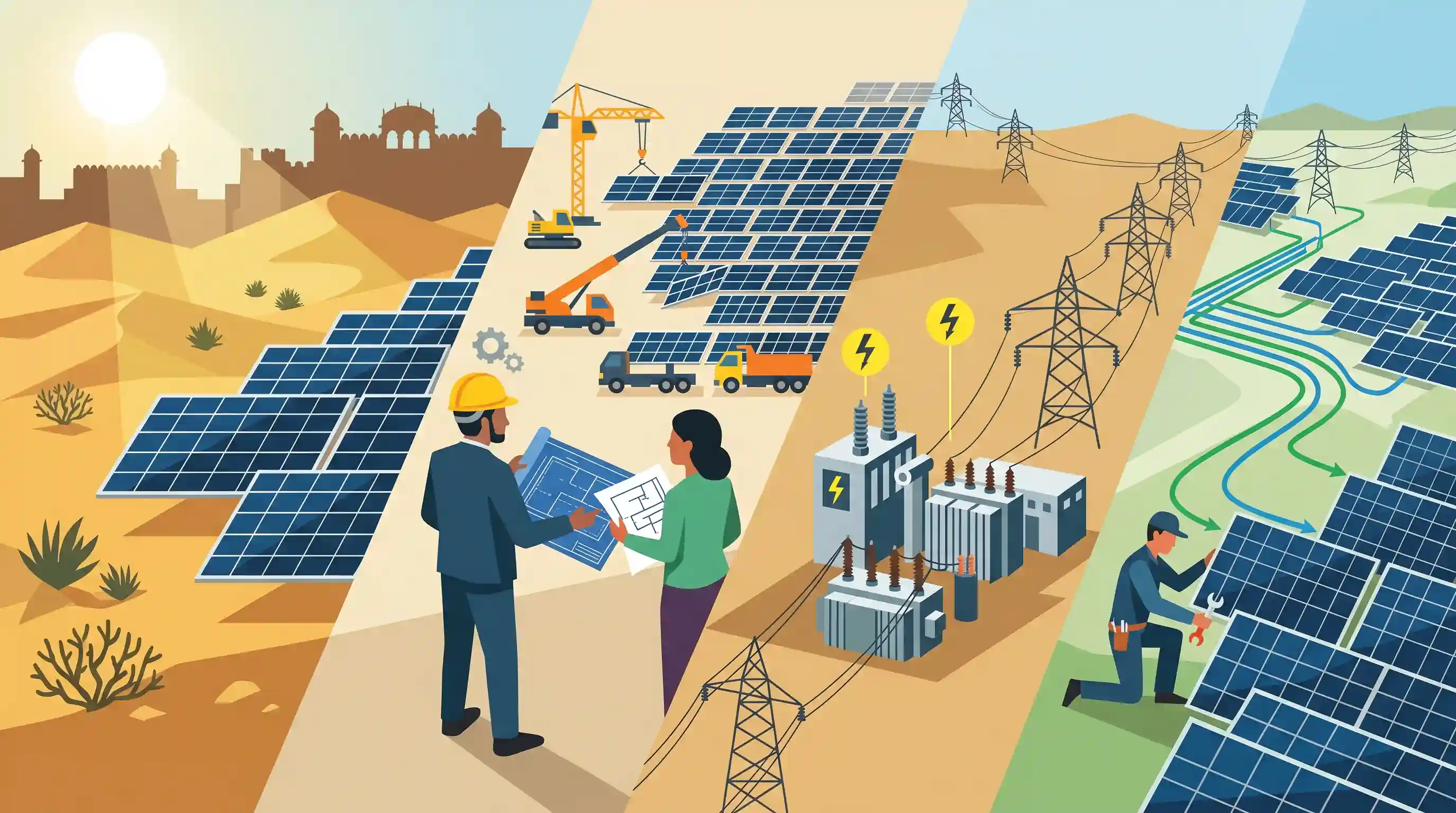
Engineering Projects (India) Limited (EPI), a CPSE under the Ministry of Heavy Industries, has invited Expressions of Interest (EOI) to identify partners for an upcoming EPC package to set up grid-connected solar power projects of up to 250 MW cumulative capacity. The project will be located near the 220 kV Bikaner-IV substation in the Bikaner district of Rajasthan. The selected partner will collaborate with EPI to submit bids for land acquisition, design, engineering, construction, commissioning, and three years of O&M services.
Key Points
- Engineering Projects (India) Ltd. (EPI) has invited Expressions of Interest (EOIs) to partner for an upcoming grid-connected solar EPC package in Rajasthan.
- The project has a cumulative capacity of up to 250 MW AC and is located near the 220 kV Bikaner-IV substation in Bikaner, Rajasthan.
- The scope of work covers engineering, procurement, construction (EPC), land acquisition, and operations and maintenance (O&M) services for a period of 3 years.
- EPI is a central public sector enterprise (CPSE) under the Ministry of Heavy Industries, Government of India, and is headquartered in New Delhi.
- The overall project completion period is set at 510 days, with the bid validity spanning 180 days.
Important Terms
Engineering Projects (India) Limited (EPI)

A Mini-Ratna Category-I Central Public Sector Enterprise under the Ministry of Heavy Industries, specializing in the turnkey execution and consultancy of multidisciplinary industrial, civil, and infrastructure projects.
UPSC context
GS Paper III (Infrastructure & CPSEs); tests the role of public enterprises in implementing national renewable energy and civil infrastructure.
Ministry of Heavy Industries
A Ministry of the Government of India responsible for promoting the heavy engineering sector, machine tools, automotive industries, and administering various Central Public Sector Enterprises.
UPSC context
GS Paper II (Ministries) and GS III (Industrial growth); tests administrative oversight of industrial and public sector development.
Central Public Sector Enterprise (CPSE)
Government-owned corporations in India where the Central Government holds a majority stake of 51% or more, categorized into Maharatna, Navratna, and Miniratna based on financial performance.
UPSC context
GS Paper III (Indian Economy); tests understanding of state-led economic development, public sector autonomy, and capital expenditure frameworks.
Engineering, Procurement, and Construction (EPC) Model
An infrastructure contract model where the contractor is responsible for all stages—from design and material procurement to construction, commissioning, and final project handover to the client.
UPSC context
GS Paper III (Infrastructure & PPP models); tests knowledge of infrastructure execution, financial allocation, and project management risks.
Prelims Trap
Engineering Projects (India) Limited (EPI), which executes large-scale solar EPC projects, is under the Ministry of New and Renewable Energy (MNRE).
Aspirants often assume solar/clean energy execution agencies must function under the Ministry of New and Renewable Energy (MNRE) or Ministry of Power, overlooking EPI's actual administrative ministry.
Static Concepts Connected
What are the criteria for granting Miniratna Category-I and Category-II status to CPSEs?
- Category-I eligibility: Must have made profit for three consecutive years, with a pre-tax profit of Rs 30 crore or more in at least one year, and positive net worth.
- Category-II eligibility: Must have made profit for three consecutive years and have a positive net worth, without defaulting on loans.
- Financial autonomy: Category-I can invest up to Rs 500 crore or net worth without prior approval; Category-II up to Rs 250 crore or 50% of net worth.
What is the Green Energy Corridor (GEC) project in India?
- Core objective: Aims to synchronize electricity produced from renewable sources with conventional power grids through robust intra-state and inter-state transmission networks.
- Implementation mechanism: Divided into GEC-I and GEC-II, focusing on building transmission lines and substations across solar-rich states like Rajasthan and Gujarat.
- Funding model: Supported by a combination of Central Financial Assistance (grants) and soft loans from development banks like Germany's KfW.
Cross-Topic Patterns
PSU diversification and decarbonisation
Non-energy CPSEs (like Heavy Industries) bidding for solar EPC reflects a strategic push for state-backed decarbonisation and asset diversification to meet national net-zero targets.
Grid stability and desert solar hubs
Scaling Rajasthan's solar capacity to 125 GW by 2030 requires balancing the Inter-State Transmission System (ISTS) to prevent severe grid congestion and power curtailment.

UPSC may test the ministerial jurisdiction of non-obvious CPSEs (like EPI under Heavy Industries) executing major solar/RE initiatives.
Linked PYQs · 3
Linked PYQs · 3
- 2021RPSC_PRELIMSGS1
'Green Energy Corridor' – Through which of the following districts will it pass in Rajasthan?
- 2021RPSC_PRELIMSGS1
In which year was the Rajasthan Solar Energy Policy announced?
- 2023RPSC_PRELIMSGS1
Which agency has been given the responsibility of implementing the PM-KUSUM scheme (Component A) in Rajasthan, which involves the establishment of solar power plants with a capacity of 0.5 MW to 2 MW?
