Indian and US envoys to China hold strategic meeting in Beijing
Source:The Hindu ↗
Why It Matters
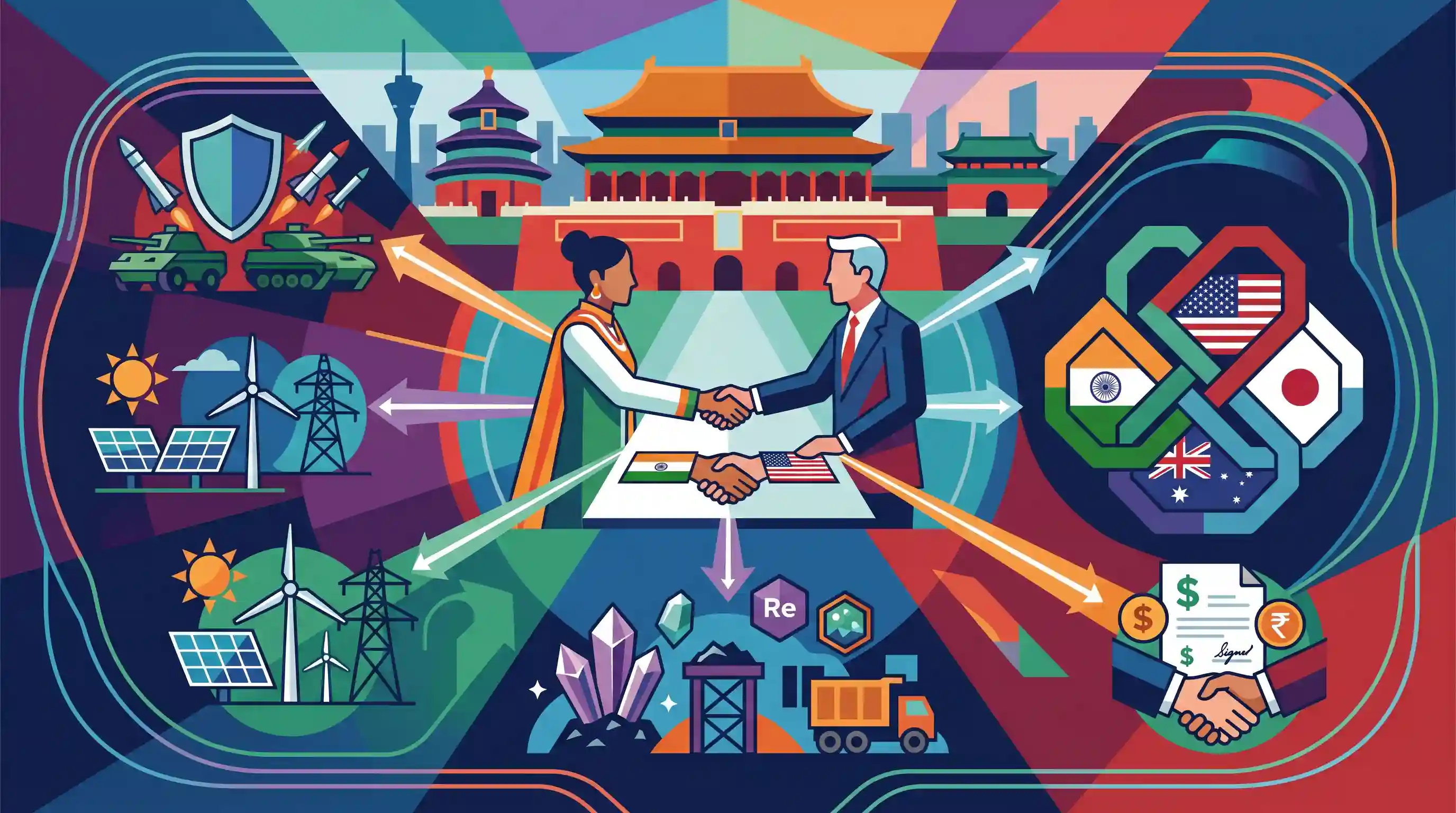
This article is important for UPSC aspirants as it demonstrates the practical application of India's multi-alignment and strategic partnerships. The coordination of Indian, US, and Japanese diplomats within Beijing reflects the evolving geopolitical dynamics of the Indo-Pacific, the relevance of the Quad, and growing cooperation in critical sectors like defense and critical minerals supply chains.
Summary
In a significant diplomatic move, the envoys of India and the United States to China met in Beijing to discuss deepening bilateral ties and shared strategic interests. The meeting between Pradeep Rawat and David Perdue covered cooperation in defense, energy, critical minerals, and the Quad framework. This engagement, the second since December when the Japanese envoy also joined them, highlights the increasing geopolitical coordination between the US, India, and other Quad partners directly within the Chinese capital. The talks follow the recent signing of an interim trade deal between New Delhi and Washington.
Key Points
- Indian Ambassador to China Pradeep Rawat and US Ambassador to China David Perdue held a rare meeting in Beijing to discuss bilateral ties.
- The discussions centered on shared interests including defense cooperation, energy, critical minerals, and Quad engagement.
- This marks their second meeting since December, when they also met with Japanese Ambassador Kenji Kanasugi, underscoring strategic coordination among Quad members in the Chinese capital.
- The meeting comes shortly after the signing of a recent interim trade deal between India and the United States.
Important Terms
Quad (Quadrilateral Security Dialogue)

A strategic informal forum comprising India, the United States, Japan, and Australia, focused on maintaining a "free and open" Indo-Pacific and upholding a rules-based international order.
UPSC context
GS Paper II (Bilateral, regional and global groupings); vital for Indo-Pacific strategy and maritime security discussions.
Interim Trade Deal (India-US)
A 2026 preliminary pact between India and the US reducing tariffs to 18% on Indian goods in exchange for energy purchase shifts and increased US market access.
UPSC context
GS Paper II & III (Bilateral trade & Economy); tests understanding of trade diplomacy and geoeconomic negotiations.
Critical Minerals
Strategic metallic or non-metallic elements (like lithium and cobalt) essential for high-tech, defense, and green energy, where supply disruptions pose significant economic and national security risks.
UPSC context
GS Paper III (Environment, Science & Tech, Security); central to India's Critical Minerals Mission and de-risking from China.
Bilateral Trade Agreement (BTA)
A comprehensive trade pact currently under negotiation between India and the US, following the 2026 framework aimed at long-term reciprocal market access and resilient supply chains.
UPSC context
GS Paper II (International Relations); represents the evolution of India-US economic ties beyond limited sector-specific deals.
Supply Chain Resilience
A strategic framework to diversify sourcing of essential goods (like minerals or semiconductors) to reduce dependence on single-country suppliers and mitigate geopolitical or pandemic-related shocks.
UPSC context
GS Paper III (Economic Development); relates to the "China Plus One" strategy and Atmanirbhar Bharat initiatives.
Reciprocal Tariffs
A trade policy where a country matches the import duty rates of its partner; a key feature of US trade strategy (2025-26) impacting Indian exports.
UPSC context
GS Paper III (Economy); relevant for understanding global trade wars and their impact on Indian exports and MSMEs.
Prelims Trap
"India and the US have recently signed a Comprehensive Free Trade Agreement (FTA)."
The article specifies an 'interim' trade deal. Aspirants often confuse early harvest or interim agreements with full FTAs or CEPAs, which India and the US do not yet have.
Static Concepts Connected
What is an Early Harvest Scheme (Interim Trade Agreement)?
- Precursor to FTA: It reduces tariffs on a limited, select list of goods and services to build trust and momentum before negotiating a comprehensive Free Trade Agreement.
- WTO Compliance: Under GATT Article XXIV, such interim agreements must include a plan and schedule to form a full FTA or customs union within a reasonable time.
What is the Minerals Security Partnership (MSP)?
- US-led Initiative: A global plurilateral alliance launched by the US to catalyze public and private investment in critical mineral supply chains, mitigating supply risks.
- India's Membership: India joined the MSP in 2023 to secure strategic elements (like lithium and cobalt) essential for its clean energy transition and defense manufacturing.
Cross-Topic Patterns
Quad's shift to supply chains
The Quad has evolved beyond maritime security into geoeconomics, mapping critical mineral dependencies and semiconductor supply chains to systematically reduce dependence on Chinese manufacturing.
Diplomatic signaling via minilateralism
Envoys coordinating directly in Beijing mirrors the trend of 'minilateralism', where plurilateral groups align their ground-level diplomatic messaging and posturing directly within rival states.

Expect a 2026 prelims question merging India-US interim trade mechanisms with India's membership in the Minerals Security Partnership.
Linked PYQs · 2
Linked PYQs · 2
- 2020MainsGS2
Quadrilateral Security Dialogue (Quad)' is transforming itself into a trade bloc from a military alliance, in present times - Discuss.
- 2020MainsGS2
What is the significance of Indo-US defence deals over Indo-Russian defence deals? Discuss with reference to stability in the Indo-Pacific region.
