Coal Thermal Power Plant Exemptions from Emission Systems
Source:The Hindu ↗
Why It Matters
Demonstrates the conflict between environmental regulation and economic constraints in India's energy sector. It serves as an excellent case study for Mains answers regarding the enforcement of emission standards, the functioning of the CPCB/MoEFCC, and the health impacts of thermal power generation.
Summary
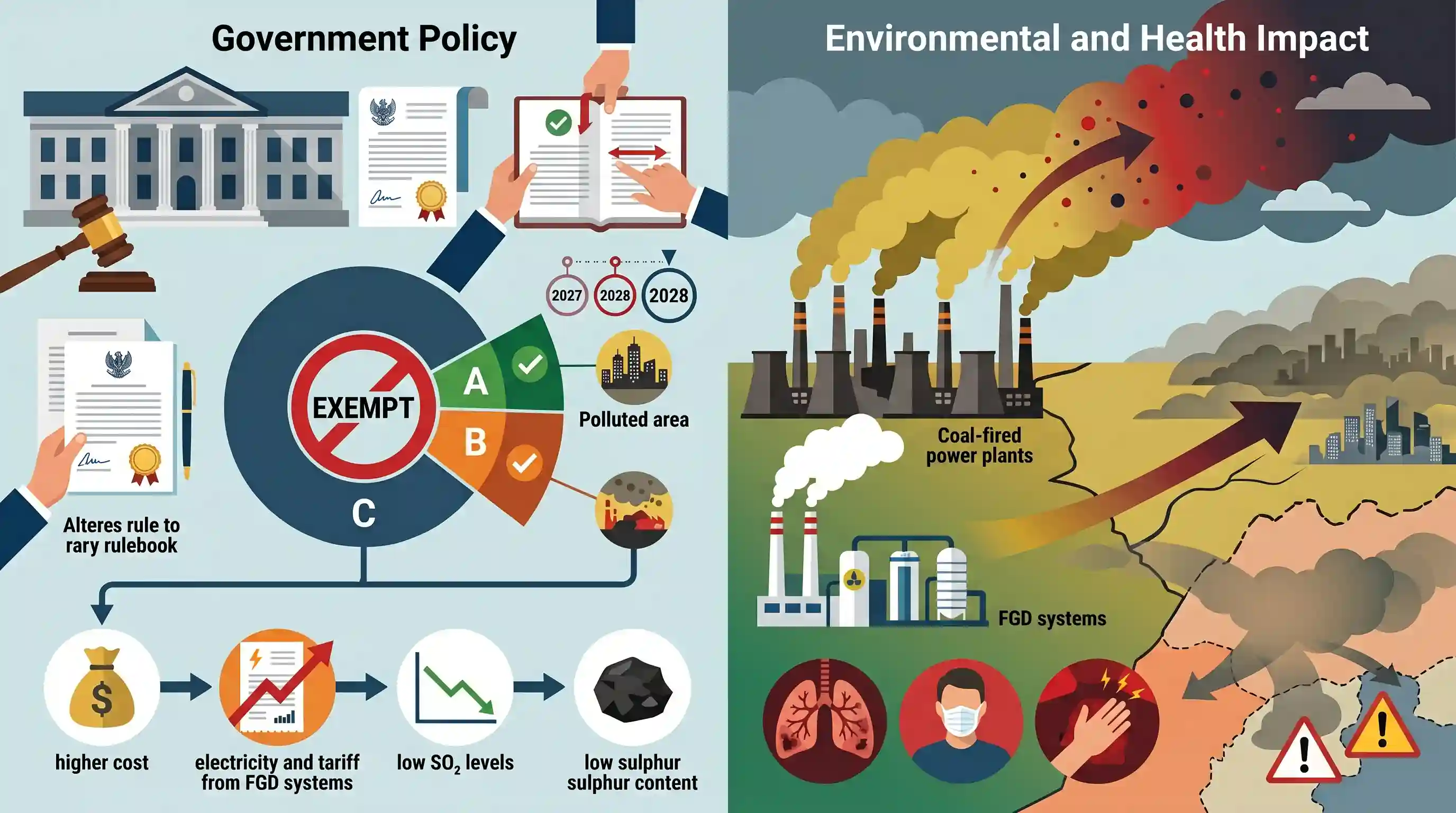
The Union Environment Ministry has significantly diluted emission norms by exempting 78% of coal thermal power plants (designated as Category C) from the requirement to install flue gas desulphurisation (FGD) systems to cut sulphur dioxide (SO2) emissions. Only Category A and B plants—located near major cities, critically polluted areas, or non-attainment cities—are mandated to install these systems by 2027 and 2028, respectively. The government argued that India's SO2 levels are generally low, Indian coal has low sulphur content, and the high cost of FGDs would increase electricity tariffs. However, experts strongly criticize the move, highlighting that SO2 reacts in the atmosphere to form dangerous secondary particulate matter (PM2.5) that can travel up to 200 kilometers, creating severe transboundary pollution risks.
Key Points
- The Environment Ministry has exempted 78% of India's coal-fired thermal power plant capacity (Category C plants) from installing Flue Gas Desulphurisation (FGD) systems.
- Category A plants (within 10 km of the NCR or million-plus cities) must install FGDs by December 2027, and Category B plants (near critically polluted areas or non-attainment cities) by December 2028.
- The government cited low overall SO2 levels, the low sulphur content of Indian coal, high installation costs, and limited domestic vendor availability as reasons for the exemption.
- Environmental experts warned that SO2 leads to the formation of secondary particulate matter (PM2.5), which can travel long distances (up to 200 km), negating local pollution control efforts.
Important Terms
Central Pollution Control Board (CPCB)

The apex statutory body for pollution control in India, established under the Water Act (1974) and Air Act (1981). It sets national air and water quality standards.
UPSC context
GS Paper 2/3: Institutional frameworks for environmental governance and enforcement of pollution norms.
National Clean Air Programme (NCAP)
A flagship policy launched in 2019 to reduce particulate matter (PM10 and PM2.5) concentrations by 20-40% by 2026 across 131 targeted cities.
UPSC context
GS Paper 3: Government policies for air quality management and time-bound environmental targets.
Flue Gas Desulphurisation (FGD)
Technology used to remove sulphur dioxide (SO2) from coal plant exhaust. It typically uses limestone or ammonia-based scrubbing to convert SO2 into neutral compounds like gypsum.
UPSC context
GS Paper 3: Infrastructure and pollution control technologies in the energy sector.
Non-attainment Cities
Cities that consistently failed to meet the National Ambient Air Quality Standards (NAAQS) for five consecutive years, now the primary targets for NCAP interventions.
UPSC context
GS Paper 3: Urban pollution management and criteria-based geographical targeting in policy.
Ministry of Environment, Forest and Climate Change (MoEFCC)
The nodal central ministry responsible for planning, promoting, and coordinating India's environmental, forestry, and climate change policies and international agreements.
UPSC context
GS Paper 2: Role of the executive in environmental administration and policy-making.
Expert Appraisal Committee (EAC)
A statutory body of experts that evaluates the environmental impact of developmental projects and recommends Environmental Clearance (EC) to the Ministry.
UPSC context
GS Paper 3: Environmental Impact Assessment (EIA) process and regulatory oversight.
Centre for Research on Energy and Clean Air (CREA)
An independent, non-profit research organization (think tank) that provides scientific data and analysis on global energy trends and their impacts on air quality.
UPSC context
GS Paper 3: Role of civil society and independent data in evaluating environmental policy effectiveness.
Particulate Matter (PM2.5)
Microscopic inhalable particles (≤2.5 microns) that pose severe health risks. They can form secondarily from sulphur dioxide emissions reacting in the atmosphere.
UPSC context
GS Paper 3: Scientific understanding of pollutants, their health impacts, and secondary atmospheric reactions.
Prelims Trap
Indian coal is characterized by both high ash and high sulphur content, heavily polluting the atmosphere.
Indian coal actually has low sulphur content (~0.5%), which the government cited to dilute FGD mandates. Its poor quality stems from high ash and low calorific value, not high sulphur.
Static Concepts Connected
What are the primary characteristics of Indian coal?
- High ash content: Typically 35-45%, which lowers burning efficiency and leads to massive fly ash generation requiring separate disposal.
- Low sulphur content: Usually around 0.5%, which is relatively low compared to many global reserves (a fact used to justify FGD exemptions).
- Low calorific value: High non-combustible material reduces the energy output per kg of coal, making it less efficient than high-grade imported varieties.
How do Flue Gas Desulphurisation (FGD) systems work?
- Wet scrubbing: Commonly uses a limestone slurry spray to react with SO2 in power plant exhaust gases, removing up to 95% of the pollutant.
- Byproduct generation: The chemical reaction produces synthetic gypsum (calcium sulphate), which can be circularly reused in cement and drywall manufacturing.
- Secondary PM control: By stripping SO2 precursor gases, FGDs prevent the downstream atmospheric formation of dangerous, far-traveling secondary PM2.5 aerosols.
Cross-Topic Patterns
FGD costs vs DISCOM debt
Mandating FGDs increases electricity generation costs. Passing this on raises consumer tariffs, while absorbing it exacerbates the chronic debt trap and financial stress of state DISCOMs.
Airshed management beyond city limits
SO2's ability to travel 200km and form secondary PM2.5 highlights why NCAP's focus on city-specific 'non-attainment' borders is insufficient without regional airshed-level management.

Expect a multi-statement prelims question combining Indian coal traits (low sulphur/high ash) with the industrial byproducts of FGDs.
Linked PYQs · 4
Linked PYQs · 4
- 2024PrelimsGS1
According to the Environmental Protection Agency (EPA), which one of the following is the largest source of sulphur dioxide emissions?
- 2022PrelimsGS1
In the context of WHO Air Quality Guidelines, consider the following statements: 1. The 24-hour mean of PM2.5 should not exceed 15 µg/m³ and annual mean of PM2.5 should not exceed 5 µg/m³. 2. In a year, the highest levels of ozone pollution occur during the periods of inclement weather. 3. PM10 can penetrate the lung barrier and enter the bloodstream. 4. Excessive ozone in the air can trigger asthma. Which of the statements given above are correct?
- 2014MainsGS3
Environmental Impact Assessment studies are increasingly undertaken before a project is cleared by the Government. Discuss the environmental impacts of coal-fired thermal plants located at coal pitheads.
- 2021PrelimsGS1
With reference to furnace oil, consider the following statements : 1. It is a product of oil refineries. 2. Some industries use it to generate power. 3. Its use causes sulphur emissions into environment. Which of the statements given above are correct?
