Delhi Zoo Privatisation Claims and Conservation Partnerships
Source:The Hindu ↗
Why It Matters
The article underscores the debate around private sector involvement in wildlife conservation. Understanding ex-situ conservation methods (like zoos and rescue centers), the regulatory role of the Central Zoo Authority, and the nuances of public-private synergy in environmental management are highly relevant for GS3 (Environment) and Prelims.
Summary
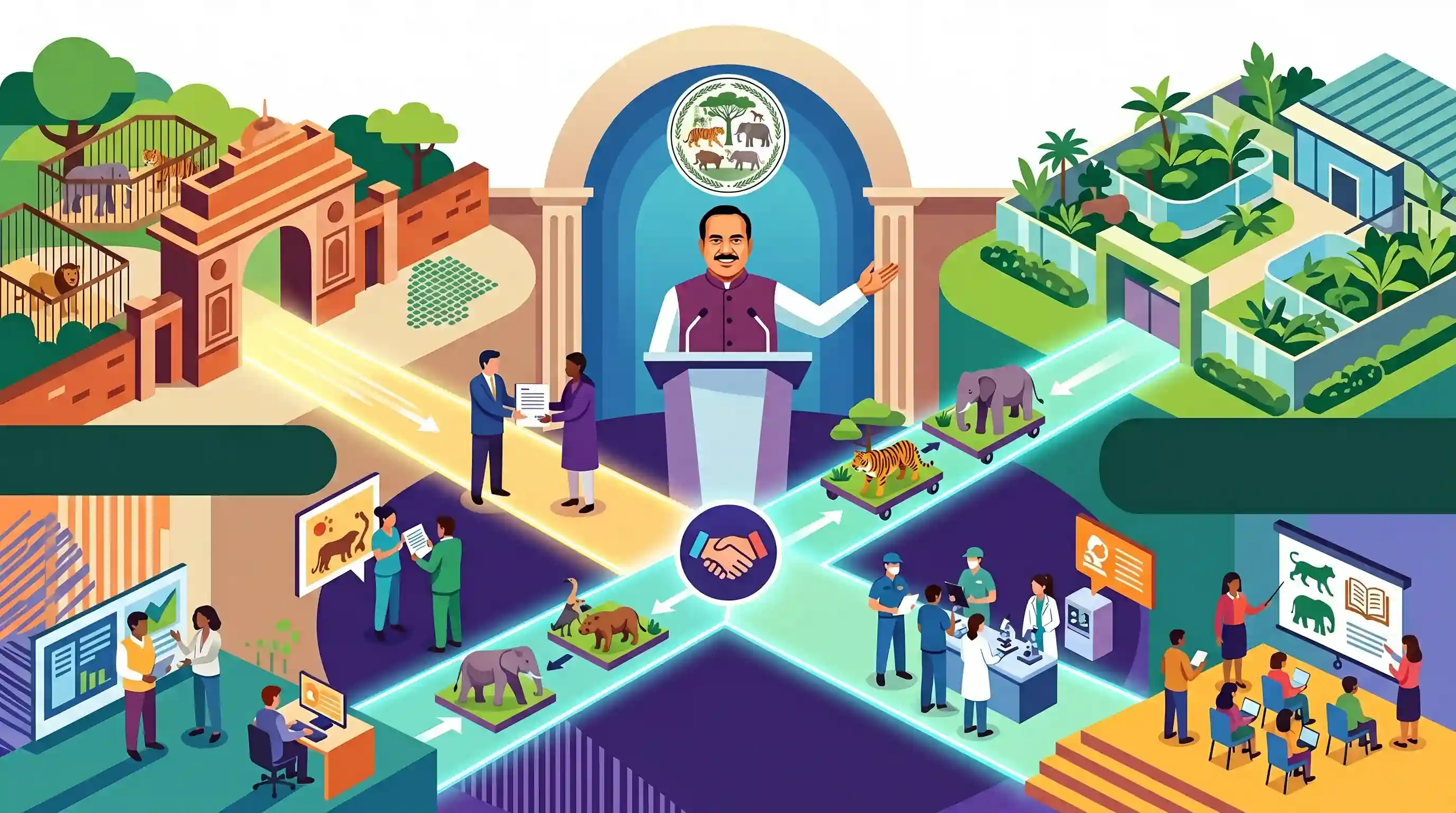
Union Environment Minister Bhupender Yadav dismissed allegations raised by the opposition regarding the privatisation of the National Zoological Park in New Delhi. He clarified that the government is merely exploring a knowledge-sharing Memorandum of Understanding (MoU) with the Reliance Industries-run Greens Zoological Rescue and Rehabilitation Centre (GZRRC), which operates the Vantara facility in Gujarat. The collaboration focuses on enhancing ex-situ conservation through technical expertise, animal exchange, veterinary care, and capacity building. The administrative control of the Delhi Zoo remains unchanged, operating under the regulatory framework of the Central Zoo Authority (CZA).
Key Points
- The Union Environment Ministry refuted claims that the National Zoological Park (Delhi Zoo) is being privatised, maintaining that it remains fully under government control.
- The government is exploring a knowledge-sharing Memorandum of Understanding (MoU) with the Reliance-backed Greens Zoological Rescue and Rehabilitation Centre (GZRRC), which operates the Vantara facility in Jamnagar.
- The proposed partnership aims to facilitate technical collaboration, animal exchange, capacity building, veterinary care, and the design of animal enclosures.
- GZRRC is a registered society and a rescue facility officially recognized by the Central Zoo Authority (CZA).
- The debate highlights the growing role of corporate-backed facilities in ex-situ wildlife conservation and rehabilitation in India.
Important Terms
Central Zoo Authority (CZA)

A statutory body established in 1992 under the Wildlife (Protection) Act, 1972, to oversee zoo operations, enforce welfare standards, and coordinate conservation breeding across India.
UPSC context
GS Paper III: Environment; tests knowledge of statutory bodies, wildlife regulation, and conservation management frameworks.
Wildlife (Protection) Act, 1972
India's primary legal framework for protecting wild animals, birds, and plants. It regulates trade and establishes protection schedules; amended in 2022 to align with CITES.
UPSC context
GS Paper III: Environment & Ecology; critical for legal protection mechanisms, protected area categories, and international treaty compliance.
Ex-situ Conservation
The conservation of biological diversity components outside their natural habitats, utilizing facilities like zoological parks, botanical gardens, and seed banks for research and potential reintroduction.
UPSC context
GS Paper III: Biodiversity & Environment; tests conceptual clarity on conservation strategies and species recovery programs.
National Zoological Park (NZP)
Established in 1959 in New Delhi, this institution serves as India’s central model zoo under the direct administrative control of the Union Environment Ministry.
UPSC context
GS Paper III: Conservation; relevant for institutional frameworks of wildlife education and captive breeding in India.
Ministry of Environment, Forest and Climate Change (MoEFCC)
The nodal agency of the Union Government for planning, promoting, and overseeing the implementation of India's environmental, forestry, and wildlife policies and programs.
UPSC context
GS Paper II: Governance; GS Paper III: Environment; essential for understanding the administrative structure of environmental governance.
Greens Zoological Rescue and Rehabilitation Centre (GZRRC)
A private rescue and rehabilitation facility in Gujarat (Vantara) that collaborates with government zoos for technical expertise, veterinary care, and animal welfare enhancements.
UPSC context
GS Paper III: Environment/PPP; relevant to emerging private sector collaborations in wildlife rehabilitation and knowledge-sharing.
Prelims Trap
Wild animals housed in privately run, CZA-recognized rescue facilities become the legal property of the private entity.
Under Section 39 of the Wildlife (Protection) Act, 1972, wild animals remain the absolute property of the Government, even if housed in privately run facilities.
Static Concepts Connected
What is the statutory backing and mandate of the Central Zoo Authority (CZA)?
- Statutory Body: Established in 1992 via an amendment to the Wildlife (Protection) Act, 1972 (not the Environment Protection Act).
- Mandate: No zoo or rescue facility—public or private—can legally operate in India without formal recognition from the CZA.
- Leadership: The Authority is chaired by the Union Minister of Environment, Forest and Climate Change.
How does ex-situ conservation differ from in-situ conservation?
- In-situ Conservation: Conserving species within their natural ecosystems (e.g., National Parks, Wildlife Sanctuaries, Tiger Reserves, Biosphere Reserves).
- Ex-situ Conservation: Conserving species outside their natural habitats (e.g., Zoological Parks, Botanical Gardens, Cryopreservation, Seed Banks, Rescue Centres).
Cross-Topic Patterns
Corporate role in Ex-situ conservation
The Vantara/GZRRC partnership highlights an emerging trend of Corporate Social Responsibility (CSR) funds and private trusts financing and managing capital-intensive ex-situ wildlife rehabilitation centers.
WPA 1972 and CITES exotic transfers
Recent amendments to the Wildlife Protection Act streamlining CITES implementation directly impact how the CZA regulates the import, transfer, and exchange of exotic species by private and public zoos.

Expect a multi-statement question on CZA's statutory backing and State ownership of wild animals under WPA 1972 in Prelims 2026.
Linked PYQs · 3
Linked PYQs · 3
- 2011PrelimsGS1
Which one of the following is not a site for in-situ method of conservation of flora?
- 2022PrelimsGS1
With reference to Indian laws about wildlife protection, consider the following statements : 1. Wild animals are the sole property of the government. 2. When a wild animal is declared protected, such animal is entitled for equal protection whether it is found in protected areas or outside. 3. Apprehension of a protected wild animal becoming a danger to human life is sufficient ground for its capture or killing. Which of the statements given above is/are correct?
- 2022MainsGS3
Why is Public Private Partnership (PPP) required in infrastructural projects ? Examine the role of PPP model in the redevelopment of Railway Stations in India.
