Airshed Level Air Pollution Management and Governance Reform
Source:Indian Express ↗
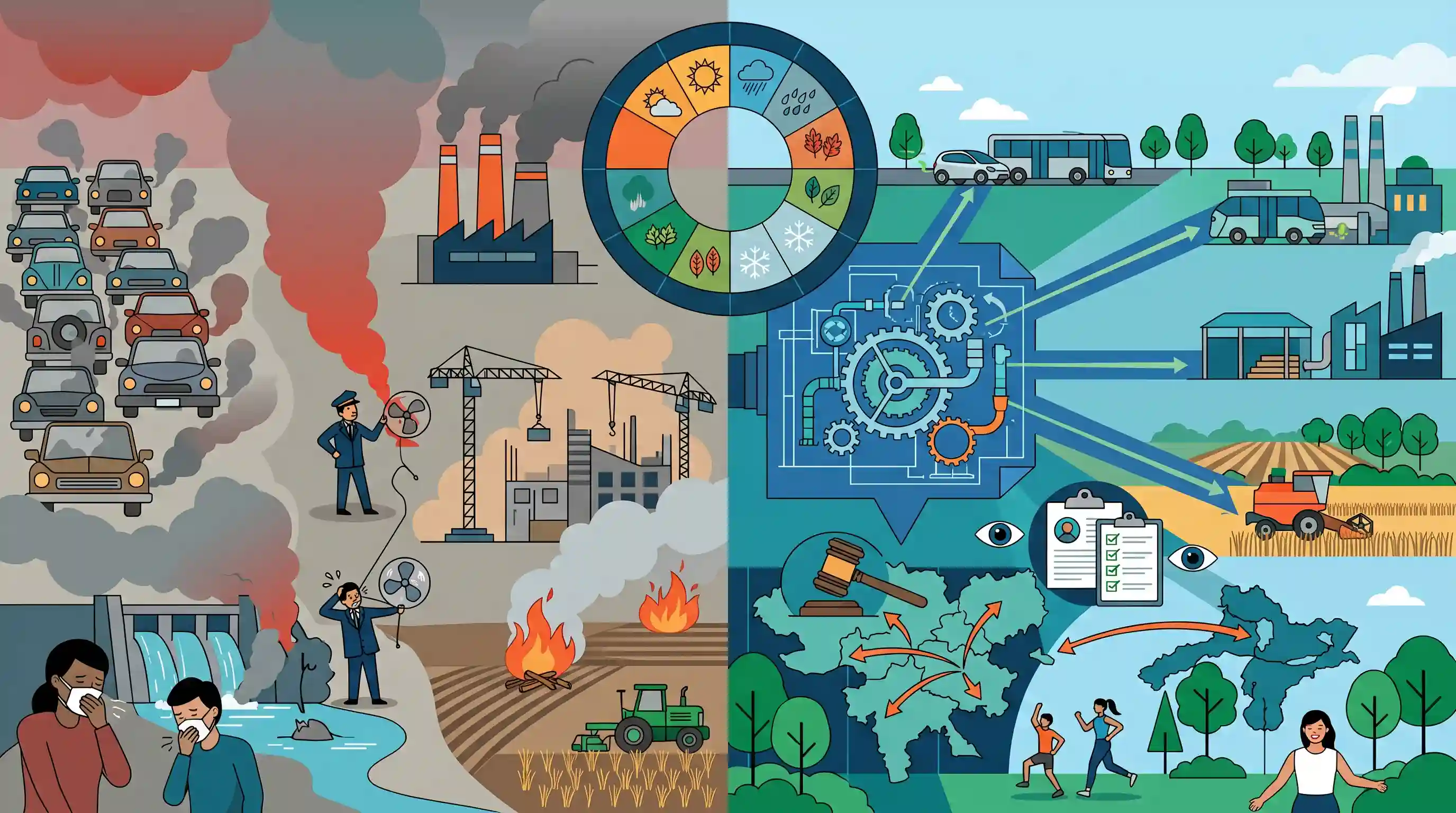
Why It Matters
Air pollution is a recurring national crisis and a staple topic in UPSC GS1 (Urbanization), GS2 (Governance/Health), and GS3 (Environment). Understanding the limitations of current reactive policies like GRAP and the need for comprehensive, airshed-level governance is crucial for answering questions on environmental policy effectiveness and urban planning.
Summary
The article advocates for a fundamental shift in the approach to managing air pollution in Delhi and surrounding regions. It emphasizes that relying on seasonal or reactionary measures is inadequate for solving the severe smog crisis. Instead, policymakers and environmental agencies must adopt a holistic, year-round strategy that tackles all sources of pollution—vehicular, industrial, construction-related, and biomass burning—simultaneously. The piece underscores the need for structural policy reforms, stricter enforcement by regulatory bodies, and coordinated action across the entire airshed to achieve sustained improvements in air quality.
Key Points
- Piecemeal and seasonal approaches to Delhi's air pollution are insufficient; year-round, comprehensive mitigation strategies are required.
- Policy interventions must simultaneously target all major sources of pollution, including vehicular exhaust, construction dust, industrial emissions, and stubble burning.
- Effective environmental governance necessitates stricter enforcement of existing norms by regulatory bodies and improved inter-state coordination across the entire NCR airshed.
- The management of air quality should shift from emergency responses (like invoking GRAP stages during peak winter smog) to proactive, structural changes.
Important Terms
Commission for Air Quality Management (CAQM)

A statutory body (est. 2021) with overarching authority to coordinate, research, and resolve air quality issues specifically in the National Capital Region (NCR) and adjoining states.
UPSC context
GS Paper II & III: Statutory bodies; environmental governance. Tests knowledge of centralized vs. state-led pollution control.
National Clean Air Programme (NCAP)
A long-term national strategy launched in 2019 aiming for a 40% reduction in particulate matter (PM2.5 and PM10) by 2026 across 131 "non-attainment" cities.
UPSC context
GS Paper III: Environmental pollution/degradation. Focuses on flagship government schemes and time-bound environmental targets.
Graded Response Action Plan (GRAP)
A set of emergency, stage-wise measures triggered in Delhi-NCR based on Air Quality Index (AQI) levels to provide an incremental response to severe smog episodes.
UPSC context
GS Paper III: Pollution management. Tests understanding of emergency policy frameworks and the role of judiciary-led initiatives.
Central Pollution Control Board (CPCB)
India's apex statutory body (est. 1974) responsible for monitoring air/water quality and providing technical services to the Ministry of Environment, Forest and Climate Change.
UPSC context
GS Paper II: Statutory bodies. Tests administrative structures for environmental protection and inter-state coordination.
National Green Tribunal (NGT)
A specialized judicial body (est. 2010) for the effective and expeditious disposal of cases relating to environmental protection and the enforcement of legal environmental rights.
UPSC context
GS Paper II: Judiciary/Quasi-judicial bodies. Tests environmental jurisprudence and the "Polluter Pays" principle.
Prelims Trap
Stubble burning is the primary year-round contributor to PM 2.5 emissions in the Delhi-NCR region.
While stubble burning causes severe seasonal smog in winter, structural sources like vehicular exhaust and industrial emissions form the vast majority of the baseline year-round pollution.
Static Concepts Connected
What is the 'Airshed' approach to managing air quality?
- Geographical Basis: An airshed is a geographic area sharing the same air flow and dispersion patterns, meaning emissions in one part directly affect the whole.
- Administrative Shift: It moves away from city-centric mitigation to regional coordination, bypassing local political boundaries to treat the whole pollution zone as one unit.
- CAQM mandate: The Commission for Air Quality Management (CAQM) was established as a statutory body specifically to manage the multi-state Delhi-NCR airshed.
Which 8 pollutants are measured in the National Air Quality Index (AQI)?
- Particulate Matter: PM10 and PM2.5 are the primary and most frequently cited particulates measured.
- Harmful Gases: Nitrogen Dioxide (NO2), Sulphur Dioxide (SO2), Carbon Monoxide (CO), Ozone (O3), and Ammonia (NH3).
- Heavy Metals & Traps: Lead (Pb) is the only heavy metal tracked. Notably, CO2 and Methane are NOT included in AQI calculations.
Cross-Topic Patterns
Airshed management vs Cooperative Federalism
The statutory powers of CAQM override state pollution control boards, creating administrative friction that ties environmental governance directly to Center-State relations and cooperative federalism in the NCR region.
Air Quality + Demographic Dividend
Chronic PM2.5 exposure reduces cognitive capacity and worker productivity, serving as a silent drag on India's ability to maximize its demographic dividend and economic output in major urban hubs.

Expect a 2026 Prelims question comparing the statutory powers of CAQM vs CPCB, and distinguishing NCAP targets from GRAP emergency stages.
Linked PYQs · 4
Linked PYQs · 4
- 2015MainsGS1
Mumbai, Delhi and Kolkata are the three mega cities of the country but the air pollution is much more serious problem in Delhi as compared to the other two. Why is this so?
- 2021MainsGS3
Describe the key points of the revised Global Air Quality Guidelines (AQGs) recently released by the World Health Organisation (WHO). How are these different from its last update in 2005? What changes in India's National Clean Air Programme are required to achieve these revised standards?
- 2016PrelimsGS1
In the cities of our country, which among the following atmospheric gases are normally considered in calculating the value of Air Quality Index? 1. Carbon dioxide 2. Carbon monoxide 3. Nitrogen dioxide 4. Sulfur dioxide 5. Methane Select the correct answer using the code given below.
- 2018PrelimsGS1
How is the National Green Tribunal (NGT) different from the Central Pollution Control Board (CPCB)? 1. The NGT has been established by an Act whereas the CPCB has been created by an executive order of the Government. 2. The NGT provides environmental justice and helps reduce the burden of litigation in the higher courts whereas the CPCB promotes cleanliness of streams and wells, and aims to improve the quality of air in the country. Which of the statements given above is/are correct?
