Holistic Urban Air Pollution Mitigation Frameworks
Source:Indian Express ↗
Why It Matters
Air pollution in urban centers like Delhi is a recurring governance and environmental challenge. Understanding the multi-source nature of emissions and the shift from reactive to proactive, year-round policy frameworks is highly relevant for GS3 Environment and Disaster Management questions.
Summary
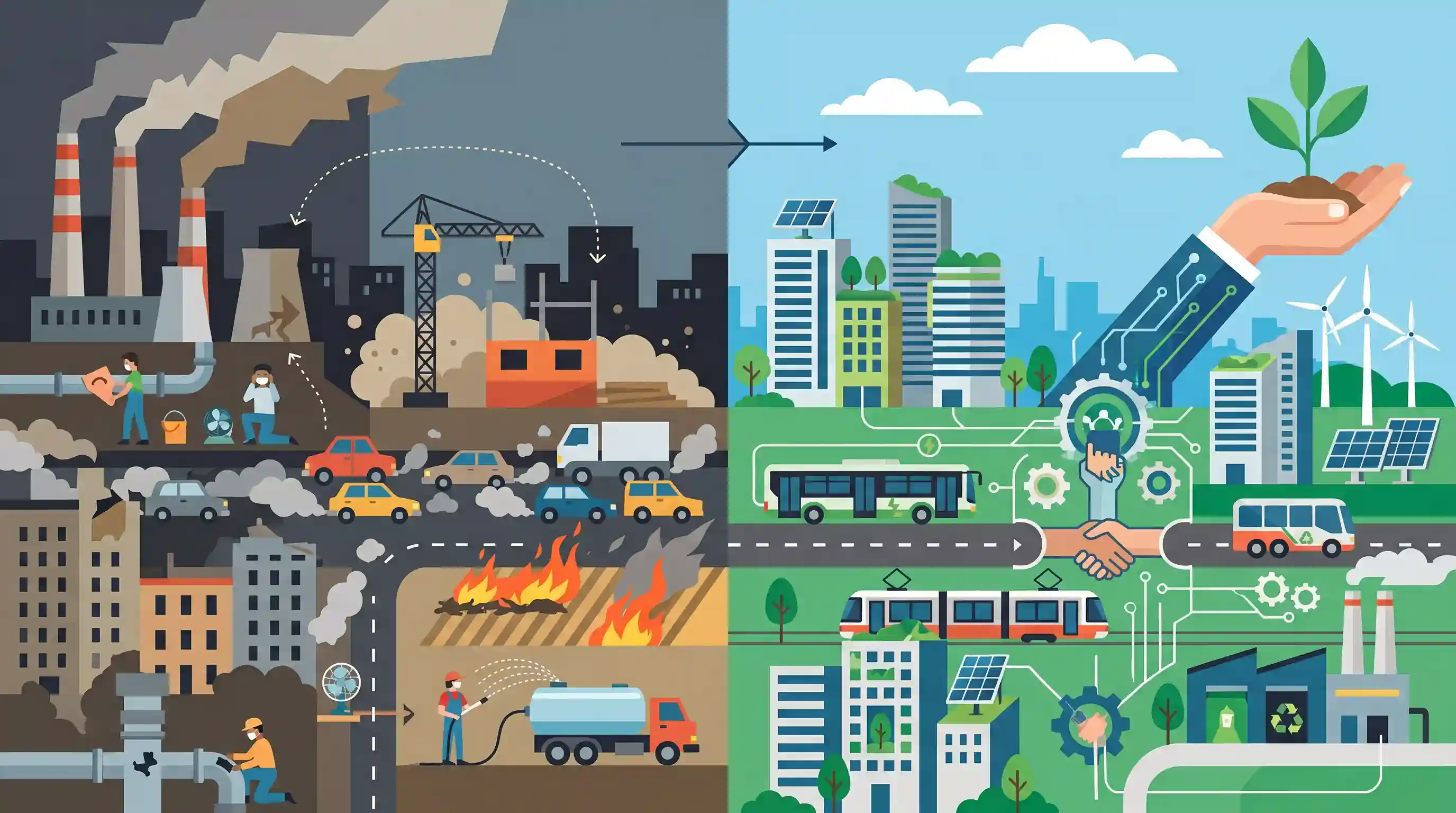
The article highlights the urgent need for a paradigm shift in how environmental pollution, particularly air quality in Delhi, is managed. It argues against piecemeal and seasonal interventions, advocating instead for a holistic approach that simultaneously tackles all major pollution sources such as vehicular exhaust, industrial emissions, construction dust, and stubble burning to ensure long-term sustainability.
Key Points
- Delhi's air pollution crisis requires a comprehensive, year-round strategy rather than seasonal or reactive measures.
- The policy approach must address all sources of pollution simultaneously, including vehicular emissions, construction dust, industrial waste, and stubble burning.
- Effective environmental management relies on structural changes in urban planning and strict enforcement of emission norms.
Important Terms
National Clean Air Programme (NCAP)

Launched in 2019 by MoEFCC, it is India’s first national framework to reduce particulate matter (PM10/PM2.5) concentrations by 40% by 2026 in 131 'non-attainment' cities.
UPSC context
GS Paper III (Environment). Tests knowledge of national air quality targets, non-attainment cities, and the efficacy of collaborative governance.
Commission for Air Quality Management (CAQM)
A powerful statutory body established in 2021 to coordinate, plan, and execute air quality management strategies in Delhi-NCR and adjoining states like Punjab and Haryana.
UPSC context
GS Paper III (Environmental Governance). Tests understanding of institutional shifts from EPCA and the hierarchy of statutory powers in NCR.
Graded Response Action Plan (GRAP)
A set of four-stage emergency measures (Poor to Severe+) triggered by Delhi's AQI levels to prevent air quality from worsening during peak pollution months.
UPSC context
GS Paper III. Tests ability to distinguish between seasonal emergency protocols and long-term mitigation strategies like NCAP.
Delhi Pollution Control Committee (DPCC)
An autonomous regulatory body established in 1991 to monitor and enforce pollution control laws in Delhi under delegated powers from the Central Pollution Control Board.
UPSC context
GS Paper III. Tests knowledge of the decentralized structure of India's pollution control boards and state-level enforcement mechanisms.
SAFAR
An indigenous initiative by the Ministry of Earth Sciences that provides location-specific, real-time air quality data and 72-hour forecasts for major Indian metros.
UPSC context
GS Paper III & Prelims. Tests awareness of technological interventions and the role of the Ministry of Earth Sciences in pollution monitoring.
Prelims Trap
"The National Clean Air Programme (NCAP) targets PM reduction across all Indian cities by 2026."
NCAP does not apply to all cities. It is restricted to 131 specific 'non-attainment cities' that consecutively failed to meet National Ambient Air Quality Standards (NAAQS).
Static Concepts Connected
What is the Commission for Air Quality Management (CAQM)?
- Statutory Body: Established by the CAQM Act 2021, replacing the Supreme Court-mandated Environment Pollution (Prevention and Control) Authority (EPCA).
- Overriding Powers: Its orders prevail over the CPCB and state pollution control boards regarding air quality management.
- Jurisdiction: Applies specifically to Delhi-NCR and adjoining areas in Punjab, Haryana, UP, and Rajasthan that impact NCR's air quality.
What are the targets and mechanisms of the National Clean Air Programme (NCAP)?
- Emission Targets: A revised target to reduce PM10 and PM2.5 concentrations by 40% by 2026, using 2017 as the base year.
- City-Specific Scope: Focuses strictly on 131 non-attainment cities identified using ambient air quality data from 2011-2015.
- Multi-source Approach: Relies on multi-sectoral city-specific action plans (CSAPs) addressing vehicles, road dust, biomass burning, and construction.
Cross-Topic Patterns
Agriculture policy driving environmental crises
Crop residue burning is fundamentally driven by the paddy-wheat cycle in Northwest India, incentivized by open-ended MSP procurement and free agricultural electricity.
Cooperative federalism in environmental governance
CAQM's binding jurisdiction across multiple states (Punjab, Haryana, UP) tests India's cooperative federalism, as upstream states bear the political and economic costs of mitigation for downstream (Delhi) benefits.

Expect a multi-statement Prelims question comparing CAQM's overriding statutory powers with the CPCB's mandate under the Air Act 1981.
Linked PYQs · 3
Linked PYQs · 3
- 2020MainsGS3
What are the key features of the National Clean Air Programme (NCAP) initiated by the Government of India?
- 2022PrelimsGS1
In the context of WHO Air Quality Guidelines, consider the following statements: 1. The 24-hour mean of PM2.5 should not exceed 15 µg/m³ and annual mean of PM2.5 should not exceed 5 µg/m³. 2. In a year, the highest levels of ozone pollution occur during the periods of inclement weather. 3. PM10 can penetrate the lung barrier and enter the bloodstream. 4. Excessive ozone in the air can trigger asthma. Which of the statements given above are correct?
- 2025PrelimsGS1
Artificial way of causing rainfall to reduce air pollution makes use of
