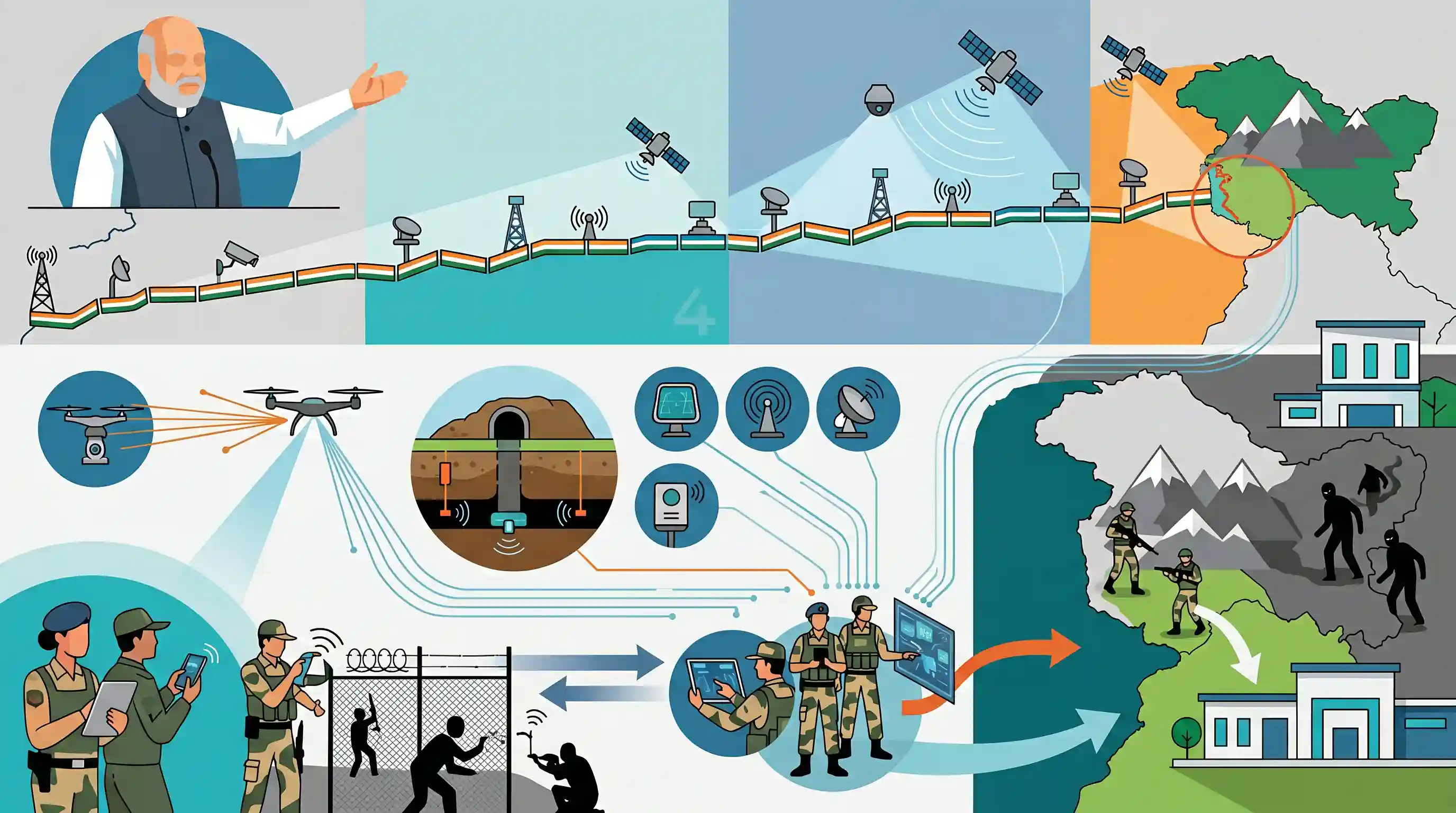
Electronic Surveillance Architecture for International Border
Source:The Hindu ↗
Why It Matters
Highlights India's shift toward technology-driven border management (CIBMS-style systems) to counter non-traditional threats like drones and cross-border tunnels. Important for GS-3 questions on border security challenges, modernization of armed forces, and measures to tackle terrorism.
Summary
Union Home Minister Amit Shah announced that an advanced electronic surveillance system will cover the entire India-Pakistan border within the next four years. Currently being tested along the Jammu border, this system is part of over 26 new technological initiatives, which include anti-drone mechanisms and tunnel identification technology. The goal is to detect infiltrators, prevent cross-border terrorism, and provide real-time information to security forces like the BSF. During his visit to Kathua in Jammu and Kashmir, Shah inaugurated improved border facilities worth ₹47.22 crore, emphasizing the government's commitment to upgrading border infrastructure and minimizing troop casualties. He also acknowledged that while terrorism in J&K has been curbed, it remains a persistent challenge that has not been completely eliminated.
Key Points
- The entire India-Pakistan border will be covered by an electronic surveillance system over the next four years to detect infiltrators and tunnels.
- Two models of the electronic surveillance system are currently undergoing testing along the Jammu border.
- Over 26 technology initiatives, including anti-drone technology and tunnel identification systems, are being tested to bolster border security.
- Home Minister Amit Shah noted that while terrorism in Jammu and Kashmir has been curbed, it is not entirely eliminated.
- New facilities worth ₹47.22 crore, including a composite border outpost and women's barracks, were inaugurated to support BSF personnel.
Important Terms
Border Security Force (BSF)

India's primary border guarding organization, established in 1965, responsible for the 'First Line of Defence' along the borders with Pakistan and Bangladesh.
UPSC context
GS Paper III: Internal Security; role of security forces and their mandate in border management.
Comprehensive Integrated Border Management System (CIBMS)
A high-tech surveillance framework integrating sensors (thermal, laser, sonar), cameras, and communication networks to provide round-the-clock, seamless border monitoring.
UPSC context
GS Paper III: Security challenges and their management in border areas; use of technology in security.
Anti-Drone Technology
Technological systems designed to detect, track, and neutralize unmanned aerial vehicles (UAVs) used for smuggling narcotics, weapons, or conducting reconnaissance.
UPSC context
GS Paper III: Science and Technology developments; internal security challenges (asymmetric warfare).
Central Armed Police Forces (CAPF)
Seven specialized paramilitary forces under the Ministry of Home Affairs, including BSF, CRPF, and ITBP, tasked with internal security and border guarding.
UPSC context
GS Paper III: Various Security forces and agencies and their mandate.
Smart Fencing
An electronic barrier system using laser-activated fences, fiber-optic sensors, and infra-red alarms to plug gaps where physical fencing is not feasible.
UPSC context
GS Paper III: Border management; effective deterrence against infiltration and cross-border terrorism.
Vibrant Village Programme (VVP)
A centrally sponsored scheme to develop infrastructure and improve livelihoods in villages along the northern border to prevent migration and enhance security.
UPSC context
GS Paper II & III: Governance and Security; development of border infrastructure and community-led defense.
Prelims Trap
Electronic surveillance and CIBMS will completely replace physical troop deployment along the border.
Surveillance tech acts as a force multiplier, shifting BSF roles to Quick Reaction Teams (QRTs). It supplements but does not eliminate physical border deployment.
Static Concepts Connected
What are the core components of the CIBMS framework?
- Sensor Networks: Deploying thermal imagers, infrared sensors, sonars, and ground radars to create a 24/7 invisible electronic fence across diverse terrains.
- Unified Command: Centralized communication and control centers that integrate multi-sensor data to provide commanders with real-time situational awareness.
- QRT Action: Quick Reaction Teams formed by BSF personnel to swiftly intercept threats based on precise technological alerts rather than exhaustive manual patrolling.
Which forces operate under India's "One Border, One Force" principle?
- Border Security Force: Guards the highly active, sensitive, and geographically diverse borders with Pakistan and Bangladesh.
- ITBP & SSB: ITBP secures the high-altitude India-China LAC, while SSB manages the open, friendly borders with Nepal and Bhutan.
- Assam Rifles: Manages the porous India-Myanmar border, notably operating under the dual control of the MHA (administrative) and MoD (operational).
Cross-Topic Patterns
Drones & narco-terrorism nexus
Smuggling of arms and drugs via low-cost UAVs links border security directly to organized crime, state-sponsored terrorism, and the Golden Crescent geography.
Women in CAPF border roles
Inaugurating women's barracks at forward posts highlights the structural and operational integration of women in border guarding forces, connecting GS-3 security to GS-1/GS-2 social empowerment.

Expect a GS-3 Mains question combining physical terrain challenges with CIBMS deployment, anti-drone tech, and the evolving role of CAPFs.
Linked PYQs · 3
Linked PYQs · 3
- 2023MainsGS3
The use of unmanned aerial vehicles (UAVs) by our adversaries across the borders to ferry arms/ammunitions, drugs, etc., is a serious threat to the internal security. Comment on the measures being taken to tackle this threat.
- 2020MainsGS3
Analyze internal security threats and transborder crimes along Myanmar, Bangladesh and Pakistan borders including Line of Control (LoC). Also discuss the role played by various security forces in this regard.
- 2023MainsGS3
Winning of 'Hearts and Minds' in terrorism-affected areas is an essential step in restoring the trust of the population. Discuss the measures adopted by the Government in this respect as part of the conflict resolution in Jammu and Kashmir.
