Navigating climate negotiations and domestic green energy targets
Source:Indian Express ↗
Why It Matters
Provides strategic insights into India's approach to global climate negotiations (COP30), balancing modest international NDC pledges with aggressive domestic green energy transitions for economic and technological benefits. It also touches upon India's climate leadership role in the Global South.
Summary
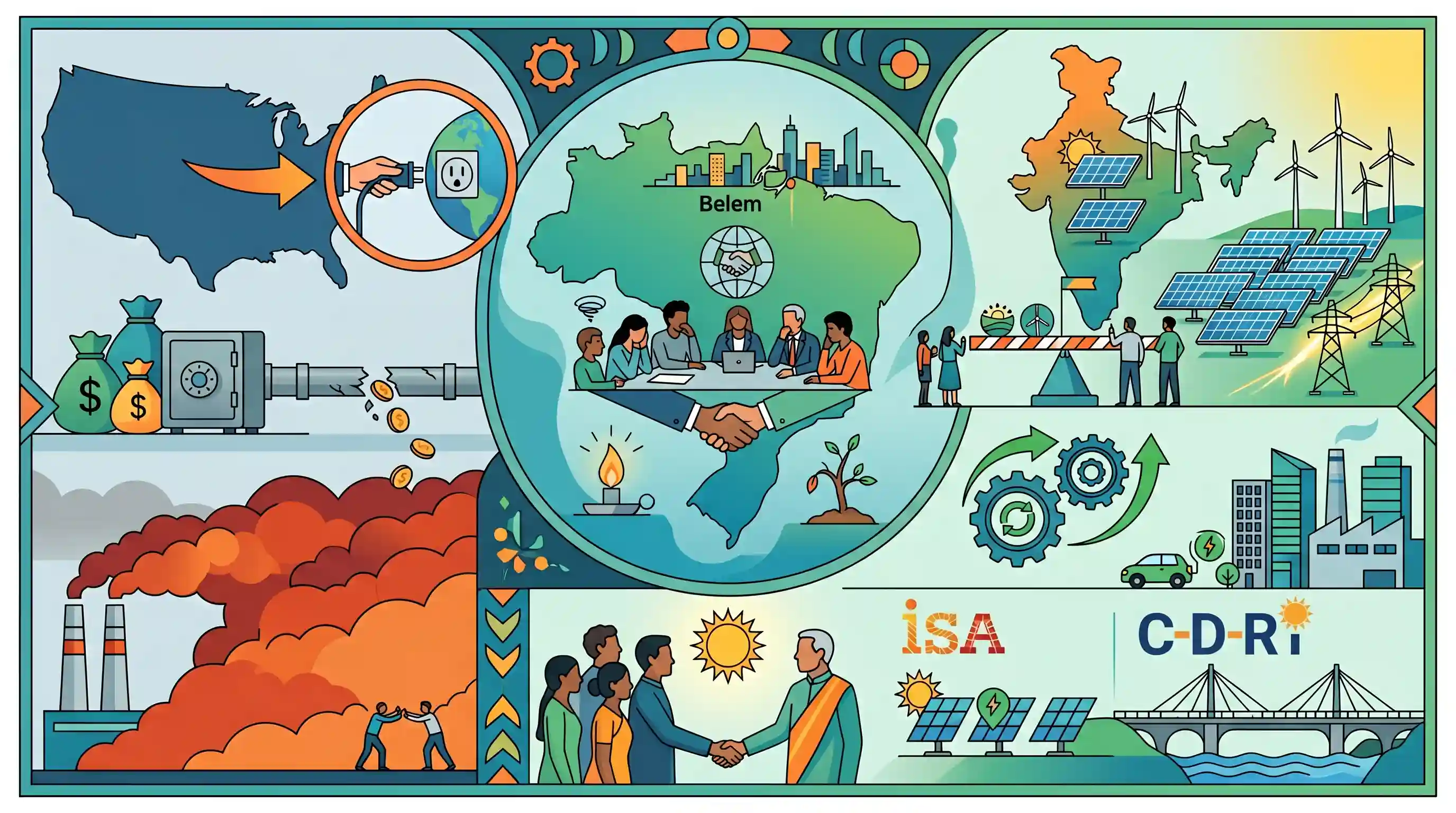
The editorial analyzes the subdued global expectations for the upcoming COP30 climate summit in Belem, Brazil, driven by the US's renewed withdrawal from the Paris Agreement and lagging climate finance. Against a backdrop of record-high CO2 emissions in 2024, the piece argues that while India's formal 2035 Nationally-Determined Contributions (NDCs) might remain modest, the country must pursue aggressive domestic clean energy deployment in its own economic interest. This transition is framed as essential for technological leapfrogging, economic growth, and climate resilience, while platforms like the ISA and CDRI offer India a chance to lead the Global South in climate diplomacy.
Key Points
- Enthusiasm for COP30 is subdued due to the US withdrawing from the Paris Agreement again and developing nations' disillusionment over unfulfilled climate finance.
- Global CO2 emissions reached a record 41.6 billion tonnes in 2024, indicating the Paris Agreement's limited success in curbing emissions after a decade.
- India is expected to submit its 2035 Nationally-Determined Contributions (NDCs) and its first National Adaptation Plan (NAP), which may remain modest given the lack of aggressive targets from peers like China.
- Despite modest international pledges, India needs to aggressively deploy clean energy domestically for technological leapfrogging, global economic competitiveness, and mitigating extreme weather impacts.
- India can leverage climate diplomacy platforms like the International Solar Alliance (ISA) and the Coalition for Disaster-Resilient Infrastructure (CDRI) to cement its leadership of the Global South.
Important Terms
Paris Agreement

A legally binding 2015 international treaty aiming to limit global warming to well below 2°C, ideally 1.5°C, through self-determined national climate action plans (NDCs).
UPSC context
GS-3 Environment (Climate Change) and GS-2 International Treaties; essential for understanding global climate governance and India’s decarbonization pathway.
Conference of the Parties (COP)
The supreme decision-making body of the UNFCCC, meeting annually to negotiate climate action; COP30 (Belem, 2025) is dubbed the 'COP of Implementation' for the Amazon region.
UPSC context
GS-3 Conservation and Environmental Pollution; tests knowledge of international environmental negotiations and the mandate of global climate forums.
Nationally-Determined Contributions (NDCs)
Climate action plans submitted by parties to the Paris Agreement, updated every five years with increasing ambition to reduce national emissions and enhance climate resilience.
UPSC context
GS-3 Environment; critical for understanding the "ratchet mechanism" and India's specific 2030 and 2035 clean energy and emission-intensity targets.
International Solar Alliance (ISA)
An India-France led intergovernmental organization (HQ: Gurugram) aiming to scale solar energy deployment and mobilize $1 trillion in investments by 2030, particularly in developing nations.
UPSC context
GS-2 International Relations and GS-3 Energy/Infrastructure; reflects India’s leadership in climate diplomacy and South-South cooperation.
Coalition for Disaster-Resilient Infrastructure (CDRI)
An India-led global partnership (HQ: New Delhi) that promotes the resilience of infrastructure systems to climate and disaster risks through knowledge exchange and capacity building.
UPSC context
GS-3 Disaster Management and GS-2 India’s Interests; highlights India’s proactive stance on climate adaptation and global infrastructure standards.
Global South
Economically developing nations in Africa, Asia, and Latin America characterized by shared histories of colonization and common vulnerabilities in climate finance and debt.
UPSC context
GS-2 International Relations; essential for understanding India’s positioning as a "Vishwa Bandhu" (global friend) and leader of developing world interests.
Prelims Trap
India submitted its first National Adaptation Plan (NAP) to the UNFCCC in 2008 consisting of eight climate missions.
The NAPCC was a domestic policy framework launched in 2008. The National Adaptation Plan (NAP) is a formal international reporting document under the UNFCCC, which India is preparing for its first submission.
Static Concepts Connected
How does a country legally withdraw from the Paris Agreement under UNFCCC rules?
- Article 28: A party can notify its withdrawal three years after the Agreement has entered into force for that specific country.
- Notice period: The withdrawal takes effect exactly one year after the UN Secretary-General receives the formal notification.
- UNFCCC withdrawal: Any party that withdraws from the parent UNFCCC convention is considered to have implicitly withdrawn from the Paris Agreement as well.
What are the structural features and primary mandate of the CDRI?
- Launch: Launched by India at the 2019 UN Climate Action Summit in New York to build infrastructure resilience.
- Structure: Unlike the ISA, CDRI is not a treaty-based intergovernmental organization but a multi-stakeholder global partnership.
- Scope: It covers both new and existing infrastructure systems to mitigate climate and disaster risks, emphasizing adaptation rather than just mitigation.
Cross-Topic Patterns
Climate initiatives as soft-power
India uses functional multilateral platforms like ISA (mitigation) and CDRI (adaptation) to anchor the Global South, bridging the gap left by unmet Western climate finance and countering Chinese clean-tech dominance.
Clean energy vs Trade protectionism
Aggressive domestic renewable energy deployment is no longer just about NDCs; it is a vital trade defense mechanism against upcoming Western carbon border taxes (like the EU's CBAM) affecting Indian exports.

Expect a multi-statement Prelims question comparing the funding mechanisms and membership criteria of ISA, CDRI, and Global Biofuel Alliance.
Linked PYQs · 5
Linked PYQs · 5
- 2025MainsGS3
Write a review on India's climate commitments under the Paris Agreement (2015) and mention how these have been further strengthened in COP26 (2021). In this direction, how has the first Nationally Determined Contribution intended by India been updated in 2022?
- 2021MainsGS3
Describe the major outcomes of the 26th session of the Conference of the Parties (COP) to the United Nations Framework Convention on Climate Change (UNFCCC). What are the commitments made by India in this conference?
- 2022MainsGS2
‘Clean energy is the order of the day.’ Describe briefly India's changing policy towards climate change in various international fora in the context of geopolitics.
- 2016PrelimsGS1
The term 'Intended Nationally Determined Contributions' is sometimes seen in the news in the context of
- 2025PrelimsGS1
Consider the following statements : Statement I: Article 6 of the Paris Agreement on climate change is frequently discussed in global discussions on sustainable development and climate change. Statement II: Article 6 of the Paris Agreement on climate change sets out the principles of carbon markets. Statement III : Article 6 of the Paris Agreement on climate change intends to promote inter-country non-market strategies to reach their climate targets. Which one of the following is correct in respect of the above statements?
