Delimitation exercise and federal challenges in India
Source:The Hindu ↗
Why It Matters
Delimitation and the North-South demographic divide represents one of the most pressing upcoming constitutional crises in India. It tests the foundational principles of Indian federalism and impacts future electoral frameworks, heavily linking with syllabus topics on Centre-State relations, Parliament composition, and constitutional amendments.
Summary
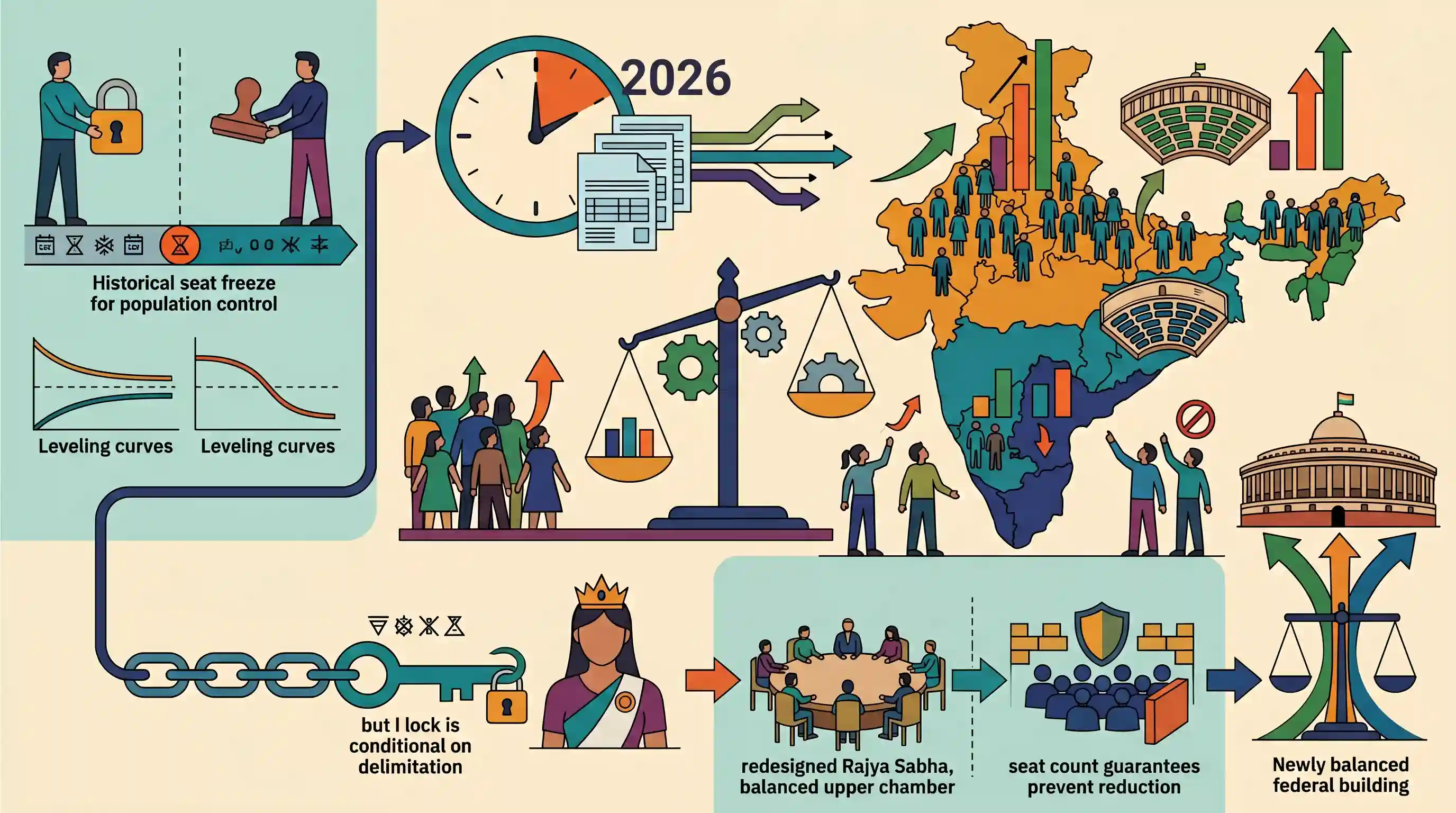
The forthcoming delimitation exercise, slated to occur after the first census post-2026, has ignited a critical debate on preserving India's federal structure. Historically, the 42nd and 84th Constitutional Amendments froze the state-wise allocation of Lok Sabha seats based on the 1971 census to encourage population control. With the freeze lifting, southern states face the prospect of diminished political representation relative to northern states, effectively penalizing them for successful demographic management. This creates a tension between proportional representation ('one person, one vote') and federal equity. The situation is further complicated by the Nari Shakti Vandan Adhiniyam, which links women's reservation to the completion of delimitation. Addressing this requires innovative constitutional mechanisms, such as reforming the Rajya Sabha or guaranteeing existing seat counts, to ensure that the demographic realities do not undermine the political voice of smaller or progressive states.
Key Points
- The impending delimitation of Lok Sabha constituencies post-2026 poses a significant challenge to Indian federalism due to asymmetrical population growth between northern and southern states.
- Southern states, having successfully implemented national population control policies, risk losing political representation and bargaining power in Parliament if seats are strictly reapportioned by current population data.
- There is an inherent conflict between the democratic ideal of 'one person, one vote' (proportional representation) and the need to protect the federal balance so that demographically stabilizing states are not penalized.
- The 106th Constitutional Amendment (Women's Reservation Act) complicates the timeline, as its implementation for providing 33% reservation to women is explicitly contingent upon the completion of the next delimitation exercise.
- Proposed solutions to ensure federalism include capping the total number of seats per state, restructuring the Rajya Sabha to ensure equal representation for all states (similar to the US Senate), or decoupling women's reservation from interstate reallocation of seats.
Important Terms
Delimitation Commission of India

A high-powered independent body constituted under an Act of Parliament to redraw boundaries of Lok Sabha and State Assembly constituencies based on recent census data to ensure equal representation.
UPSC context
GS Paper II: Statutory bodies and electoral reforms. Tests knowledge of the mechanism ensuring 'one person, one vote'.
Article 81
Specifies the composition of the Lok Sabha and mandates that the ratio between seat allocation and population should, as far as practicable, be uniform across all states.
UPSC context
GS Paper II: Indian Constitution. Crucial for understanding proportional representation and federal challenges in seat allocation.
Article 82
Mandates the readjustment of Lok Sabha seat allocation and the division of states into territorial constituencies after each census, as determined by Parliament.
UPSC context
GS Paper II: Parliament and State Legislatures. Fundamental to the constitutional process governing periodic delimitation exercises.
84th Constitutional Amendment Act
Legislation passed in 2001 that extended the freeze on the total number of Lok Sabha and State Assembly seats until the first census after 2026.
UPSC context
GS Paper II: Amendments and Federalism. Tests understanding of demographic policy's impact on political representation.
42nd Constitutional Amendment Act
Enacted in 1976, it initially froze the allocation of Lok Sabha seats to states based on the 1971 census to support national population control efforts.
UPSC context
GS Paper II: Historical amendments. Significant for tracing the evolution of India's representation-population freeze.
106th Constitutional Amendment Act (Nari Shakti Vandan Adhiniyam)
Officially known as the Nari Shakti Vandan Adhiniyam (2023), it reserves 33% of seats for women in the Lok Sabha and State Assemblies, effective post-delimitation.
UPSC context
GS Paper II: Social Justice and Governance. Key for questions on gender parity and legislative reforms.
Prelims Trap
Orders of the Delimitation Commission can be challenged in the Supreme Court if they violate federalism.
Delimitation Commission orders have the force of law and cannot be questioned in any court. This immunity ensures that the electoral process is not stalled by endless litigation.
Static Concepts Connected
How is the Delimitation Commission constituted and what are its powers?
- Constitution: Appointed by the President of India under the Delimitation Commission Act, it operates in close collaboration with the Election Commission of India.
- Composition: Comprises a retired Supreme Court judge as chairperson, the Chief Election Commissioner, and the respective State Election Commissioners.
- Legal immunity: Its orders carry the force of law and cannot be questioned in any court. Neither Parliament nor State Legislatures can modify its orders.
How does Rajya Sabha seat allocation differ from the US Senate?
- Indian model: The Fourth Schedule allocates Rajya Sabha seats based on state population, meaning highly populated states like Uttar Pradesh have significantly more seats than smaller states.
- US model: The US Senate mandates absolute federal equality, granting exactly two senators to every state regardless of its demographic or geographic size.
- Federal rationale: India's asymmetric representation reflects a 'holding together' federation with diverse populations, unlike the US 'coming together' model of sovereign states.
Cross-Topic Patterns
Finance Commission & Demographic Dividends
Similar to delimitation fears, the 15th Finance Commission faced backlash from Southern states over population-based tax devolution, which was mitigated by introducing a specific 'demographic performance' reward criterion.
106th CAA Contingency Clause
The Nari Shakti Vandan Adhiniyam's implementation is constitutionally contingent on the completion of the next delimitation, creating a rare interdependency between gender justice and territorial electoral mapping.

Expect a 2026 multi-statement question intertwining the 84th Amendment freeze, Art 82 delimitation powers, and 106th CAA contingencies.
Linked PYQs · 3
Linked PYQs · 3
- 2024PrelimsGS1
How many Delimitation Commissions have been constituted by the Government of India till December 2023?
- 2024MainsGS2
What changes has the Union Government recently introduced in the domain of Centre-State relations ? Suggest measures to be adopted to build the trust between the Centre and the States and for strengthening federalism.
- 2025MainsGS2
Examine the evolving pattern of Centre-State financial relations in the context of planned development in India. How far have the recent reforms impacted the fiscal federalism in India?
