Language Debate and English Medium Education Policy in India
Source:The Hindu ↗
Why It Matters
The medium of instruction debate intersects multiple UPSC themes: educational reforms under NEP 2020, fundamental rights (freedom of choice in education), and social justice (language as a tool for empowerment vs. marginalization). It is highly relevant for GS2 questions on education policy and vulnerable sections, as well as philosophical Essay topics on the true purpose and social impact of education.
Summary
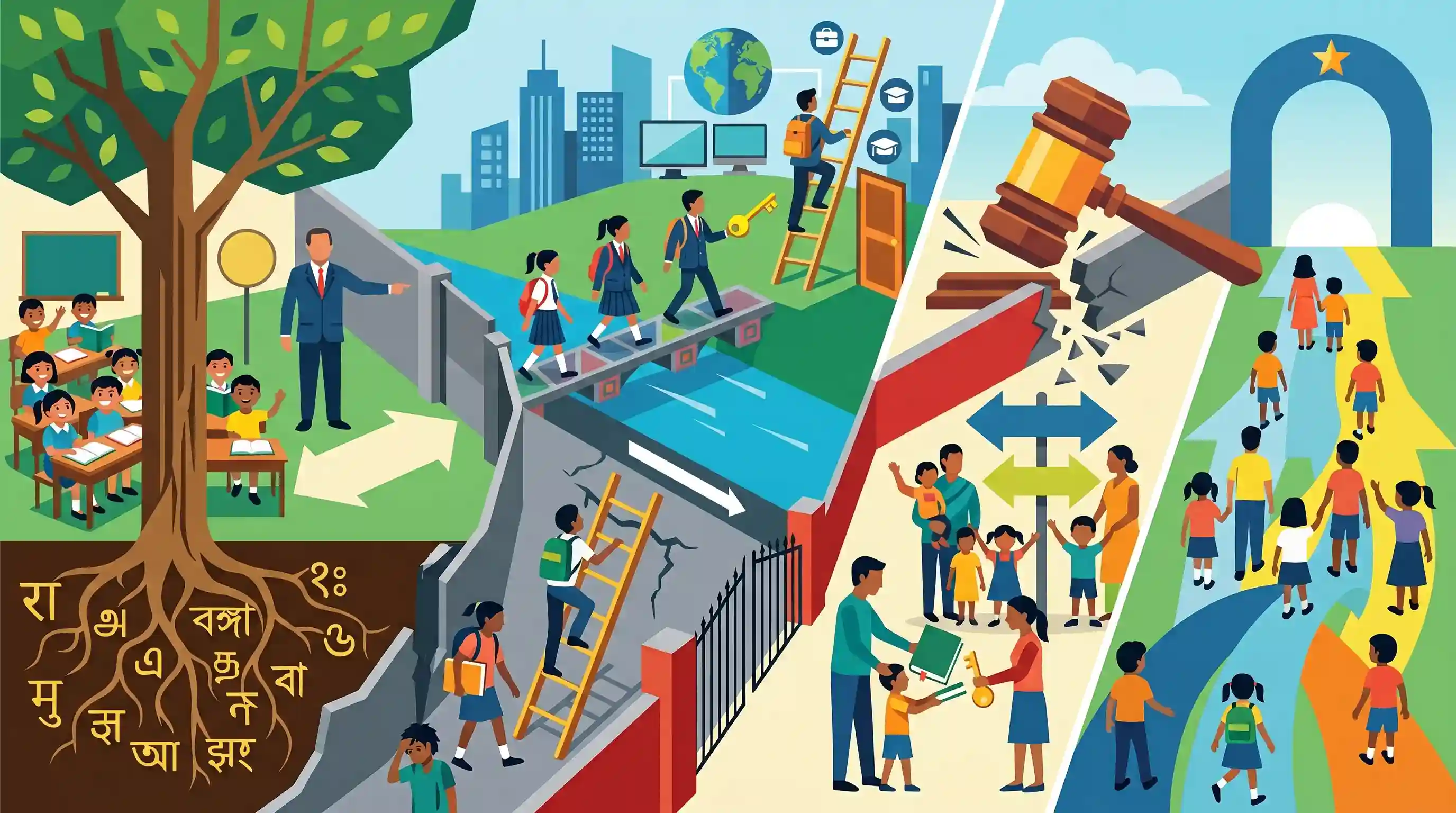
The editorial analyzes the ongoing debate over the medium of instruction in Indian schools, contrasting the National Education Policy's (NEP) emphasis on mother tongue learning with the ground reality of widespread aspirations for English-medium education. While early education in the mother tongue is pedagogically sound, the article argues that denying English instruction in public schools disproportionately harms marginalized and subaltern communities, for whom English serves as an essential tool for socio-economic mobility. Furthermore, a 2014 Supreme Court ruling affirmed that the choice of instructional language is a fundamental right of parents and children, cautioning that state-imposed language mandates could deepen educational and social inequalities.
Key Points
- The National Education Policy (NEP) and current political narratives strongly advocate for mother tongue instruction, sometimes carrying an anti-English undertone.
- Despite these policy pushes, there is a widespread popular aspiration for English-medium education, which is viewed as a critical pathway to upward socio-economic mobility, particularly among subaltern castes.
- While pedagogical research supports early learning in one's mother tongue, the socio-economic reality in India makes English proficiency intrinsically linked to empowerment and global opportunities.
- A 2014 Supreme Court judgment struck down a Karnataka government order that mandated Kannada as the sole medium of instruction up to Class 4, upholding the fundamental freedom of choice for parents and students.
- Restricting English-medium education in state schools risks exacerbating social inequality, as affluent families will simply shift to private schools, leaving marginalized communities deprived of crucial language skills.
Important Terms
National Education Policy (NEP) 2020

A comprehensive 2020 framework for Indian education that advocates for instruction in the mother tongue or regional language until Grade 5 to improve foundational literacy and cognitive outcomes.
UPSC context
GS Paper II (Governance/Social Justice); tests understanding of educational reforms and pedagogical shifts in India.
Three-language formula
A language policy (since 1968) requiring students to learn three languages: English, Hindi, and a regional language, aimed at fostering multilingualism and national integration.
UPSC context
GS Paper II; relevant for center-state relations, linguistic federalism, and the debate on language imposition.
Medium of Instruction
The primary language used by teachers for instruction, currently a point of contention between pedagogical effectiveness (mother tongue) and socio-economic mobility (English).
UPSC context
GS Paper II; relates to educational equity, social justice, and human resource development.
Article 350A
A constitutional directive (inserted by the 7th Amendment) requiring states to provide adequate facilities for instruction in the mother tongue at the primary level for linguistic minorities.
UPSC context
GS Paper II; crucial for understanding constitutional safeguards for linguistic minorities and state educational obligations.
Right to Choice of Medium (2014 Ruling)
A fundamental right (under Article 19(1)(a)) affirmed by the Supreme Court in 2014, ensuring parents/guardians can choose the instructional language for their children.
UPSC context
GS Paper II (Polity/Judiciary); tests understanding of fundamental rights and judicial limits on state educational mandates.
Subaltern Communities
Marginalized or lower-caste social groups who frequently view English-medium education as a tool for socio-economic mobility and social dignity.
UPSC context
GS Paper I (Society) and GS Paper II; relevant for discussions on social justice and empowerment.
Prelims Trap
Under NEP 2020, it is legally mandatory for all primary schools to use the mother tongue as the medium of instruction up to Class 5.
NEP 2020 recommends that the medium of instruction be the mother tongue 'wherever possible' up to Grade 5. It is an advisory guideline, not a legally binding mandate.
Static Concepts Connected
What are the Constitutional safeguards regarding the mother tongue and linguistic minorities?
- Article 350A: Directs States to provide adequate facilities for instruction in the mother-tongue at the primary stage of education to children belonging to linguistic minority groups.
- Article 350B: Provides for a Special Officer for Linguistic Minorities, appointed by the President, to investigate matters relating to constitutional safeguards.
- Article 29: Guarantees the right of any section of citizens residing in India to conserve their distinct language, script, or culture.
How did the Supreme Court interpret the right to choose the medium of instruction?
- 2014 SC Ruling: In a 2014 judgment (State of Karnataka v. Associated Management), a Constitution Bench struck down a mandate imposing Kannada as the sole medium in primary schools.
- Article 19(1)(a): The Court held that a child's or parent's right to choose the medium of instruction is implicitly protected under the freedom of speech and expression.
Cross-Topic Patterns
Linguistic Capital & Dalit Empowerment
English proficiency is widely viewed as a tool to bypass traditional caste barriers, aligning with subaltern movements that advocate for integration into the globalized knowledge economy.
NEP 2020 vs. Fundamental Rights
The tension between state educational directives (like NEP's mother-tongue emphasis) and judicial rulings upholding parental choice under Art 19(1)(a) highlights a classic governance-vs-rights friction.

Prelims 2026 may test the exact Article (19(1)(a)) protecting the choice of medium of instruction, or pit Art 350A against NEP guidelines.
Linked PYQs · 3
Linked PYQs · 3
- 2020MainsGS2
National Education Policy 2020 is in conformity with the Sustainable Development Goal-4 (2030). It intends to restructure and reorient education system in India. Critically examine the statement.
- 2017MainsEssay
Destiny of a nation is shaped in its classrooms.
- 2023MainsEssay
Education is what remains after one has forgotten what one has learned in school.
