NITI Aayog Urges Engineering Students to Join Defence Research
Source:The Hindu ↗
Why It Matters
The article touches upon the fundamental GS-3 themes of 'indigenization of technology' and 'achievements of Indians in science and technology'. Understanding the historical context of institutions like the DRDO and the contributions of pioneering scientists provides crucial factual fodder for Mains answers relating to self-reliance (Atmanirbhar Bharat) in the defence sector.
Summary
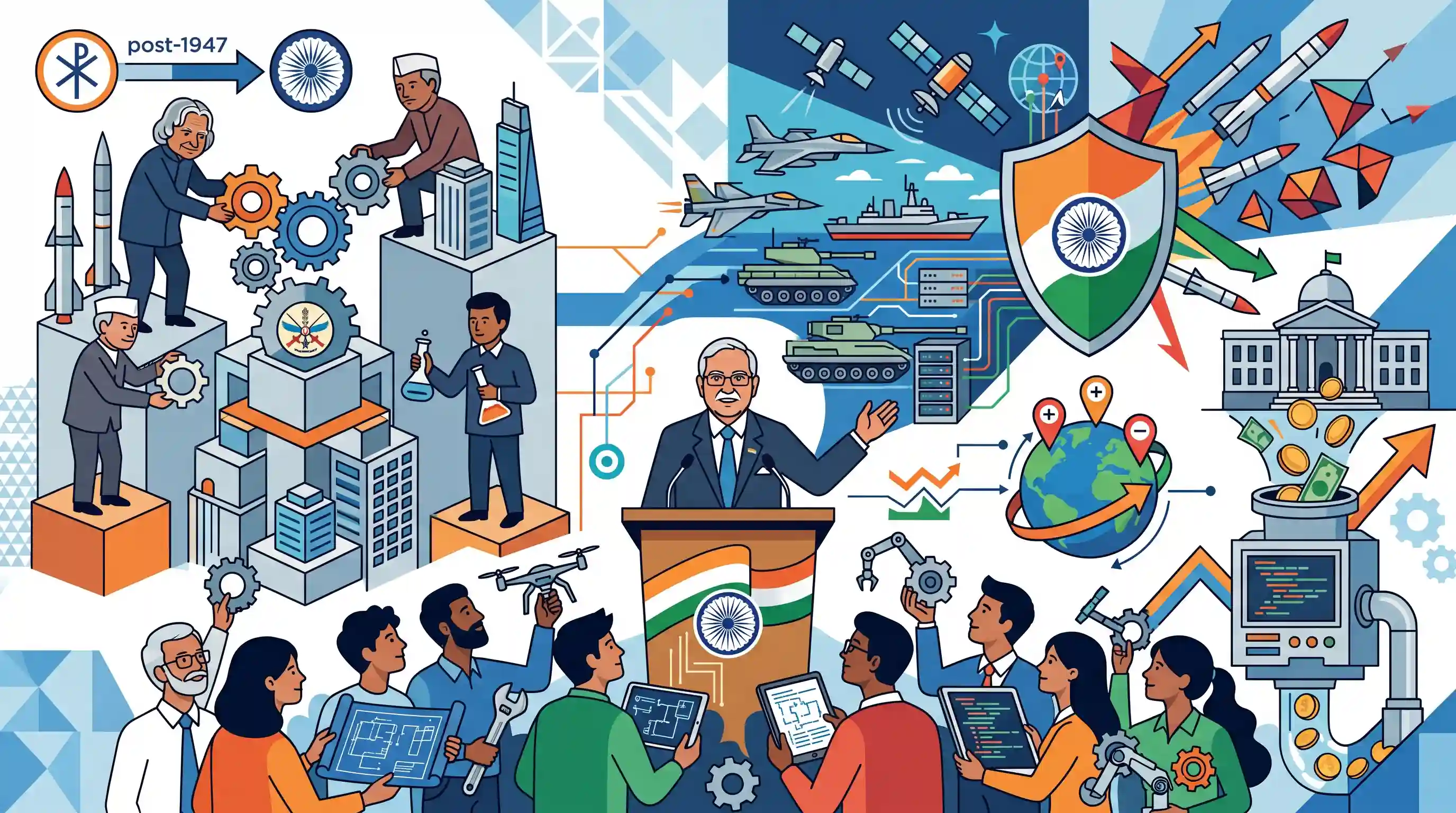
Addressing engineering students, NITI Aayog member and former DRDO chief Dr. V.K. Saraswat called for greater youth participation in defence research to enhance India's self-reliance and national security. He traced the roots of India's defence R&D post-1947, acknowledging stalwarts like Jawaharlal Nehru, Patrick Blackett, Daulat Singh Kothari, and APJ Abdul Kalam who built the foundation for institutions like the DRDO. Emphasizing the multidisciplinary nature of modern warfare, Saraswat highlighted increased budgetary allocations for defence and urged emerging engineers to develop technologies of international standards to address modern geopolitical threats.
Key Points
- NITI Aayog member Dr V.K. Saraswat emphasized the need for engineering students to take an active interest in defence research to bolster national security.
- He highlighted the historical evolution of India's defence research framework, initiated post-1947 by Jawaharlal Nehru and Patrick Blackett.
- The foundational role of Indian scientists such as Daulat Singh Kothari (who formed DRDO), Suri Bhagavantam, APJ Abdul Kalam, and Raja Ramanna in building a self-reliant defence sector was underscored.
- Saraswat pointed out the recent increase in Union Budget allocations for the defence sector, aimed at maintaining global competitiveness in defence capabilities.
- He urged young engineers to leverage their multi-disciplinary skills to design advanced defence systems capable of countering emerging international threats.
Important Terms
NITI Aayog

India's premier policy think tank established in 2015, replacing the Planning Commission. It fosters cooperative federalism by involving states in the policy-making process through a bottom-up approach.
UPSC context
GS Paper 2 (Governance) and 3 (Economy). Tests understanding of cooperative federalism and the shift from centralized planning.
DRDO
The Research and Development (R&D) arm of the Ministry of Defence, established in 1958. It designs and develops advanced sensors, weapon systems, and military platforms for the Indian Armed Forces.
UPSC context
GS Paper 3 (Science & Tech/Security). Crucial for topics on indigenization and internal security infrastructure.
Indigenization of Technology
The process of developing and manufacturing technology within the country to replace imports. It emphasizes domestic design, R&D, and intellectual property ownership rather than just local assembly.
UPSC context
GS Paper 3 (Science & Tech). Essential for discussing strategic autonomy and the 'Make in India' initiative.
Atmanirbharta in Defence
A national vision to achieve self-reliance in military hardware through domestic production and reduced import dependency. Key tools include 'Positive Indigenisation Lists' and increased Foreign Direct Investment (FDI).
UPSC context
GS Paper 3 (Security/Economy). Tests knowledge of India's strategic goal to become a net exporter of defence equipment.
Daulat Singh Kothari
An eminent physicist and the first Scientific Advisor to the Ministry of Defence (1948). Known as the 'Architect of Defence Science,' he laid the foundation for the DRDO.
UPSC context
GS Paper 1 (Modern History/Personalities) and 3 (Science & Tech). Relevant for the history of scientific institutions in India.
Prelims Trap
DRDO was founded in 1947 immediately after Independence under the leadership of Dr. A.P.J. Abdul Kalam.
DRDO was established in 1958, not 1947. Dr. D.S. Kothari was its foundational architect, whereas Dr. Kalam later gained prominence leading the IGMDP in the 1980s.
Static Concepts Connected
How did India's institutional framework for defence research evolve post-independence?
- Early beginnings: Defence Science Organisation (DSO) was set up in 1948 with guidance from British physicist and Nobel laureate Patrick Blackett.
- DRDO Formation: Established in 1958 by merging the DSO with existing Technical Development Establishments under the leadership of Dr. D.S. Kothari.
- IGMDP Launch: Initiated in 1983 under Dr. A.P.J. Abdul Kalam to secure self-reliance in guided missiles (Prithvi, Agni, Akash, Nag, Trishul).
What are the core pillars of India's current defence indigenisation policy?
- Capital Budgets: Reserving a major share (approx 75%) of the defence capital acquisition budget exclusively for domestic manufacturers to ensure assured demand.
- Import Embargoes: Notifying Positive Indigenisation Lists that strategically ban the import of specified weapons, platforms, and sub-systems to force domestic R&D.
- iDEX Framework: Engaging startups, MSMEs, and individual engineers to develop advanced, dual-use technologies for the military.
Cross-Topic Patterns
Institution building + Post-independence History
The contributions of scientists like D.S. Kothari map directly to GS-1 post-independence consolidation, linking early state-building to modern technological self-reliance in GS-3.
Defence economics + Startup ecosystem
The call for engineers to enter defence links GS-3 Security to GS-3 Economy via schemes like iDEX, highlighting the strategic shift from relying solely on PSUs to leveraging private startups.

Expect a Prelims 'match-the-following' pairing post-independence scientists (Kothari/Defence, Bhabha/Nuclear, Bhatnagar/CSIR) in 2026.
Linked PYQs · 3
Linked PYQs · 3
- 2014MainsGS3
Foreign Direct Investment (FDI) in the defence sector is now set to be liberalized. What influence this is expected to have on Indian defence and economy in the short and long run?
- 2019MainsGS3
How was India benefitted from the contributions of Sir M. Visvesvaraya and Dr. M. S. Swaminathan in the fields of water engineering and agricultural science respectively?
- 2021MainsGS3
How is S-400 air defence system technically superior to any other system presently available in the world?
