Labor Intensive Export Performance Amid Trade Barriers
Source:The Hindu ↗
Why It Matters
Highlights the performance of MSME-driven, labor-intensive export sectors (engineering, textiles). It provides critical real-world context for questions concerning India's manufacturing competitiveness, the MSME sector's contribution to GDP/exports, and strategies to navigate global protectionism and tariff barriers.
Summary
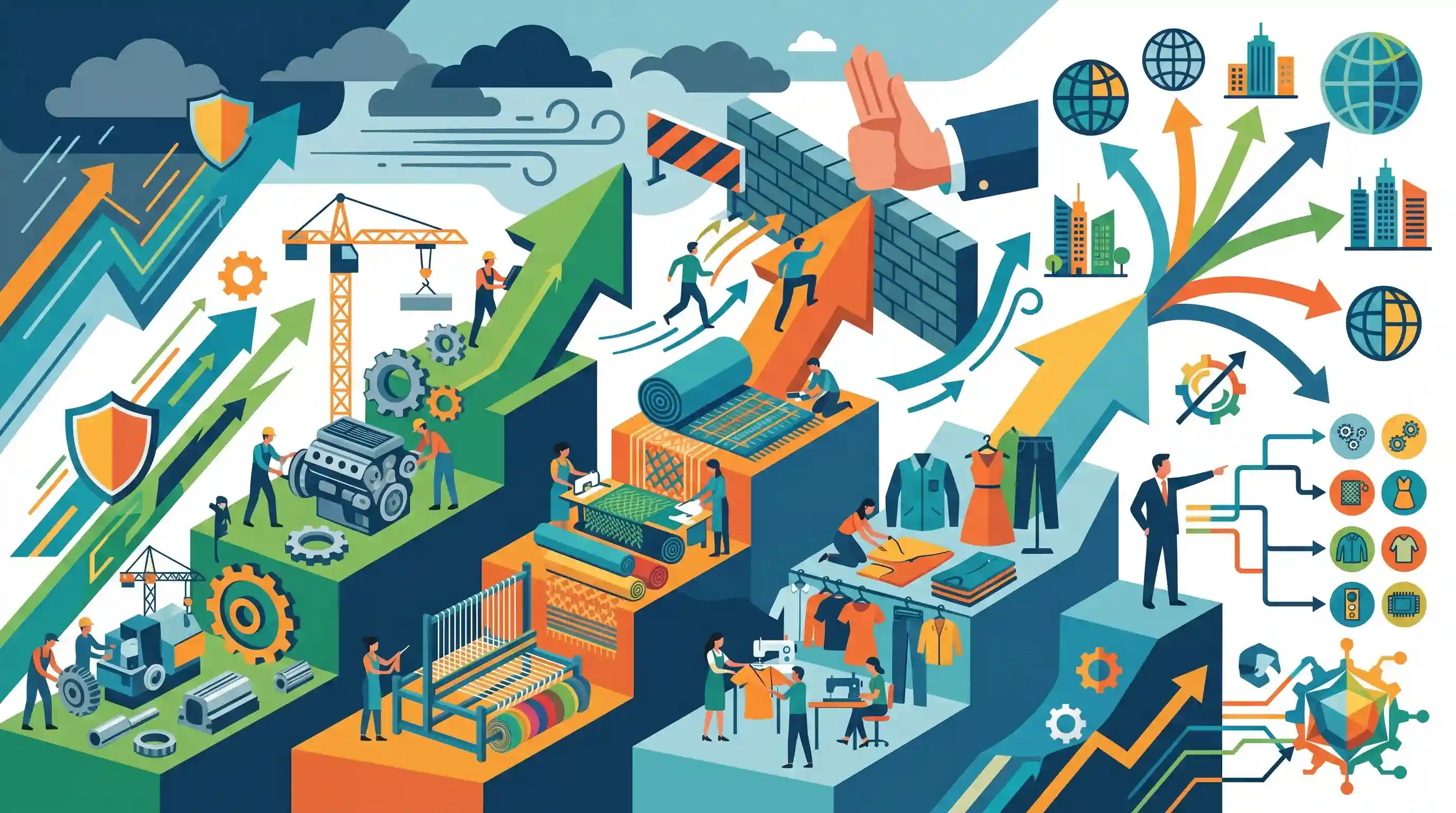
India’s engineering, textile, and apparel exports maintained a positive growth trajectory in July, recording year-on-year increases of 13.75%, 5.84%, and 4.75%, respectively. These labor-intensive sectors, fundamentally driven by Micro, Small, and Medium Enterprises (MSMEs), exhibited substantial resilience amid global trade uncertainties and potential tariff escalations stemming from the US. The Engineering Export Promotion Council (EEPC) of India noted that sustained momentum requires continuous risk mitigation strategies, particularly through the aggressive diversification of export markets and product portfolios to counter global macroeconomic headwinds.
Key Points
- India's engineering goods exports grew by 13.75% year-on-year in July.
- Textile exports grew by 5.84% and apparel exports grew by 4.75% over the same period.
- The engineering, textile, and garment sectors are heavily reliant on Micro, Small and Medium Enterprise (MSME) exporters.
- Despite global trade uncertainties and US-triggered tariff anxieties, the export sector showed resilience.
- Exporters are actively pursuing market and product diversification to mitigate geopolitical and macroeconomic risks.
Important Terms
EEPC India

A premier trade and investment promotion organization for India's engineering sector, established in 1955 and sponsored by the Ministry of Commerce and Industry.
UPSC context
GS Paper III: Indian Economy, External Sector. Tests understanding of institutional mechanisms for export promotion.
MSMEs
Enterprises classified by investment and turnover; Micro (<=₹1cr/₹5cr), Small (<=₹10cr/₹50cr), and Medium (<=₹50cr/₹250cr). They contribute ~40% to India's total exports.
UPSC context
GS Paper III: Growth, Employment, Inclusive Growth. Key for questions on industrial policy and job creation.
Labor-intensive Sectors
Industries requiring a high proportion of labor relative to capital, such as textiles, apparel, and leather. These are vital for utilizing India's demographic dividend.
UPSC context
GS Paper III: Economic Development, Employment. Crucial for manufacturing-led growth and poverty reduction strategies.
Macroeconomic Headwinds
Adverse large-scale economic forces, such as high inflation, rising interest rates, or geopolitical tensions, that slow down growth or impede business activity.
UPSC context
GS Paper III: External Sector, Global Economy. Tests ability to analyze external risks to India's economic stability.
Market Diversification
A trade strategy of expanding exports into new geographical regions or product categories to reduce reliance on traditional markets and mitigate external shocks.
UPSC context
GS Paper III: Foreign Trade. Relevant for strategies to counter global protectionism and trade volatility.
Prelims Trap
"Engineering Export Promotion Council (EEPC) functions under the Union Ministry of Heavy Industries."
EEPC functions under the Ministry of Commerce and Industry, not Heavy Industries. UPSC frequently swaps ministries for sector-specific trade bodies to confuse aspirants.
Static Concepts Connected
What is the administrative control and mandate of Export Promotion Councils (EPCs)?
- Nature: They are typically non-profit organizations registered under the Companies Act or the Societies Registration Act.
- Nodal Ministry: They function under the administrative control of the Department of Commerce, Ministry of Commerce and Industry.
- Function: They act as an advisory body to the government on export policies and assist exporters in market diversification and global compliance.
What is the macroeconomic footprint of MSMEs in India's economy?
- Export Share: MSMEs account for approximately 40-45% of India's total merchandise exports, making them a critical driver of foreign trade.
- Employment: The sector is the second-largest employment generator in India after agriculture, heavily sustaining labor-intensive industries like textiles and apparel.
- Definition Criteria: MSME classification is currently based on a composite criteria of both Investment in Plant & Machinery/Equipment and Annual Turnover.
Cross-Topic Patterns
MSME Vulnerability + Western Protectionism
While MSMEs drive ~45% of exports, they lack capital buffers to absorb sudden tariff shocks (like US duties or EU's CBAM), making government-backed diversification strategies critical.
Labor-Intensive Exports vs. FTA Utilization
Sustaining growth in labor-intensive sectors like textiles highlights the urgency of concluding FTAs with the UK and EU to match zero-duty competitors like Bangladesh and Vietnam.

Expect a multi-statement question linking MSME export shares, updated definitions, and impacts of Western tariff escalations in 2026.
Linked PYQs · 4
Linked PYQs · 4
- 2023MainsGS3
Faster economic growth requires increased share of the manufacturing sector in GDP, particularly of MSMEs. Comment on the present policies of the Government in this regard.
- 2025MainsGS3
What are the challenges before the Indian economy when the world is moving away from free trade and multilateralism to protectionism and bilateralism? How can these challenges be met?
- 2018MainsGS3
How would the recent phenomena of protectionism and currency manipulations in world trade affect macroeconomic stability of India?
- 2023PrelimsGS1
Consider the following statements with reference to India: 1. According to the 'Micro, Small and Medium Enterprises Development (MSMED) Act, 2006', the 'medium enterprises' are those with investments in plant and machinery between ₹ 15 crore and ₹ 25 crore. 2. All bank loans to the Micro, Small and Medium Enterprises qualify under the priority sector. Which of the statements given above is/are correct?
