Engineered Proteins and Cellular Quantum Sensors in Medicine
Source:The Hindu ↗
Why It Matters
The integration of quantum mechanics with biological systems represents a cutting-edge frontier in Science and Technology. It is highly relevant for UPSC GS-3 topics covering advancements in biotechnology, quantum computing applications, and their role in transforming the healthcare and diagnostics sectors.
Summary
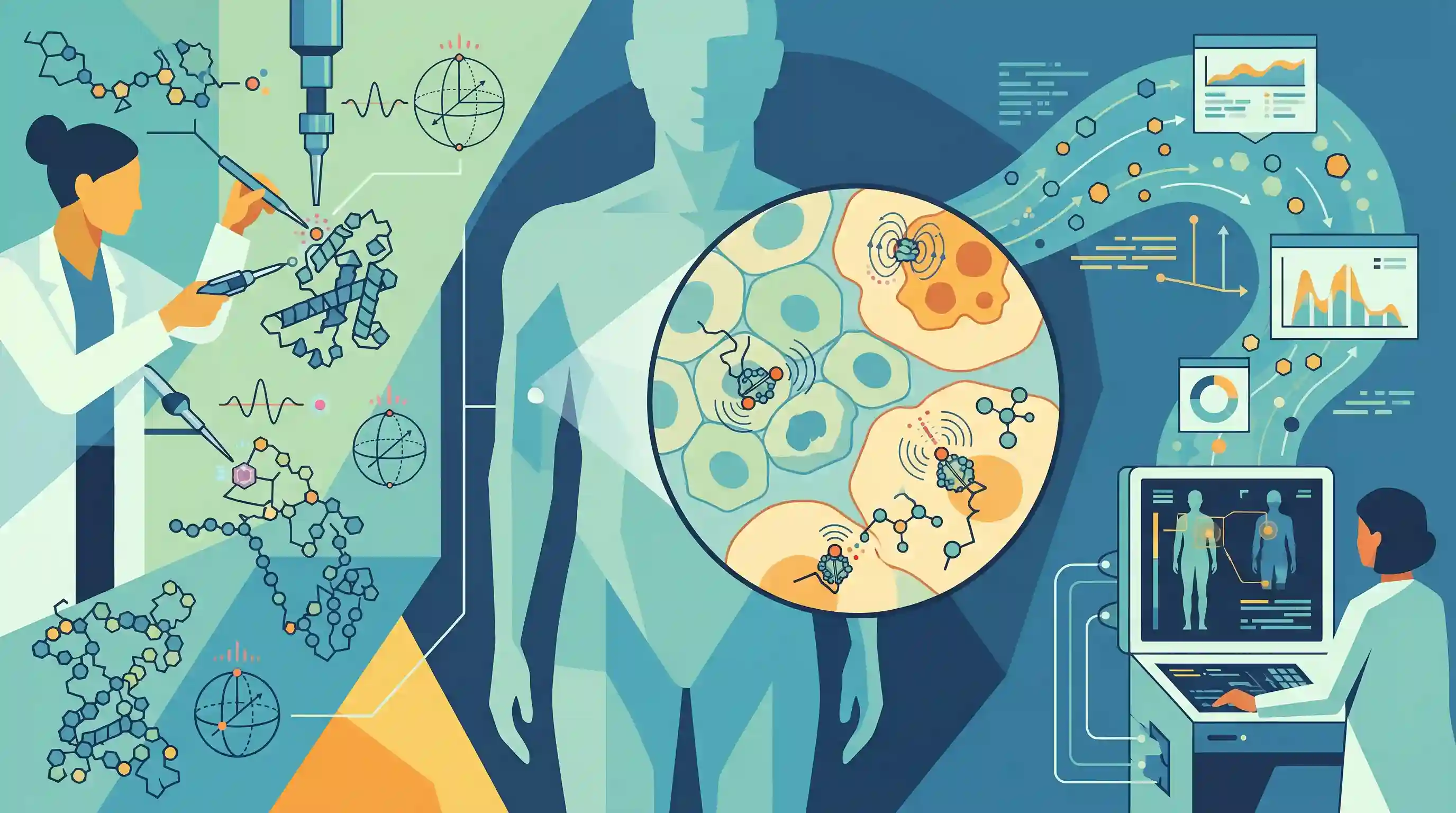
Scientists are advancing the frontiers of medical diagnostics by engineering proteins to act as quantum sensors inside the human body. By utilizing 'maglov qubits', researchers aim to harness quantum phenomena—such as sensitivity to minute magnetic or electrical changes—at the cellular level. This convergence of synthetic biology and quantum technology could revolutionize healthcare by enabling non-invasive, ultra-precise monitoring of cellular processes, disease progression, and the efficacy of targeted treatments at the molecular scale.
Key Points
- Researchers are engineering proteins to function as highly sensitive 'quantum sensors' capable of operating inside living cells.
- The technology incorporates the concept of 'maglov qubits', leveraging quantum states to monitor biological processes at an unprecedented molecular level.
- This approach merges synthetic biology with quantum mechanics, allowing biological molecules to process or relay quantum information.
- Such quantum biosensors hold immense potential for precision medicine, enabling ultra-precise diagnostics, disease monitoring, and targeted drug delivery without disrupting normal cellular functions.
Prelims Trap
"All quantum sensors, including those used in medicine, require ultra-cold cryogenic temperatures to prevent decoherence."
Biological quantum sensors like MagLOV specifically operate at room temperature inside living cells using the radical pair mechanism.
Static Concepts Connected
What are the core properties of quantum bits (Qubits)?
- Superposition: The ability of a quantum system to exist in multiple states (0 and 1) simultaneously until measured.
- Entanglement: The state where qubits become intrinsically linked, meaning the state of one instantly dictates the state of another, regardless of distance.
- Decoherence: The loss of quantum coherence (information) due to interaction with environmental noise like heat or electromagnetic interference.
How do genetically encodable biosensors function in living cells?
- DNA Integration: The genetic instructions (DNA) for a specific sensor protein are inserted into the host organism's genome.
- Endogenous Synthesis: The host cell uses its own native machinery (ribosomes) to transcribe and translate the inserted DNA into functional sensor proteins.
- Biocompatibility: Because the body produces the sensor naturally, it eliminates the need for invasive physical implantation of foreign electronic devices.
Cross-Topic Patterns
Quantum Biology & Magnetoreception
The 'radical pair mechanism' used by MagLOV proteins is the exact same quantum phenomenon theorized to help migratory birds navigate using the Earth's magnetic field.
Solid-state vs. Synthetic Biology
UPSC often tests material limits. Traditional quantum sensors use hard materials (like diamonds) requiring physical implantation, whereas these synthetic biology sensors are genetically encoded and synthesized by the cell natively.

Expect a 2026 Prelims question mixing synthetic biology (genetically encoded proteins) with room-temperature quantum sensing mechanics.
Linked PYQs · 4
Linked PYQs · 4
- 2022PrelimsGS1
Which one of the following is the context in which the term "qubit" is mentioned ?
- 2019PrelimsGS1
What is Cas9 protein that is often mentioned in news?
- 2020MainsGS3
What do you understand by nanotechnology and how is it helping in health sector?
- 2021MainsGS3
What are the research and developmental achievements in applied biotechnology? How will these achievements help to uplift the poorer sections of the society?
