Fatehpur regains Jal Shakti Engineer-in-Chief office after eight years
Source:tribuneindia ↗
Why It Matters
Knowledge of state-specific irrigation projects (such as Shah Nehar and Phinna Singh) and the administrative setup of the Jal Shakti Department is highly relevant for HPAS Prelims, particularly for the Himachal Pradesh general knowledge sections.
Summary
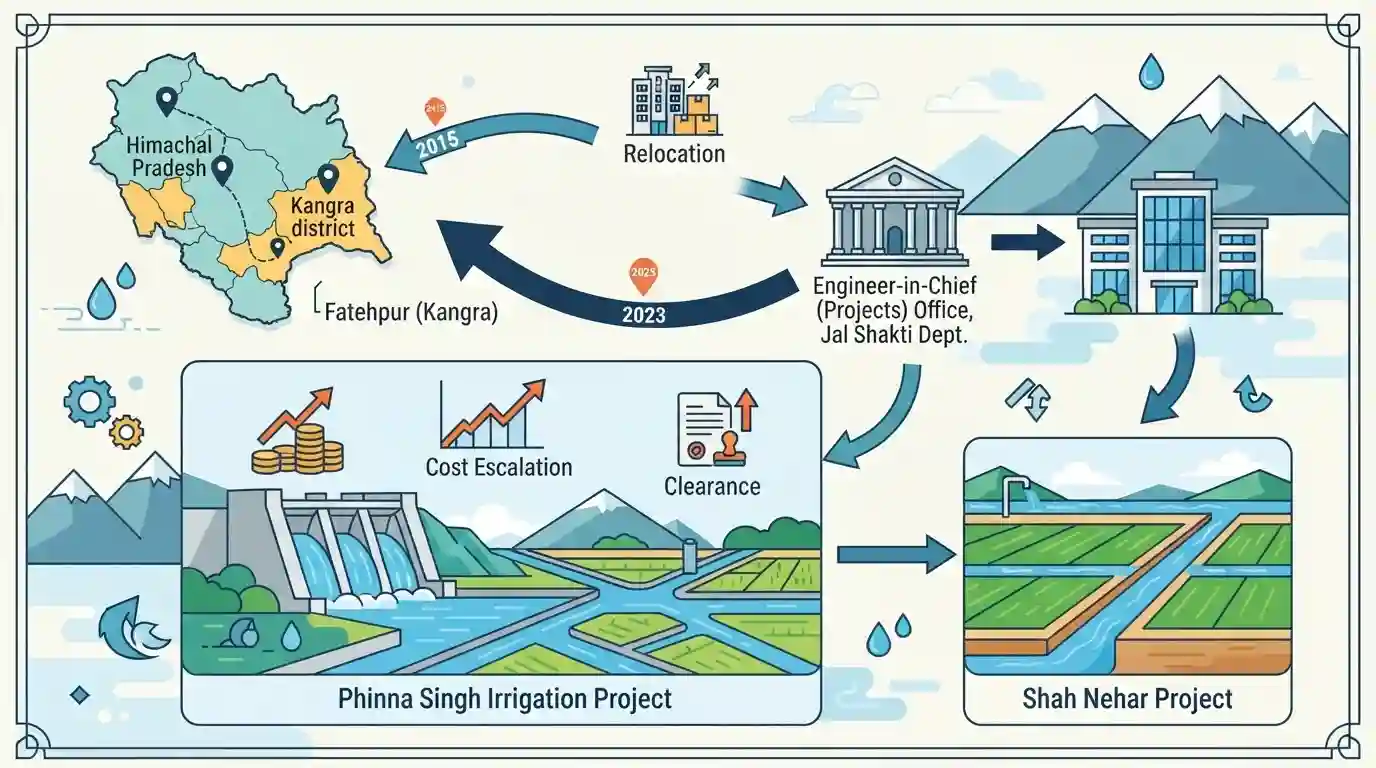
After an eight-year hiatus, the Himachal Pradesh government is relocating the Engineer-in-Chief (Projects) office of the Jal Shakti Department back to Fatehpur in Kangra district. Originally established there in 2013 to oversee major irrigation works like the Shah Nehar and Phinna Singh projects, the office was moved to Mandi by the previous administration. The reinstatement is expected to fast-track delayed projects, notably the Phinna Singh Irrigation Project, which has seen massive cost escalations and is awaiting clearance for Central funding.
Key Points
- The Engineer-in-Chief (Projects) office of the Jal Shakti Department is being restored to Fatehpur in Kangra district after 8 years.
- The office was initially established in Fatehpur in 2013 but was shifted to Mandi during the previous BJP government.
- It oversees critical irrigation projects including the Shah Nehar, Phinna Singh, Sidhatha, and the proposed Sukhahaar projects.
- The Phinna Singh irrigation project has faced severe delays and cost escalations (reaching ₹643 crore), making its completion heavily reliant on funding from the Centre.
Important Terms
Shah Nehar Project

The only major irrigation project in Himachal Pradesh, located in Kangra district, designed to irrigate over 15,000 hectares using water diverted from the Beas River via a barrage at Talwara.
UPSC context
GS Paper III: Infrastructure (Irrigation), testing interstate water sharing, project execution delays, and command area development.
Phinna Singh Irrigation Project
An ongoing medium irrigation project in Nurpur, Kangra district of Himachal Pradesh, designed to provide assured irrigation to approximately 4,025 hectares of culturable command area.
UPSC context
GS Paper III: Infrastructure and Irrigation, testing state-sponsored development initiatives and cost overrun challenges in hill states.
Sidhatha Irrigation Project
A completed medium irrigation project in Jawali, Kangra district, Himachal Pradesh, which diverts flow from the Dehar stream to irrigate 3,150 hectares of culturable command area.
UPSC context
GS Paper III: Agricultural Water Management, testing knowledge of run-of-the-river diversion schemes and regional command areas.
Jal Shakti Vibhag (Himachal Pradesh)
The principal state department responsible for water supply, sewerage, flood control, and irrigation infrastructure, executing flagship schemes like the Jal Jeevan Mission and managing state-level projects.
UPSC context
GS Paper II: Governance and Public Policy, testing state-level administrative mechanisms for executing crucial public utility and water services.
Central Water Commission (CWC)
India's premier technical organization in water resources, functioning as an attached office under the Ministry of Jal Shakti, coordinating flood control, irrigation, and dam safety nationwide.
UPSC context
GS Paper II & III: Statutory/Regulatory Bodies and Water Resources, testing centralized coordination of river valley projects.
Prelims Trap
The Shah Nehar project is built on the Sutlej river to irrigate the southern plains of Himachal Pradesh.
Shah Nehar draws water from the Beas River (below Pong Dam) and irrigates the northern Kangra district, not the Sutlej.
Static Concepts Connected
What are the criteria for classifying irrigation projects in India?
- Major Irrigation: Projects with a Culturable Command Area (CCA) exceeding 10,000 hectares, involving large canal networks.
- Medium Irrigation: Projects with a CCA between 2,000 and 10,000 hectares, often utilizing medium-sized reservoirs or stream diversions.
- Minor Irrigation: Projects with a CCA up to 2,000 hectares, relying primarily on groundwater or local lift irrigation systems.
What is the Accelerated Irrigation Benefit Programme (AIBP)?
- Integration: Launched in 1996, it is now integrated as a major component of the Pradhan Mantri Krishi Sinchayee Yojana (PMKSY).
- Core Objective: Aims to accelerate the implementation of stalled major and medium irrigation projects across the country.
- Funding Pattern: Provides up to 90% central financial assistance for Himalayan, North-Eastern, and drought-prone states.
Cross-Topic Patterns
Hill state infrastructure and central dependencies
Severe cost overruns in fragile Himalayan terrains make states highly dependent on Central schemes like PMKSY-AIBP, showcasing the nuances of fiscal federalism in mountain states.
Hydrological diversion vs. ecological flows
Irrigation diversions from Himalayan rivers like the Beas must balance local agricultural needs against the strict ecological flows required downstream in eco-sensitive zones.

PMKSY-AIBP command area criteria and special funding provisions for Himalayan states will likely feature in a 2026 prelims question.
