ENGIE Secures Financial Closure for Barmer Solar Power Project
Source:renewablewatch ↗
Why It Matters
The project highlights the expansion of solar energy capacity in western Rajasthan (Barmer) and underscores the state's attractiveness for foreign corporate investments (like ENGIE) in the renewable sector. Questions regarding new power projects, capacities, and locations are frequent in the RPSC RAS Prelims exam.
Summary
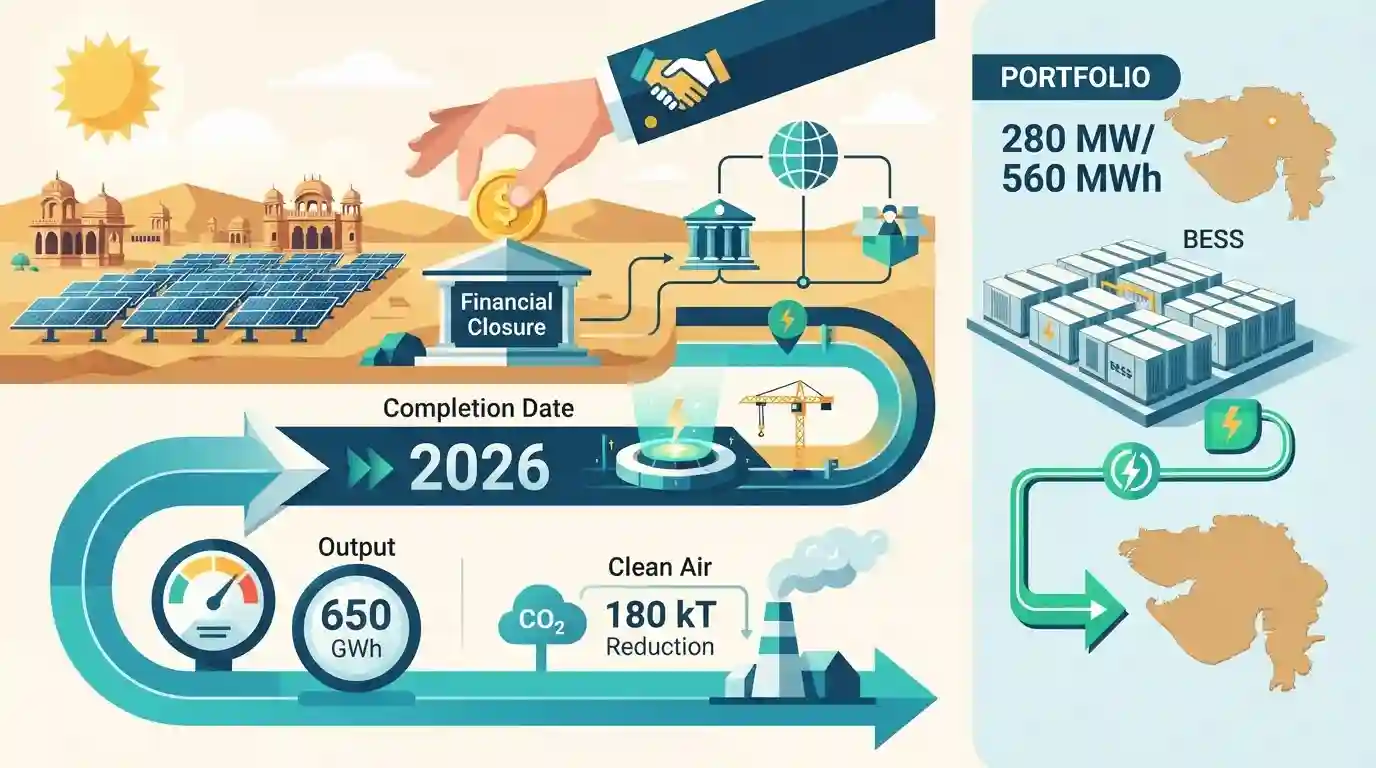
ENGIE has secured financial closure for its 250 MW Khaba solar power project in Barmer, Rajasthan, backed by leading global financial institutions. The project, implemented by its subsidiary Khaba Renewable Energy Private Limited, is set to be completed by the third quarter of 2026. It will generate 650 GWh of clean electricity and reduce CO2 emissions by approximately 180 kilotonnes annually. Additionally, ENGIE's broader portfolio in India includes a recent 280 MW/560 MWh battery energy storage system (BESS) project in Gujarat.
Key Points
- ENGIE has achieved financial closure for its 250 MW Khaba solar project in Barmer, Rajasthan.
- The project is being developed by Khaba Renewable Energy Private Limited, a wholly-owned subsidiary of ENGIE.
- Once commissioned by Q3 2026, the project will generate around 650 GWh of clean electricity annually and offset 180 kilotonnes of CO2 emissions.
- Earlier in March 2026, ENGIE India signed a PPA with GUVNL for a 280 MW/560 MWh standalone battery energy storage system (BESS) in Gujarat.
Important Terms
ENGIE

A French multinational utility company and a global leader in low-carbon energy. It actively invests in India's clean energy transition by developing utility-scale solar, wind, and battery energy storage projects.
UPSC context
GS Paper 3 (Energy). Highlights foreign direct investment (FDI) and global corporate participation in achieving India's renewable energy and decarbonization targets.
Khaba Renewable Energy Private Limited
A wholly-owned subsidiary of ENGIE acting as a Special Purpose Vehicle (SPV) to develop and execute the 250 MW commercial solar power project in Barmer, Rajasthan.
UPSC context
GS Paper 3 (Infrastructure). Illustrates the Special Purpose Vehicle (SPV) mechanism used to execute and manage large-scale regional renewable energy infrastructure projects.
Gujarat Urja Vikas Nigam Limited (GUVNL)
An apex state-owned electrical utility in Gujarat responsible for the bulk purchase and sale of electricity. It conducts major competitive auctions for solar, wind, and standalone Battery Energy Storage Systems.
UPSC context
GS Paper 3 (Energy). Relevant for understanding state-level power procurement, viability gap funding, and grid integration of intermittent renewable energy sources.
Prelims Trap
Foreign Direct Investment (FDI) in utility-scale solar energy projects requires prior government approval.
India permits 100% FDI under the automatic route for renewable energy projects. Therefore, no prior government approval is required for such capital inflows.
Static Concepts Connected
What does "Financial Closure" mean in infrastructure projects?
- Definition: The stage where all necessary debt, equity, and key financing agreements have been legally executed.
- Significance: It marks the transition from the project planning phase to the physical execution and construction phase.
- Risk reduction: Once achieved, funds can be drawn down, significantly lowering the risk of the project stalling due to capital shortage.
Why are Battery Energy Storage Systems (BESS) critical for renewables?
- Grid balancing: They store surplus power generated during peak sunlight/wind and discharge it during peak demand hours, solving generation intermittency.
- Ancillary services: BESS can rapidly inject or absorb power, helping operators manage grid frequency and voltage fluctuations.
- Policy push: India is promoting BESS deployment through Viability Gap Funding (VGF) to integrate 500 GW of non-fossil capacity by 2030.
Cross-Topic Patterns
FDI automatic route + Climate NDCs
The influx of foreign private capital directly underpins India’s ability to fund its updated NDC targets, specifically the goal of achieving 50% non-fossil installed capacity by 2030.
Grid Intermittency + BESS infrastructure
Utility-scale solar expansion requires corresponding storage investments to ensure round-the-clock grid stability and prevent duck-curve issues when the sun goes down.

Expect a multi-statement question linking 100% automatic FDI in renewables, BESS utility (grid stability), and India's updated NDC targets.
Linked PYQs · 3
Linked PYQs · 3
- 2012RPSC_PRELIMSGS1
Where will the first solar park (solar park) be set up in Rajasthan?
- 2021RPSC_PRELIMSGS1
In which year was the Rajasthan Solar Energy Policy announced?
- 2023RPSC_PRELIMSGS1
Which agency has been given the responsibility of implementing the PM-KUSUM scheme (Component A) in Rajasthan, which involves the establishment of solar power plants with a capacity of 0.5 MW to 2 MW?
