India US Strategic Engagement and Critical Minerals Partnership
Source:Indian Express ↗
Why It Matters
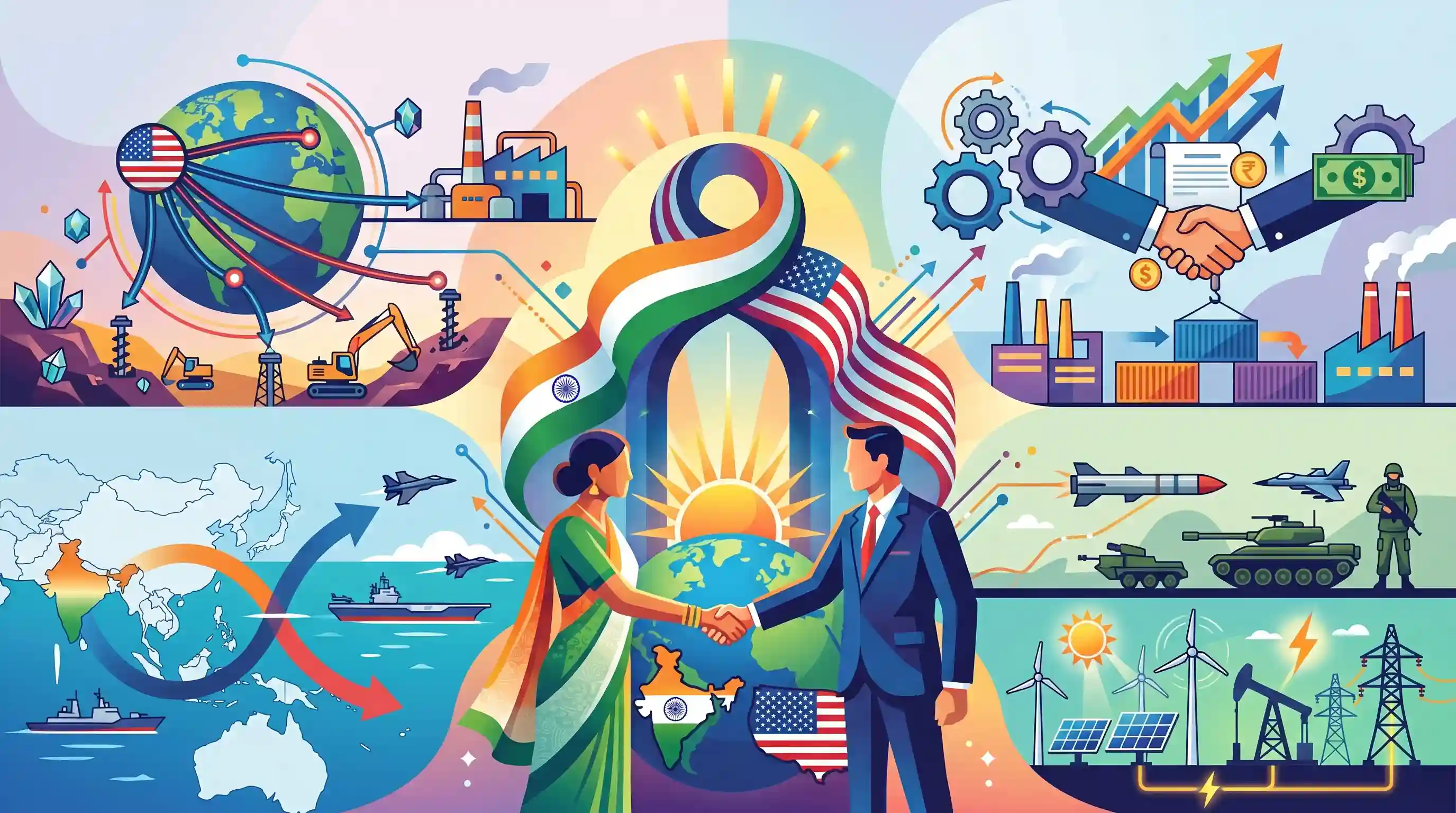
The India-US strategic partnership is central to India's foreign policy and economic growth. High-level engagements on trade, defense, and critical minerals (such as the FORGE Initiative) demonstrate the evolving, multifaceted nature of the relationship, which is critical for maintaining stability in the Indo-Pacific and securing resilient global supply chains against geoeconomic vulnerabilities.
Summary
Recent high-level diplomatic engagements between India and the United States highlight the deepening strategic partnership under the new Trump administration. External Affairs Minister S. Jaishankar held crucial meetings with top US officials, including Secretary of State Marco Rubio and Treasury Secretary Scott Bessent, to discuss economic cooperation, a potential trade deal, and advanced defense and energy ties. Underscoring the focus on global supply chain resilience, India supported the US-led FORGE Initiative aimed at collaborative exploration and processing of critical minerals. US Ambassador to India Sergio Gor praised the momentum, noting the 'limitless potential' of the relationship.
Key Points
- High-level diplomatic engagements have commenced between India and the new US administration, with US envoy Sergio Gor emphasizing the 'limitless potential' of bilateral ties.
- External Affairs Minister S. Jaishankar held critical meetings with US Secretary of State Marco Rubio and Treasury Secretary Scott Bessent in Washington DC.
- Bilateral discussions focused on advancing economic partnerships, including the prospect of a comprehensive trade deal, and enhancing cooperation in defense, energy, and nuclear technology.
- Highlighting geoeconomic priorities, India backed the US-led FORGE Initiative during a minerals summit, aiming to secure and diversify supply chains for critical minerals exploration, mining, and processing.
Important Terms
FORGE Initiative

The 'Forum on Resource, Geostrategic Engagement' is a US-led 55-nation multilateral framework (successor to the Mineral Security Partnership) aimed at securing critical mineral supply chains and reducing global dependence on China.
UPSC context
GS Paper II (International Relations); critical for questions on global supply chain resilience, resource diplomacy, and Indo-Pacific geostrategy.
India-US Comprehensive Global Strategic Partnership
The formal diplomatic framework for bilateral ties, upgraded to include cooperation in defense, critical technologies (iCET), energy, and space to ensure a free and open Indo-Pacific.
UPSC context
GS Paper II (Bilateral Ties); the foundational framework for India's most consequential strategic relationship.
India-US Bilateral Trade Agreement (BTA)
A 2026 agreement (preceded by an interim deal) aimed at reducing reciprocal tariffs and market barriers to reach 'Mission 500'—$500 billion in bilateral trade by 2030.
UPSC context
GS Paper III (Economy/Trade); tests knowledge of trade negotiations, tariff impacts, and bilateral economic cooperation.
U.S.-India COMPACT
Launched in 2025, it stands for 'Catalyzing Opportunities for Military Partnership, Accelerated Commerce & Technology,' serving as a roadmap for defense co-production and high-tech industrial integration.
UPSC context
GS Paper II (Defense/Strategic Partnerships); relevant for technology transfer and defense industrial cooperation under the Trump administration.
Pax Silica
A US-led strategic technology initiative (joined by India in 2026) focused on building secure, innovation-driven supply chains for semiconductors and Artificial Intelligence.
UPSC context
GS Paper III (Science & Tech); highlights India's role in the global semiconductor ecosystem and tech-governance.
Critical Minerals Geopolitics
Elements like lithium, cobalt, and rare earths essential for green energy, defense, and electronics; they are the focus of de-risking strategies against geostrategic supply disruptions.
UPSC context
GS Paper I (Geography) and GS III (Energy); vital for understanding energy transition and resource-based security.
Prelims Trap
"The FORGE Initiative is a WTO-mandated multilateral agreement to regulate the global trade of critical minerals."
FORGE is a US-led plurilateral initiative, not a WTO mandate. It relies on coalitions of willing nations to de-risk supply chains outside traditional multilateral frameworks.
Static Concepts Connected
What distinguishes 'Plurilateralism' from 'Multilateralism' in International Relations?
- Multilateralism: Involves universal or near-universal participation (e.g., UN, WTO) requiring broad consensus, often leading to gridlock.
- Plurilateralism: Involves a select, smaller group of countries (like Quad, FORGE) coming together for specific, issue-based cooperation.
- Flexibility: Allows faster decision-making and standard-setting without being blocked by holdout or adversary nations.
What is India's domestic framework for securing critical minerals?
- MMDR Act 2023: The Mines and Minerals (Development and Regulation) Amendment Act, 2023 removed 6 critical minerals from the 'atomic' list, allowing private sector mining.
- National Mission: Ensures stable access to vital minerals required for high-tech industries, reducing heavy import dependency.
- Global Integration: India actively participates in the US-led Mineral Security Partnership (MSP) and FORGE to secure overseas assets.
Cross-Topic Patterns
Mineral cartels and clean energy transitions
The FORGE initiative links geopolitics directly to GS3 Environment, as India's solar and EV manufacturing targets are physically constrained by critical mineral supply monopolies.
Minilateralism replacing traditional FTAs
India avoids broad multilateral trade pacts like RCEP but actively joins issue-specific geoeconomic blocks like iCET and FORGE to secure defense and tech supply chains.

Expect a 2026 Prelims multi-statement question pairing the US-led FORGE Initiative and MSP against India's domestic MMDR Act amendments.
Linked PYQs · 3
Linked PYQs · 3
- 2020MainsGS2
What is the significance of Indo-US defence deals over Indo-Russian defence deals? Discuss with reference to stability in the Indo-Pacific region.
- 2023MainsGS2
‘The expansion and strengthening of NATO and a stronger US-Europe strategic partnership works well for India.’ What is your opinion about this statement ? Give reasons and examples to support your answer.
- 2020MainsGS2
Quadrilateral Security Dialogue (Quad)' is transforming itself into a trade bloc from a military alliance, in present times - Discuss.
